

Parties Intended To Import "Body & Soul" Of Development Agreement Into Later Agreements: Supreme Court Appoints Arbitrator
The Supreme Court was considering a matter where the existence of an arbitration agreement was in dispute.

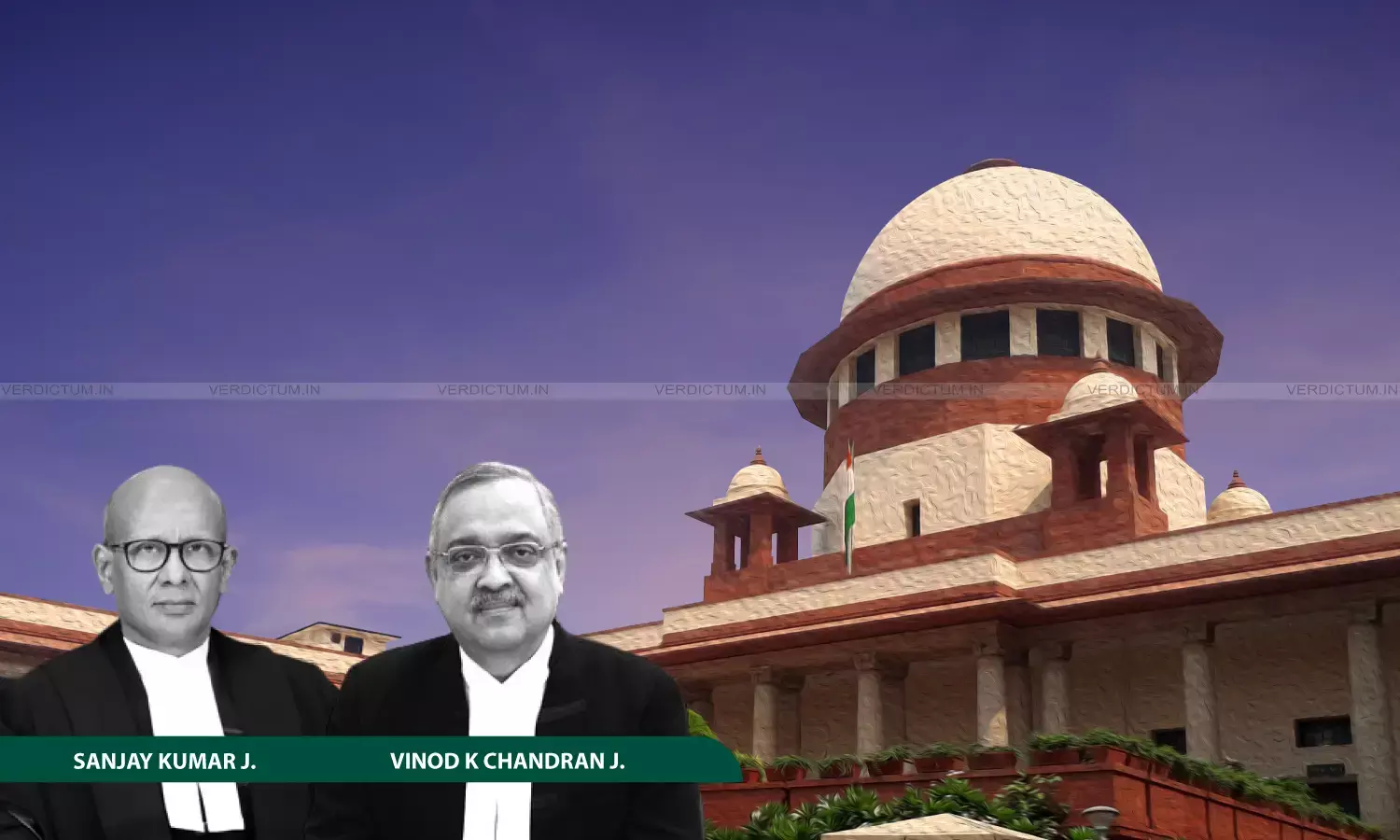
The Supreme Court has affirmed the existence of an arbitration agreement by incorporation, where the parties to a later contract clearly intended to import the Development Agreement, body and soul, into the later agreements. The Apex Court also appointed a sole arbitrator.
The Apex Court was considering a matter where the existence of an arbitration agreement was in dispute.
The Division Bench of Justice Sanjay Kumar and Justice K. Vinod Chandran held, “This was, thus, not a case of mere reference to an earlier agreement but a case where the parties to the later contract clearly intended to import the Development Agreement, body and soul, into the later agreements. Therefore, there can be no doubt as to the incorporation of Clause 36 of the Development Agreement, i.e., the arbitration clause, into the Permanent Alternate Accommodation Agreements.”
“Viewed thus, the High Court was in error in its understanding of the legal position obtaining under Section 7(5) of the Arbitration Act, as explained by this Court in the aforestated decisions. This was a fit case for the High Court to have accepted the plea of the appellant that there was an arbitration agreement between the parties by incorporation”, it added.
Senior Advocate Atul Chitale represented the Appellant while Advocate Abhay Anil Anturkar represented the Respondent.
Factual Background
The appellant, Hirani Developers, a proprietary concern involved in real estate business, entered into a Development Agreement with Nehru Nagar Samruddhi Co-operative Housing Society Limited, first respondent, for the redevelopment of its project, which was in a dilapidated condition. The Development Agreement provided for a dispute resolution mechanism in Clause 36. The appellant entered into separate Permanent Alternate Accommodation Agreements with the society and its members. The dispute revolved around five such agreements that the appellant entered into with the society and its members (respondents). The respondent members filed complaints against the appellant under the Consumer Protection Act, 2019.
At that stage, the appellant got issued individual legal notices to the five respondent members under Section 21 of the Arbitration Act, invoking Clause 36 of the Development Agreement and calling upon them to nominate/choose one of the arbitrators named therein. However, the respondent members approached the Consumer Disputes Redressal Commission at Bandra and refused to proceed with the proposed arbitration. Thereupon, the appellant filed the subject applications before the Bombay High Court. By a common order, the High Court held that there was no such arbitration agreement between the parties and dismissed the five applications filed under Section 11 of the Arbitration and Conciliation Act, 1996. The High Court opined that, in terms of Section 7(5) of the Arbitration Act, mere reference to an earlier document in the later one would not be adequate to incorporate the arbitration clause from the former into the latter.
Reasoning
The Bench, at the outset, explained that Section 7 of the Arbitration Act is titled ‘Arbitration agreement’ and Section 7(5) therein provides that the reference in a contract to a document containing an arbitration clause would constitute an arbitration agreement if the contract is in writing and the reference is such as to make that arbitration clause part of the contract. “The High Court came to the conclusion that Section 7(5) of the Arbitration Act is not satisfied in the case on hand. We are persuaded to hold otherwise”, it added.
Reference was made to the judgment in NBCC (India) Limited. vs. Zillion Infraprojects Private Limited (2024), wherein it was clarified that a general reference to another contract would not have the effect of incorporating the arbitration clause from the referred document into the contract between the parties.
On a perusal of the facts of the case, the Bench noted that this was not a case of mere reference to an earlier document containing an arbitration clause. The later Permanent Alternate Accommodation Agreements entered into by the appellant with the respondent members unequivocally recorded in Clause 14 that all the terms and conditions of the Development Agreement would be construed to form part of the said agreements and all clauses of the same would be binding on the parties to those later agreements.
The Bench thus stated, “There could be no clearer indication of the intention of the parties to incorporate and assimilate the Development Agreement dated 04.07.2012 in its entirety into the later Permanent Alternate Accommodation Agreements. Not stopping short at asserting that all terms and conditions of the said Development Agreement should be construed to be part of the Permanent Alternate Accommodation Agreements, Clause 14 goes on to affirm that all clauses of the Development Agreement shall be binding on the parties to the Permanent Alternate Accommodation Agreements.”
Holding that the plea of the appellant regarding the existence of an arbitration agreement between the parties by incorporation was acceptable, the Bench set aside the common order holding to the contrary. Allowing the appeals, the Bench appointed a sole Arbitrator to resolve the disputes and differences between the appellant and the respondent members.
Cause Title: Hirani Developers v. Nehru Nagar Samruddhi CHS Ltd. (Neutral Citation: 2026 INSC 484)
Appearance
Appellant: Senior Advocate Atul Chitale, Advocates Sameer Jayant Chitnis, Madhav Chitale, Koninica Bose, AOR Suchitra Atul Chitale
Respondent: Advocates Abhay Anil Anturkar, Dhruv Tank, Sarthak Mehrotra, AOR Surbhi Kapoor, Subhi Pastor, Uday Gautam, Aradhya Srivastava, AOR Sujeeta Srivastava