

Illegality Cannot Be Cured By Passage Of Time: Supreme Court Orders Repatriation Of Haryana Engineers Absorbed Via "Backdoor Entry" Facilitated By Political Interference
The Bench set aside the High Court's "sympathetic view" permitting illegally absorbed officers to continue in service despite finding their appointments void.

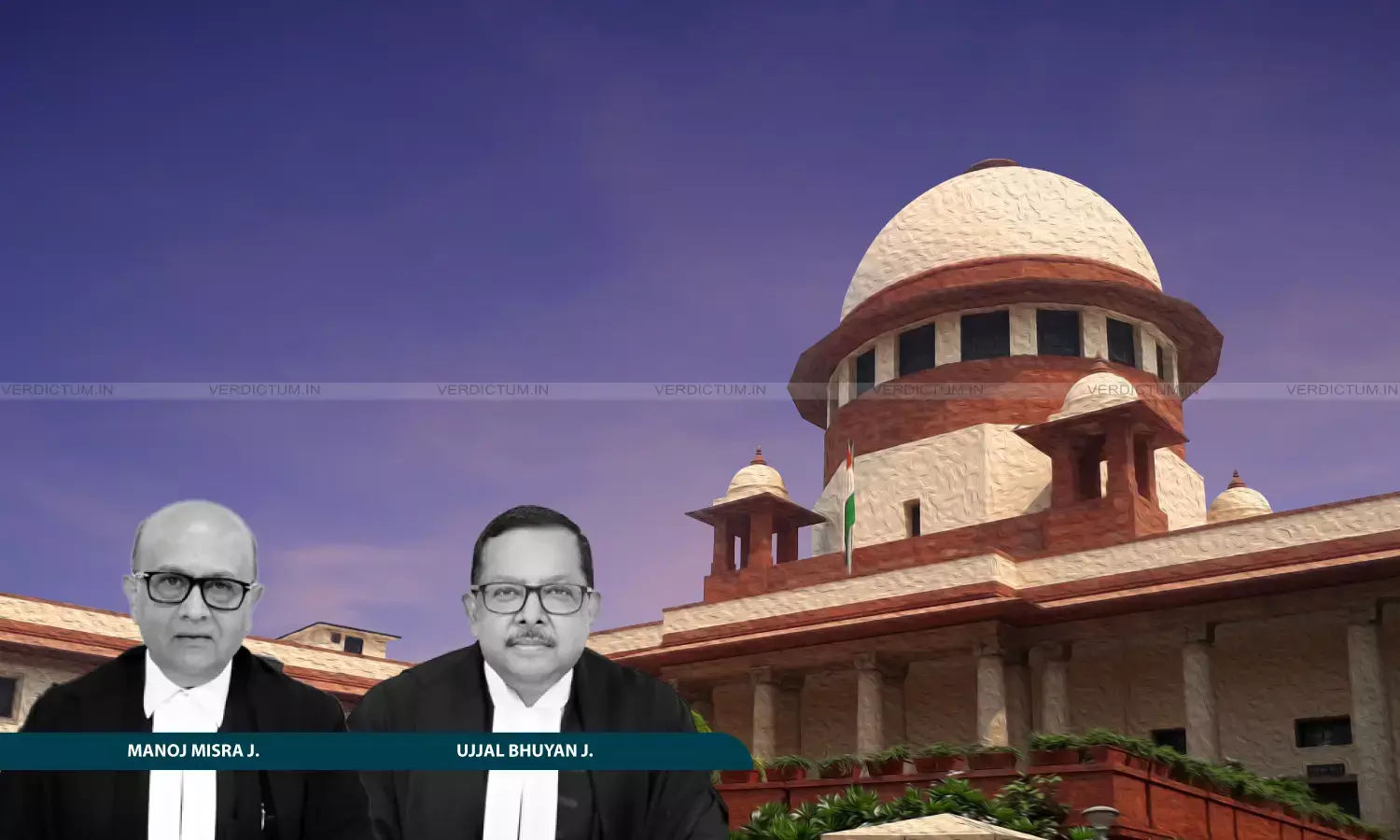
Justice Manoj Misra, Justice Ujjal Bhuyan, Supreme Court
The Supreme Court has held that an illegal appointment cannot be cured or rendered valid merely by the passage of time or long continuance in service, setting aside a Punjab and Haryana High Court judgment that had declared the deputation and absorption of four Haryana government engineers to be unlawful and a product of political machination, yet permitted them to continue in service on humanitarian grounds.
A Bench of Justice Manoj Misra and Justice Ujjal Bhuyan directed that all four officers be repatriated to their parent department, holding that their absorption as Assistant Engineers in the Public Works (Building and Roads) Department through repeated ministerial interventions and self-initiated requests, bypassing the two officers who had actually failed the direct recruitment examination for the very same post, amounted to a "backdoor entry" that the High Court ought not to have shielded through equitable considerations.
The Bench noted that, “…Illegality means something which is contrary to law; something which is wrong right from the inception. It is void ab initio. Illegality cannot be cured and made legal and valid by lapse of time. Illegality, which is distinct and different from irregularity, cannot be regularized by taking a sympathetic view on the ground of long continuance in service. This position has been explained by a Constitution Bench of this Court in Uma Devi. If the appointment itself is in infraction of the rules, in this case the 1965 Rules, it is an illegality. Such an illegality cannot be cured by resorting to the novel method of absorption which has been explained as appointment by transfer”.
“…we are of the unhesitant view that the absorption of all the above four deputationists as Assistant Engineer (Civil) /Sub-Divisional Engineer (Civil) in the PW(B&R) Department is illegal and void. Since we are holding their absorption as illegal and void and are directing their repatriation, it is not necessary to delve into 150 question (iii) to examine their seniority on an analysis of Rule 12(5) of the 1965 Rules”, the Bench further noted.
Ranjit Kumar, V. Giri, Gurminder Singh, PS Patwalia, Nidesh Gupta, Guru Krishnakumar, Senior Advocates appeared for the appellants and R.L. Garg, Brijender Chahar, Senior Advocates appeared for the respondents.
In the matter, four probationary officers, Pradeep Atri, Praveen Chaudhary, Pankaj Gaur, and Arun Bhatia, were appointed as Sub-Divisional Officers in Haryana's Development and Panchayat Department (2004–2005). Shortly into their probation, all four secured deputation to the Public Works (Building and Roads) Department through self-initiated requests and political recommendations rather than departmental necessity. Although Atri, Gaur, and Bhatia failed the direct recruitment exam for Assistant Engineer in PW(B&R), and Chaudhary did not apply, all four were permanently absorbed into the department against direct recruitment vacancies. This absorption was justified under Rule 10 of the 1965 Rules using general staff shortages and political backing as "special circumstances".
Thereafter, direct recruits challenged the absorption and seniority of four officers before the Punjab and Haryana High Court, which ruled the appointments illegal products of political interference lacking "special circumstances" under Rule 10, yet refused to quash them on sympathetic grounds given their 18 years of service. Both direct recruits and absorbed officers filed cross-appeals before the Supreme Court.
The Court, thus, overruled the High Court, holding that deputation is a temporary, consensual arrangement and that judicial sympathy or long service cannot legalize an appointment that is void ab initio. It noted that routine staff shortages do not satisfy the "special circumstances" required under Rule 10 to bypass regular recruitment, especially when three officers had failed the competitive exam for these very posts.
“‘Special circumstances’ in our understanding means something which is more than normal or routine. Accrual of vacancies in a cadre is a routine phenomenon; this is not something which is unusual or abnormal. The so-called stay was not granted by the High Court but was a statement made by the State before the High Court. These circumstances cannot be termed as special within the meaning of Rule 10…”, the Bench noted.
Condemning political intervention in probationary appointments and citing Secretary, State of Karnataka v. Umadevi (2006) 4 SCC 1, the Bench reiterated that those entering through the backdoor must exit through it, ordering the officers' immediate repatriation to their parent department.
The Court declared the deputation of Atri and Chaudhary to be illegal, and that of Gaur and Bhatia to be irregular, while holding the absorption of all four officers in the PW(B&R) Department to be illegal, non est, and void, setting the same aside.
It directed that all four officers be repatriated forthwith to the Development and Panchayat Department, Haryana, where their cadre and seniority would be redetermined by placing them immediately above those who were junior to them in the cadre of Sub-Divisional Officer (Panchayati Raj) at the time of their original deputation. The High Court's direction preserving their continuance in the PW(B&R) Department, along with all consequential directions regarding seniority, was set aside.
Cause Title: Hemant Kumar & Ors. v. State of Haryana (Neutral Citation: 2026 INSC 878)
Appearances:
Petitioner(s) / Appellant(s): Ranjit Kumar, V. Giri, Gurminder Singh, PS Patwalia, Nidesh Gupta, Guru Krishnakumar, Senior Advocates; Preetika Dwivedi, Siddharth Batra, Chritarth Palli, Soayib Qureshi, Anjuman Tripathy, Samar Vijay Singh, Advocates-on-Record; Abhisek Mohanty, Ansh Rajauria, Shivani Chawla, Chinmay Dubey, Mehul Gulati, Akshit Lunial, Chritarth Palli, Rajat Gupta, Agam Aggarwal, Harsheen M Palli, Sandeep Bajaj, Anchal Kushwaha, Aman Qayoom Wani, Ishita Singh, Kounane Jeelani, Mohit Singh Sikarwar, Navdeep Singh, Ashwin K, Arya Tripathy, and Amisha Chauhan, Advocates.
Respondent(s): R.L. Garg, Nidesh Gupta, Brijender Chahar, Senior Advocates; Amit Verma, Preetika Dwivedi, Soayib Qureshi, Samar Vijay Singh, Anjuman Tripathy, Santosh Krishnan, Advocates-on-Record; Dr. Hemant Gupta, Dinesh Kumar Mudgal, Hitesh Kumar Sharma, Akhileshwar Jha, Anupam Kumar, Deepali S. Hooda, Sandeep Bajaj, Anchal Kushwaha, Aman Qayoom Wani, Ishita Singh, Kounane Jeelani, Payal Gupta, Sabarni Som, Aman Dev Sharma, Gaj Singh, Rony John, and Keshav Mittal, Advocates.