

Supreme Court Cautions Against Release Of Accused Convicted For Heinous Offences On Ground Of No Possibility Of Appeal Being Heard
The Supreme Court was considering a criminal case allegedly arising from a political rivalry, leading to the murder of a person standing for election as Sarpanch.

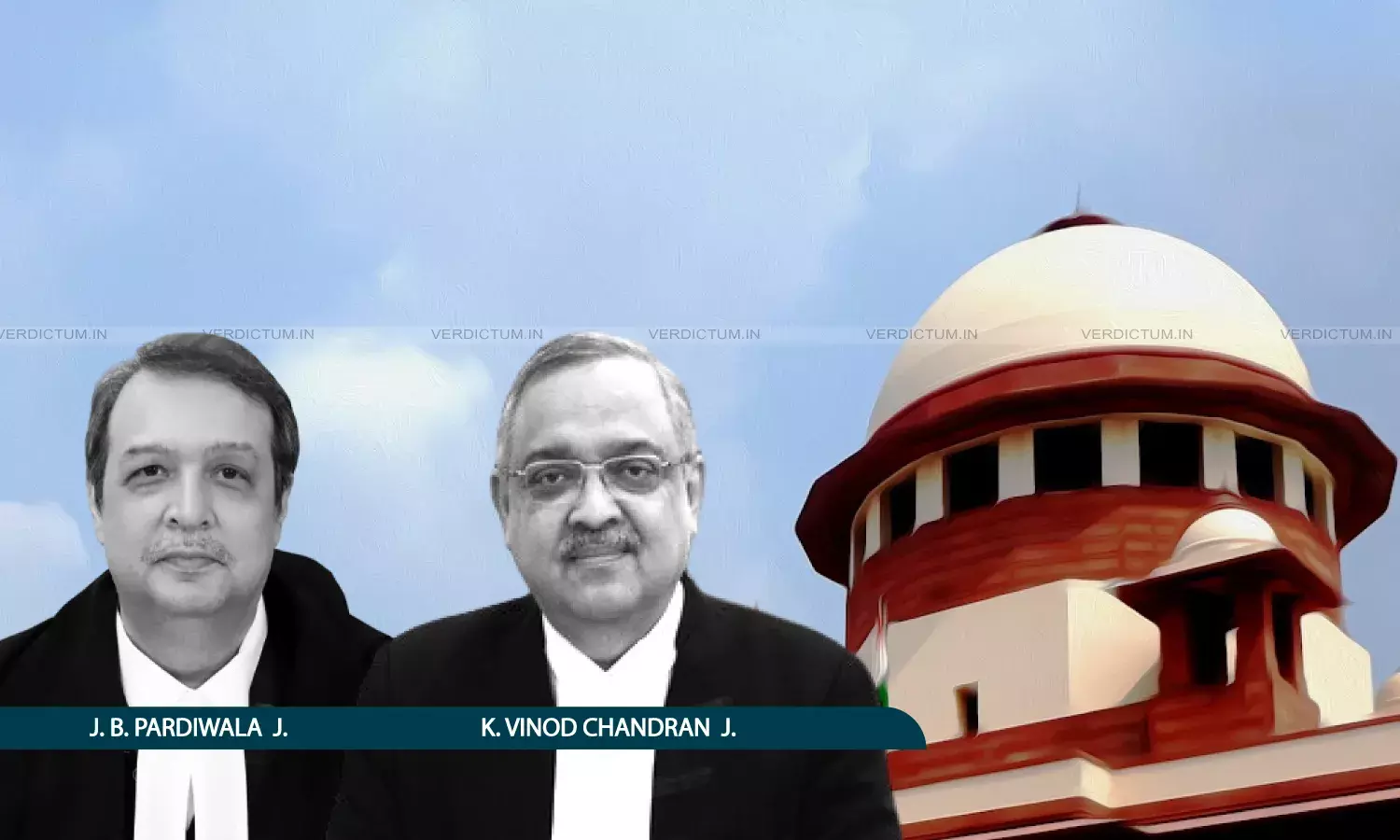
Justice J. B. Pardiwala, Justice K. Vinod Chandran, Supreme Court
While cancelling the suspension of sentence granted in favour of an accused in a Sapranch candidate murder case, the Supreme Court has cautioned against the release of accused, especially those convicted for heinous offences, after conviction by one Court on the ground of there being no possibility of the appeal being heard immediately.
The Apex Court was considering a criminal case allegedly arising from a political rivalry, leading to the murder of a person standing for election as Sarpanch.
The Division Bench of Justice J. B. Pardiwala and Justice K. Vinod Chandran held, “Oftener than ever, this Court has cautioned the releasing of accused, especially convicted for heinous offences, after conviction by one Court on the ground of there being no possibility of the appeal being heard immediately; which questions the validity of the judicial process itself. Whatever be the reason for the pendency of cases, the Courts cannot be complacent and release criminals convicted for heinous offences, especially when they have not undergone sentence for any considerable period, since it puts to peril the life of the civil society; exposing the fault lines of the system, which we definitely cannot cover up but should always endeavour to overcome.”
Factual Background
The deceased and A1, a Government Teacher, belonged to rival factions. A1’s son was elected as Sarpanch earlier who had to vacate his office when he obtained a government employment. The deceased, was standing for the resultant byeelections which enraged A1. The allegation was that a conspiracy was hatched and while A1 deliberately kept aloof, at his instigation, A6 who had been in jail with A7 planned the assassination of the candidate, carried out through A11 and A12. The party respondents who are also accused other than A1 were roped in for offence under Section 120B of the Indian Penal Code, 1860 (IPC) for hatching conspiracy and actively assisting A1, the kingpin and the perpetrators of the crime, A11 and A12.
A1 was handed down a conviction under Section 302 read with Section 120B IPC with a sentence of life imprisonment, while the other party respondents were convicted under Section 120B with imprisonment of 10 years. The High Court granted bail suspending the sentence of the party respondents. The father of the deceased, the first informant approached the Apex Court contesting the suspension of sentence.
Reasoning
The Bench noted that A1 was accused of being the masterminded the crime and though he was not present, he was behind the conspiracy. The Bench found that numerous witnesses were examined, a few of whom were eyewitnesses and a few who had specifically spoken of a motive regarding the political rivalry that A1 was not present at the scene of occurrence is fairly admitted.
On a perusal of the facts of the case, the Bench found that the testimony of the other witnesses who had been present when the threats were levelled, brazenly that the candidate would be killed, were credible. The Bench noticed that A6, who was said to have arranged the assailants through a dreaded gang-leader-A7, was still absconding, though A7 was acquitted.
“On a prima facie consideration, especially considering the threats levelled and the motive alleged, as also the specific intention coming out from the threats to ensure that the deceased does not contest the election, we are of the opinion that the High Court erred in granting bail to A1”, it added.
The Bench stated, "Though, PW12, PW13 and PW27 were proffered to prove that one of the accused had booked rooms for the perpetrators, there is no identification made by them of the actual perpetrators. PW66, PW67 and PW68 proffered to prove the purchase of the SIM cards also turned hostile.
The Bench thus cancelled the suspension of sentence as granted by the High Court to A1 while refusing to interfere with the order suspending the sentence of other accused/respondents.
Cause Title: Hanuman Prasad @ Hanuta Ram v. State of Rajasthan (Neutral Citation: 2026 INSC 1180)