Residential Zoning Can’t Extinguish State’s Legitimate Rights Over Water Bodies: Supreme Court Affirms Demolition Of Flats After Alternative Allotment
The Court held that planning regulations govern development activity within a notified zone, but mixed-residential classification cannot take away the Government’s rights over Poramboke lands and water bodies or efface the effect of Section 14-A of the Tamil Nadu Estates (Abolition and Conversion into Ryotwari) Act, 1948.
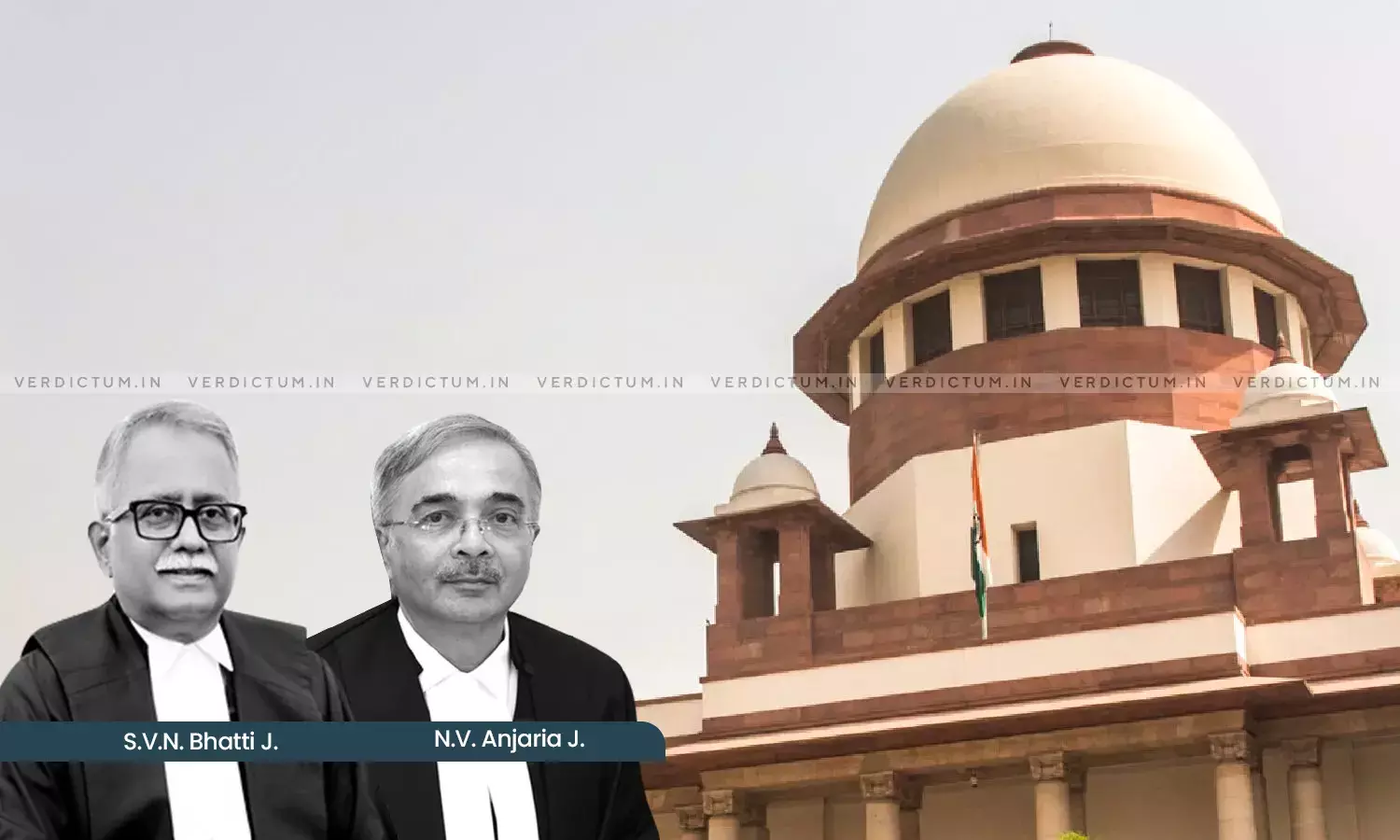
Justice S.V.N. Bhatti, Justice N.V. Anjaria, Supreme Court
The Supreme Court has held that classifying land as mixed-residential under the Tamil Nadu Town and Country Planning Act, 1971 cannot extinguish the State’s rights over water bodies protected by Section 14-A of the Tamil Nadu Estates (Abolition and Conversion into Ryotwari) Act, 1948, while affirming the demolition of 20 flats after the owners are allotted a vacant, commensurate alternative site.
The Court was hearing civil appeals challenging Madras High Court orders which upheld the Commissioner of Land Administration’s decision cancelling the patta and directing restoration of the land as a water body.
A Bench of Justice S.V.N. Bhatti and Justice N.V. Anjaria observed: “The Statement of Objects and Scope of the Acts of 1971 and 1948 is noted. Therefore, notifying a block of area in the development zone as commercial, industrial, residential, or mixed residential/mixed-use cannot be construed as taking away the Government's rights in Poramboke lands, forests, water bodies/tanks, etc. The said argument does not take into account that zoning regulations are not confined to a single survey number but apply when an individual undertakes development activity in the notified area. The development of a plot conforms to the notified zoning requirement. Reference to the subject matter being in a mixed residential zone, either in fact or in law, cannot be treated as effacing the effect of Section 14-A of the Act, 1948.”
Senior Advocate T. Raja and Advocate K.S. Mahadevan appeared for the appellants. Advocate-on-Record Jayasree Narasimhan appeared for the respondents.
Background
The dispute concerned 0.72 acres out of 1.68 acres in Survey No. 572 at Thirumullaivoyal Village, Tamil Nadu. The judgment noted that the 1911 Resurvey and Resettlement Register classified the land as “Government Poramboke–Kanakkan Kuttai”.
In 2011, the District Revenue Officer granted a ryotwari patta over the 0.72 acres to P. Ramadoss. He subsequently mortgaged the land to Tamil Nadu Mercantile Bank. A portion measuring 0.22 acres was transferred to his wife, following which approvals were obtained and 20 apartments were constructed and sold.
In 2019, the Commissioner of Land Administration cancelled the patta after finding that the land had historically been classified as a Government poramboke watercourse and that the District Revenue Officer lacked authority to grant the patta. The Madras High Court upheld that decision and directed the demolition of the structures and restoration of the water body.
The appellants contended that the Chennai Metropolitan Development Authority’s classification of the land as a mixed-residential zone established that it was ryotwari land rather than a water body. The respondents relied upon the earliest survey and settlement records and argued that subsequent private transactions and planning approvals could not affect the Government’s rights under the 1948 Act.
Court’s Observations
Ryotwari Patta Available Only For Ryoti Land
The Court rejected the contention that a separate adjudication declaring the property to be a tank was necessary before the Government could protect it.
The Bench observed: “In our considered view, this contention appears untenable because the Act, 1948 does not require adjudication to protect communal Government Poramboke, etc. Simply put, the Ryotiwari tenures under the Act, 1948 apply to Ryoti land covered by the said Act. The inquiry in this behalf determines the nature of the land, the type of enjoyment, the period of enjoyment, and the entitlement to grant of patta.”
Referring to Salem Municipality v. P. Kumar and Others (2019), the Court noted that land forming part of a tank was excluded from the definition of ryoti land. The precedent also recognised that Section 14-A cancelled even previously granted pattas concerning private tanks or ooranis.
The Court held that entitlement to a patta had to be determined from the earliest revenue, survey and settlement records. It noted that the appellants had not shown that the disputed land was classified as ryoti land during the relevant survey and settlement operations.
The Bench stated: “Therefore, non-Ryoti lands do not fall within the scope of granting a patta under the Act, 1948. Whenever a dispute arises over entitlement to a patta, the nature of the land is determined by appreciating entries in the earliest Revenue Records, including Survey and Settlement Records. The Appellants do not contend that the Revenue Records show the subject matter as Ryoti land during the Survey and Settlement operation or the contemporaneous faslis. Since the Appellants claim a Ryotwari patta, they must establish the ingredients for the land to be termed Ryoti land and that P. Ramadoss is entitled to a Ryotwari Patta.”
Planning Classification Does Not Alter Government Rights
The Court held that zoning under the Tamil Nadu Town and Country Planning Act, 1971 regulates the permissible development of plots within a notified area. Such classification does not decide ownership or eliminate rights preserved under the 1948 Act.
The Bench explained that a zoning regulation operates across a development area rather than upon a single survey number. It consequently rejected the argument that the mixed-residential classification displaced the Government’s rights or established that the property was ryoti land.
Section 14-A Prohibits Patta Over Non-Ryoti Land
The Court observed that Section 14-A was intended to prevent officers from considering or granting ryotwari pattas for non-ryoti land and to preserve the existing land classification.
The Bench held: “Section 14-A of the Act, 1948, prohibits officers from considering and granting Ryotwari Patta for non-Ryoti land. The Legislature designed a prohibitory mechanism to prevent changes in land classification. The said Section even renders the Order already issued void. That being the statutory scheme, the DRO, Tiruvallur, without any reason, went beyond the provisions of the said Act and granted Patta.”
The Court also rejected the appellants’ objections concerning lack of hearing and the revenue entries. It held that the patta-holder had been heard by the Commissioner and that the State’s material reinforced the land’s continuous classification as a tank and Government poramboke.
Alternative Land For Flat Owners
The Court observed that municipal approvals and alterations in the town-survey records had led bona fide flat purchasers to believe that the Government had no subsisting interest in the property.
The Bench stated that demolishing their homes without considering the hardship caused by the State authorities’ conduct would result in irreparable financial injury. Without compromising Section 14-A, it therefore directed the State to allot the affected flat owners a vacant and commensurate alternative site.
Conclusion
The Supreme Court declined to interfere with the Madras High Court’s judgment and dismissed the civil appeals without costs.
The Court directed the Tamil Nadu Chief Secretary and the Tiruvallur District Collector to allot a vacant, commensurate site to the flat owners represented by the society, preferably within six months. The authorities were directed to demolish the apartments occupying 0.22 acres after making that allotment.
The Court permitted development work on the vacant and unoccupied portion to continue expeditiously. It left the flat owners and the Bank free to pursue remedies against the developer, landowner or mortgagor before the competent civil court. The State was also left free to initiate or conclude disciplinary proceedings against the officials responsible for failing to maintain the records and water bodies.
Cause Title: S. Gururaj v. The Additional Chief Secretary/Commissioner of Land Administration and Others (Neutral Citation: 2026 INSC 1146)
Appearances
Appellants: Senior Advocate T. Raja; Advocates K.S. Mahadevan, Swati Bansal, R. Rangarajan, Aravind Gopinathan, R.K. Srivastav, C. Raghavendren and C. Rubavathi; Advocates-on-Record Rajesh Kumar and M.A. Chinnasamy
Respondents: Advocates-on-Record Jayasree Narasimhan; Advocates R. Sarbeshvaran and Siddheesh Yadav