

Private Place Constitutes “Place Within Public View” Under SC/ST Act Only If Accessible To Public Gaze: Supreme Court
The Court held that for offences under Sections 3(1)(r) and 3(1)(s) of the SC/ST Act to be made out, caste-based abuses must occur at a place visible or accessible to public view, and observed that a private place would qualify only where members of the public could witness the occurrence.
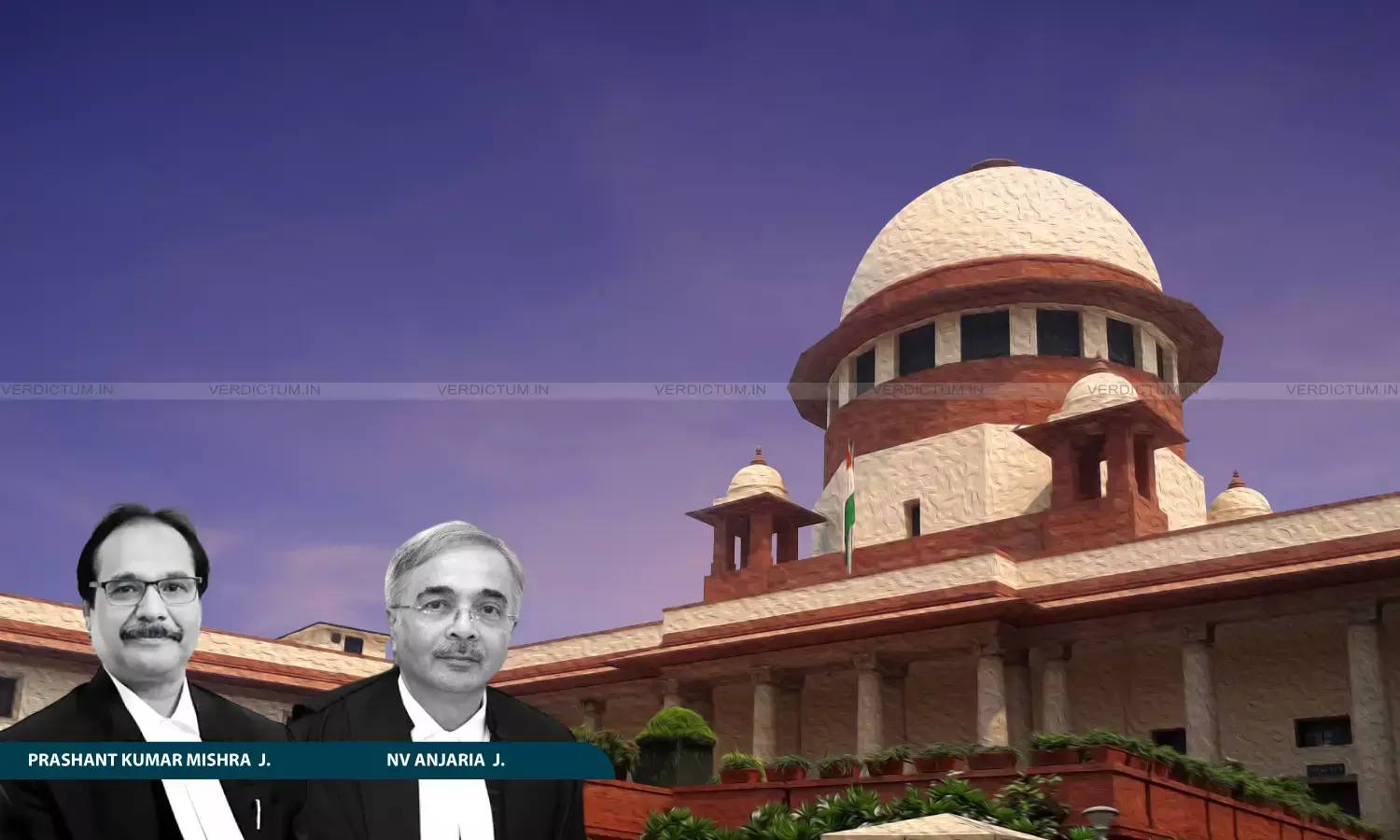
Supreme Court, Justice Prashant Kumar Mishra, Justice N.V. Anjaria
The Supreme Court has held that even if an alleged incident of caste-based abuse occurs at a private place, such location would constitute a “place within public view” under Sections 3(1)(r) and 3(1)(s) of the Scheduled Castes and Scheduled Tribes (Prevention of Atrocities) Act, 1989 if members of the public can witness or notice the occurrence.
The Court, however, added that a residential house or a purely private space would not satisfy the requirement of “public view” in the absence of any allegation showing that independent members of the public were present or that the occurrence was exposed to public gaze.
The Court was hearing an appeal challenging a Delhi High Court judgment refusing to quash charges framed against family members under Sections 3(1)(r) and 3(1)(s) of the SC/ST Act and Section 506 read with Section 34 IPC in connection with allegations of caste-based abuse and criminal intimidation arising out of a family property dispute.
A Bench comprising Justice Prashant Kumar Mishra and Justice N.V. Anjaria observed: “… in order to make out the offence under Section 3(1)(r) and/or Section 3(1)(s) of the SC/ST Act, the occurrence of the incident and the act and conduct of hurling of caste based abuses must take place at “a place within public view”. It must be a place within the public gaze. Even happens to be a private place, then in such an eventuality, a public-eye must have access to be able to notice what happens there or what is taking place that will only make the “place within public view”.
However, the Bench, upon examining the facts of the matter, further held: "it was not indicated that any independent member of the public was present to witness the occurrence, ... once that is so, to suggest that the house place was not exposed to public eye or public gaze, a residential house in no way becomes a place within public view”.
Advocate Avadh Bihari Kaushik appeared on behalf of the appellants. Archana Pathak Dave, Additional Solicitor General, appeared on behalf of the respondents.
Background
The dispute arose out of a family property dispute between brothers and their respective spouses. According to the prosecution, an FIR was registered in January 2021 alleging that one of the accused used caste-based slurs against the complainant and his wife during an altercation at a residential property.
The complaint alleged that casteist expressions were repeatedly used against the complainant and that the accused persons also threatened to implicate him in a false molestation case.
Upon completion of the investigation, charges were framed under Sections 3(1)(r) and 3(1)(s) of the SC/ST Act against one of the accused and under Section 506 read with Section 34 IPC against all the accused persons.
The trial court held that sufficient material existed to proceed to trial, and the Delhi High Court dismissed the revision petition challenging the framing of charges on the ground that at the stage of charge, the court was not expected to conduct a mini-trial or evaluate evidence in detail.
Court’s Observation
The Supreme Court undertook an extensive analysis of Sections 3(1)(r) and 3(1)(s) of the SC/ST Act and reiterated that the common and indispensable ingredient under both provisions is that the alleged insult or caste-based abuse must occur “in any place within public view.”
The Court referred to its earlier decisions in Swaran Singh v. State through Standing Counsel (2008), Hitesh Verma v. State of Uttarakhand (2020), and Karuppudayar v. State represented by the Deputy Superintendent of Police (2025).
Referring to Swaran Singh (2008), the Court reiterated the distinction between a “public place” and a “place within public view” and observed that even a private property could qualify if members of the public were capable of witnessing the occurrence.
The Bench also reiterated the principle laid down in Hitesh Verma (2020) that where the alleged incident takes place within the four walls of a private house without the presence of members of the public, the requirement of “public view” is not satisfied.
The Court noted that in the present case, the FIR itself indicated that the alleged occurrence took place inside a residential property during a family altercation. The Bench observed that the FIR nowhere stated that the alleged caste-based abuses were uttered in the presence of independent members of the public or at a place accessible to public gaze.
The Court further noted that the witnesses named in the complaint were friends of the complainant, and their statements did not disclose that they had actually witnessed the incident. The Bench held that all material on record suggested that the incident allegedly occurred “within four walls of the house” and therefore did not satisfy the statutory requirement of occurrence in a place within public view.
Referring to the absence of specific averments showing that the alleged caste-based abuses were uttered at a place accessible to public view, the Court observed that the essential ingredients of an offence under Sections 3(1)(r) and 3(1)(s) of the SC/ST Act must be discernible from the FIR itself. The Bench stated: “The basic constituents of the offence alleged in the FIR must stem and stand disclosed from the contents of the FIR.”
The Bench also examined the charge under Section 506 IPC and held that the allegations did not disclose the essential ingredient of “intent to cause alarm” necessary to constitute criminal intimidation. The Court additionally found no material suggesting a common intention among the accused persons to attract Section 34 IPC.
Conclusion
The Supreme Court held that the essential ingredients required to constitute offences under Sections 3(1)(r) and 3(1)(s) of the SC/ST Act were absent from the FIR and charge-sheet.
Accordingly, the Court set aside the Delhi High Court judgment as well as the trial court orders framing charges against the appellants.
The FIR and charge-sheet registered against the appellants under Sections 3(1)(r) and 3(1)(s) of the SC/ST Act and Section 506 read with Section 34 IPC were consequently quashed.
The appeal was allowed.
Cause Title: Gunjan @ Girija Kumari & Ors. v. State (NCT of Delhi) & Anr. (Neutral Citation: 2026 INSC 468)
Appearances
Appellants: Avadh Bihari Kaushik, AOR; Urvashi Bhatia, Jatin Khatri, Mukesh Saroja, Rishabh Kumar, Advocates
Respondents: Archana Pathak Dave, ASG; Mukesh Kumar Maroria, AOR; Kamal Rattan Digpaul, Harshita Choubey, Digvijay Dam, Udit Dediya, Advocates; Rajkumari Banju, AOR
