

Courts Cannot Substitute "Simple Interest" With "Compound Interest" By Invoking Power U/S 33 A&C Act: Supreme Court Restores Arbitral Award
The Bench further noted that a party participating in arbitration without timely objecting to expiry of arbitrator’s mandate cannot challenge award later.

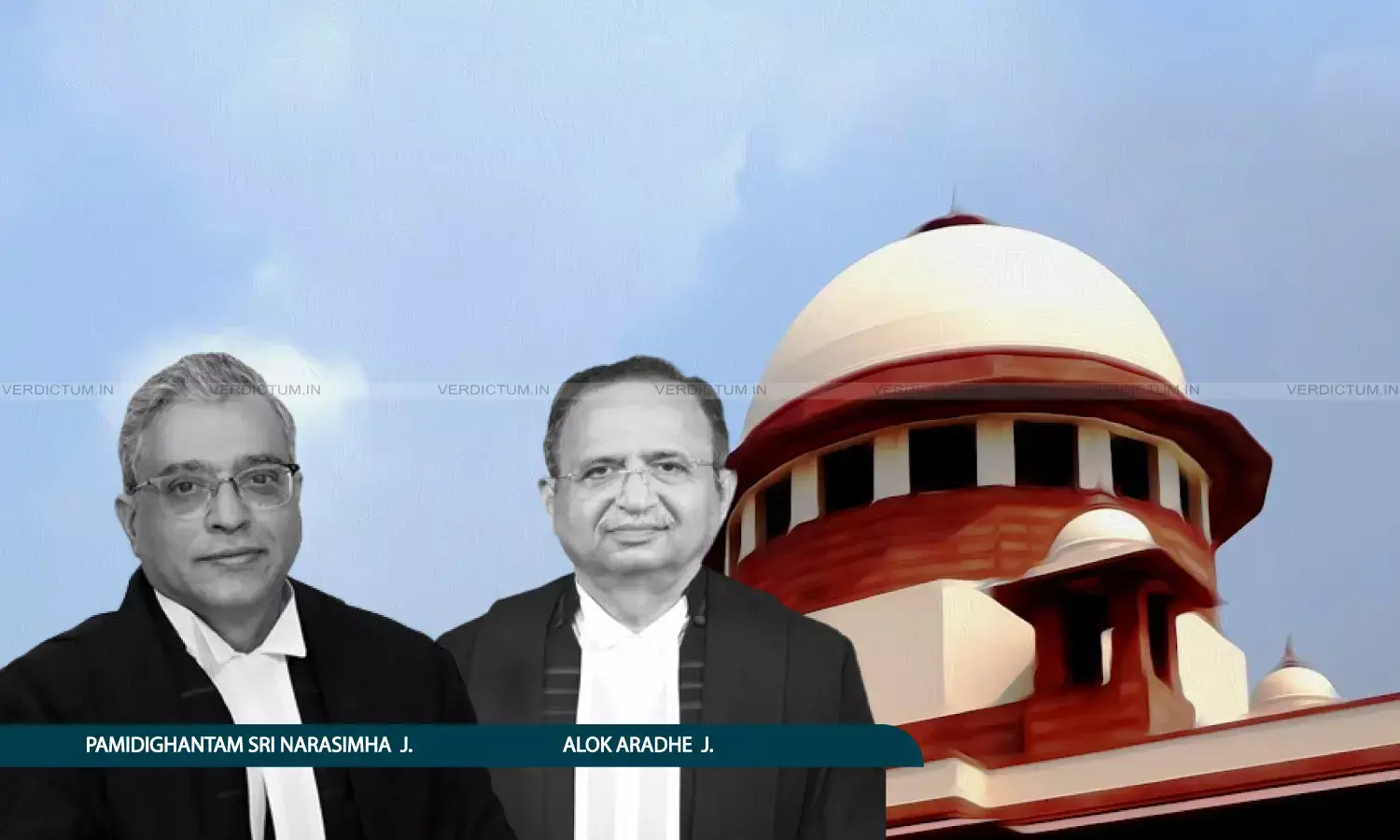
Justice Pamidighantam Sri Narasimha and Justice Alok Aradhe, Supreme Court
The Supreme Court has held that Section 33(1)(a) of the Arbitration and Conciliation Act, 1996 cannot be invoked to alter the substantive terms of an arbitral award, ruling that substituting simple interest with compound interest goes far beyond correction of clerical or computational errors.
The Bench also rejected the Board’s argument that the arbitrator’s mandate had expired before delivery of the award. It noted that although the arbitrator had extended the mandate multiple times, the Board continued participating in proceedings without raising any timely objection and only questioned jurisdiction after the award had been delivered. The Court held that the Board had tacitly accepted the extensions and was estopped from challenging the award on that ground.
A Bench of Justice Pamidighantam Sri Narasimha and Justice Alok Aradhe observed, “…it is evident that the substitution of ‘simple interest’ with ‘compound interest’ for the pendente lite period is not, by any stretch of legal reasoning, a correction of a computational, clerical, or typographical error…The characterisation of the mode of interest – whether simple or compound - goes to the very of the Arbitrator’s assessment of the equities of the case and reflects a substantive determination on the merits. It is neither a slip of the pen, nor an inadvertent arithmetical mistake, nor a clerical oversight that could be remedied under Section 33(1)(a)”, the Bench further observed.
Senior Advocates Shyam Divan, Naveen Pahwa appeared for the appellant and Senior Advocate Siddharth Bhatnagar appeared for the respondent.
Accordingly, the Bench allowed appeals filed by the Gujarat Water Supply and Sewerage Board and partly set aside orders of the Gujarat High Court and Commercial Court which had modified an arbitral award in favour of Saryu Plastics Pvt. Ltd..
In the present matter, the dispute arose out of supply contracts for PVC pipes awarded between 1998 and 2002. Following an audit alleging excess payments to suppliers, the Board blacklisted the company. More than a decade later, the parties entered into an arbitration agreement in 2012.
The sole arbitrator eventually awarded over ₹1.01 crore to the company, granting simple interest for the pendente lite period and compound interest post-award. The Commercial Court later altered the award in review proceedings by replacing simple interest with compound interest, causing the Board’s liability to rise sharply from about ₹30.38 crore to ₹144.93 crore.
Reversing that modification, the Supreme Court held that Section 33 permits only limited corrections such as computational, clerical, or typographical errors and cannot become a route for substantive review of the award. The Court observed that the nature of interest awarded reflects a substantive determination on the merits and cannot be treated as an inadvertent mistake.
“The Commercial Court, therefore, manifestly exceeded its jurisdiction in purporting to exercise powers under Section 33(1) (a) of the Act to direct such a substitution. The review jurisdiction of the Commercial Court could not have been employed to achieve a result that was impermissible even under the limited corrective power expressly conferred by Section 33(1) (a). To hold otherwise would be to render Section 33 an instrument of review and appellate correction, which is plainly 30 contrary to the scheme of the Act and the consistent judicial interpretation placed upon it”, the Bench said.
“The Board thus had tacitly agreed to extension of the mandate of the Arbitrator…The grievance of the Board about the expiry of the mandate of the Arbitrator is a matter governed by the contract and not by the statute. The Board participated in the proceeding before the Arbitrator and had acquiesced with the alleged invalidity and cannot be allowed to turn around after the Award was passed and is estopped from challenging the Award on the ground that the mandate of the Arbitrator had expired”, it further noted.
On natural justice, the Court found that the Board had been given repeated opportunities over more than three years to file replies, produce documents and participate in hearings, and could not later complain of procedural unfairness after failing to utilise those opportunities.
Accordingly, the Court restored the arbitral award to the extent that the company would be entitled only to simple interest at 21.675% for the pendente lite period, while leaving the remainder of the award intact.
Cause Title: Gujarat Water Supply And Sewerage Board v. Saryu Plastics Pvt. Ltd. (Neutral Citation: 2026 INSC 552)
Appearances:
Appellant: Shyam Divan, Sr. Adv., Naveen Pahwa, Sr. Adv., Shamik Shirishbhai Sanjanwala, AOR, Kunal Vyas, Aditya Tripathi, Shubhangi Agarwal, Aarushi Gupta, Advocates.
Respondent: Siddharth Bhatnagar, Sr. Adv., Suruchi Suri, Narendra Lal Ramnani, Chanchal Kumar Ganguli, AOR, Advocates.