

Mechanical Application Of Equal Pay For Equal Work Doctrine Should Be Eschewed; Mere Functional Similarity Of Work Not Enough: Supreme Court
The appeal before the Supreme Court was filed by the Higher Secondary School Teachers appointed through direct recruitment.

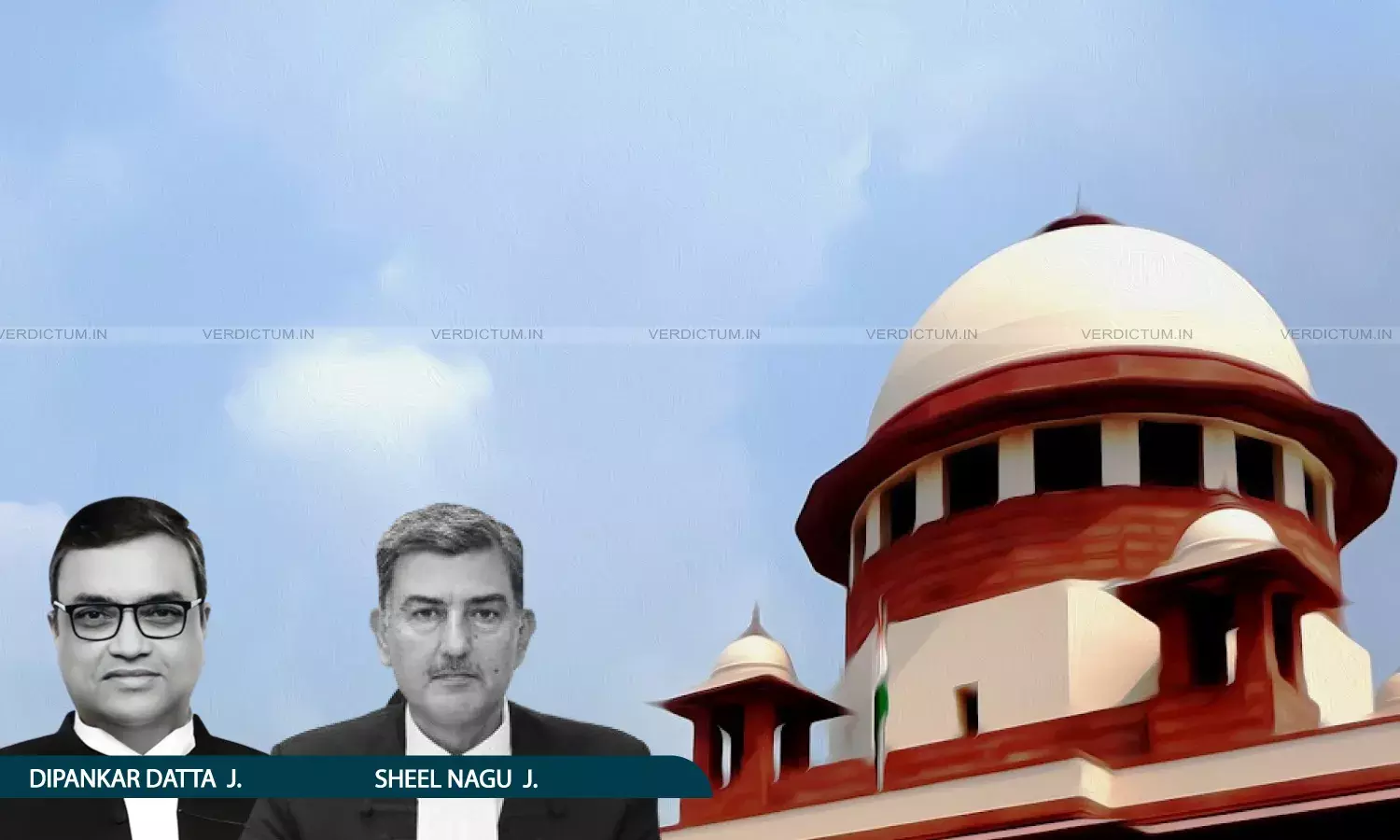
Justice Dipankar Datta, Justice Sheel Nagu, Supreme Court
While observing that mere functional similarity of work is not enough to claim equal pay, the Supreme Court has held that a mechanical application of the doctrine of equal pay for equal work has to be eschewed.
The appeal before the Apex Court was filed by the Higher Secondary School Teachers, Junior, in Government-aided schools in the State of Kerala appointed through direct recruitment.
The Division Bench of Justice Dipankar Datta and Justice Sheel Nagu held, “Decisions are legion that equal pay cannot be claimed by merely showing identical work; the claimant-employee must establish complete parity in the source of recruitment, educational qualifications and experience, mode of appointment through a constitutional process, and nature of responsibilities and accountability. Mere functional similarity of work has been held to be no longer enough.”
“It is, therefore, clear on reading the relevant precedents that a mechanical application of the doctrine of equal pay for equal work has to be eschewed. It is not the law that the doctrine can never be enforced; but, for such enforcement, a host of factors need consideration”, it added.
Senior Advocate V. Giri represented the Appellant while Senior Advocate Romy Chacko represented the Respondent.
Factual Background
The appellants in their writ petitions, claimed full-time pay scale which were being extended to teachers who were appointed either by transfer or by promotion. The Single Judge of the Kerala High Court whereby several writ petitions, preferred by the appellants, were allowed. The Division Bench of the Kerala High Court allowed an intra-court appeal carried to it by the State of Kerala and the Director of Higher Secondary Education.
Reasoning
Referring to various precedents, the Bench reiterated that to make such a claim, the employee must establish complete parity in the source of recruitment, educational qualifications and experience, mode of appointment and nature of responsibilities and accountability.
The Bench held that if there is complete parity qua all such factors and equal pay is claimed for equal work of equal value, the writ court can intervene and grant appropriate relief; otherwise not.
The Bench held that the experience of the transferee/promotee HSST, Jr. teachers compared with that of the direct recruit HSST, Jr. teachers provided a valid and intelligible differentia, having a nexus with the object sought to be achieved, to justify the grant of a higher pay to the former.
The Bench further stated, “For the reasons aforesaid, we are of the considered opinion that since the two group of teachers cannot claim equivalence qua experience in rendering service as teachers, the same is a valid criterion for differentiation in pay scales.”
Finding no ground meriting interference with the impugned order, the Bench dismissed the appeals.
Cause Title: G.P. Sangeetha & Ors. v. State of Kerala (Neutral Citation: 2026 INSC 1004)
Appearance
Appellant: Senior Advocates V. Giri, Menaka Guruswamy, AOR K. Rajeev, Advocates Rahul Narang, Niveditha R Menon, Aditya Verma, Tarun Kumar, AOR Jose Abraham, Advocates Swastika Parhi, Anto G Robert, Neya A.S., Deepa Joseph
Respondent: Senior Advocates Romy Chacko, Benet Selvan, Ramesh Babu, Giffara S., V. Chitambaresh, V. Giri, AOR Shibu Devasia Olickal, AOR Nishe Rajen Shonker, Advocates Alim Anvar, Anu K Joy, Santhosh K, Devika A.L., AOR Harshad V. Hameed, Advocates Ashwin Romy, Sachin Singh Dalal, Akshat Singh, AOR Anup Kumar, AOR Harikumar V., Advocates P. A. Noor Muhamed, Nowfal A., Bilal Niamathulla, AOR Aljo K. Joseph, Advocates Sashwat Mishra, Ajay M.