

"Story Of Her Life Will Be An Eye-Opener For Many”: Supreme Court Upholds Husband’s Conviction In Dowry Death Case Involving "Simulated Hanging"
The Bench noted that signs of assault on wife’s body later found hanging in matrimonial house, may indicate simulated hanging.

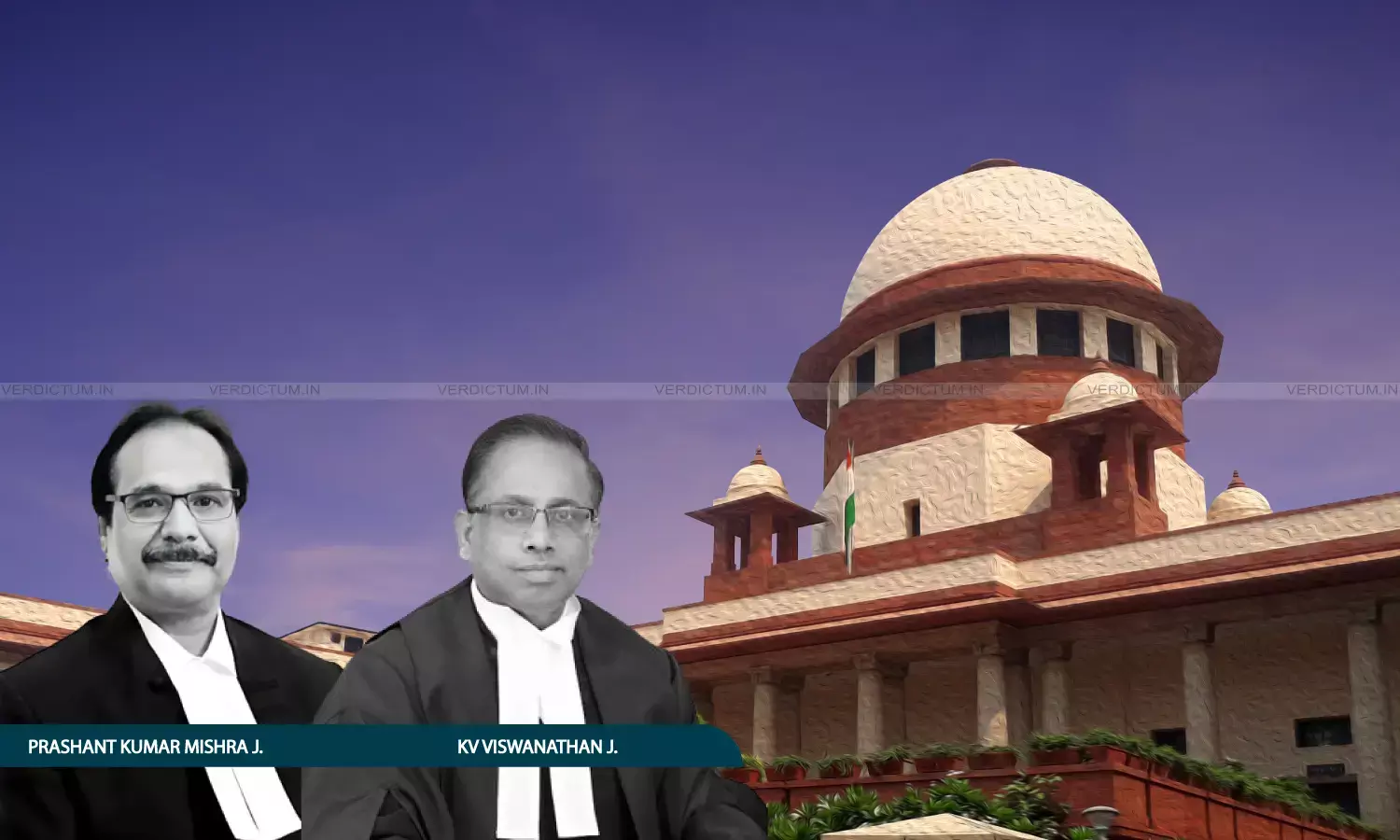
The Supreme Court has upheld the conviction of a man for murdering his wife in a dowry-related case, holding that where signs of assault or struggle are found on a body later discovered hanging, courts cannot lightly disregard the possibility of “simulated hanging”. The Court, further observed that repeated attempts at compromise despite continuing abuse had ended in a tragic and preventable death.
The Bench also noted that the deceased had repeatedly reached out to her family for help, but every complaint was met with efforts at reconciliation and assurances that things would improve. Opening the judgment on a poignant note, Justice Viswanathan observed that whether Soma’s life could have been saved would remain unanswered, but expressed hope that “the story of her life will be an eye-opener for many”.
A Bench of Justice Prashant Kumar Mishra and Justice K. V. Viswanathan observed, “Significantly, the injuries found on the body of the deceased are not consistent with an ordinary case of suicidal hanging. The existence of ante mortem injuries on different parts of the body of deceased Soma is not ordinarily capable of being self-inflicted. This fact substantially undermines the defence version of suicide. As demonstrated earlier, treatises on medical jurisprudence recognised the fact that where signs of assault or struggle are found on a body, later discovered hanging, the possibility of a case of simulated hanging cannot be lightly disregarded. In the present case, the medical evidence indicates that the deceased has been subjected to violence prior to her death thereby negating the theory of voluntary suicidal act”.
Diksha Rai, AOR appeared for the appellant and Shuvodeep Roy, AOR appeared for the respondent.
“…xxx’s near and dear naively believed that somehow -somehow- the situation will turn for the good. A false sense of optimism engulfed them. Their hopes were betrayed when xxx met with a tragic end at her matrimonial home. Hopefully, the story of her life will be an eye-opener for many.…Could the life of young xxx have been saved? Did the fear of societal opprobrium result in xxx being thrown to the wolves? These questions will remain hypothetical. Within a few days after her marriage, the deceased, xxx, was subjected to immense torture on account of demand for dowry. She repeatedly made entreaties to her parents to save her and even came to her parental home and stayed with them for a few days”, the Bench in the judgment noted, at the outset.
In the matter, the Bench ultimately dismissed the appeal filed by Gour Acharjee and affirmed his conviction under Sections 302 and 498A IPC. The Court also directed the police in Tripura to immediately trace and apprehend him after being informed that he was absconding.
As per the facts, the prosecution case arose from the death of Soma Acharjee in June 2007, barely fifteen months into her marriage. Her father alleged that she had been repeatedly harassed over demands for a motorcycle and cash, forcing village panchayats to intervene several times. Despite those interventions and written assurances, Soma continued reporting physical and mental cruelty before she was found hanging at her matrimonial home.
The Court found the medical evidence decisive. The post-mortem revealed multiple ante-mortem injuries on the chest, jaw and head, including a fatal head injury caused by a blunt weapon. At the same time, the body lacked several classic indicators of suicidal hanging, including a typical ligature mark and signs of asphyxia ordinarily associated with hanging. Relying on medical jurisprudence, the Bench held that such injuries were inconsistent with a voluntary act and strongly supported the conclusion that Soma was killed and then suspended to create the appearance of suicide.
Referring to settled precedent on deaths occurring inside a house, including Trimukh Maroti Kirkan v. State of Maharashtra (2006) 10 SCC 681, the Court reiterated that while the prosecution must establish its case, a corresponding burden falls on the inmates of the house to explain how the victim died when the incident occurs within the privacy of the matrimonial home.
Since the appellant was present in the house, informed the deceased’s father that she had allegedly died by suicide, and offered no plausible explanation when examined under Section 313 CrPC, the Court held that the circumstances clearly pointed to his guilt.
“There is clear evidence to the effect that there was consistent torture of the deceased with regard to the demand for dowry especially for the motorcycle and cash. Repeated panchayats have been held, as spoken to by the witnesses hereinabove. Even though on the same evidence, the three other accused have been acquitted and the State has not challenged the same in appeal, we are not inclined to acquit the appellant for the offence under Section 498A in the teeth of the direct overwhelming evidence against the appellant”, the Court noted.
“Hence, we have no hesitation in confirming the finding of the trial Court and the High Court that the death was due to the head injury and that the deceased was put on hanging”, the Bench observed.
Cause Title: Gour Acharjee v. The State of Tripura & Ors. (Neutral Citation: 2026 INSC 535)
Appearances:
Appellant: Diksha Rai, AOR, Atiga Singh, Purvat Wali, Sagun Srivastava, Sourabh Dahiya, Abhishek Jaiswal, Advocates.
Respondent: Shuvodeep Roy, AOR, Saurabh Tripathi, Deepayan Dutta, Subhro Sanya, Advocates.