Apprehensive Of False Complaints Made With Lure Of Future Settlement: Supreme Court Says Rape Case Can’t Be Quashed Solely On Compromise
The Court distinguished settlements arising from personal or commercial disputes and reiterated that inherent powers cannot be exercised merely on the basis of a compromise in cases involving serious offences such as rape.
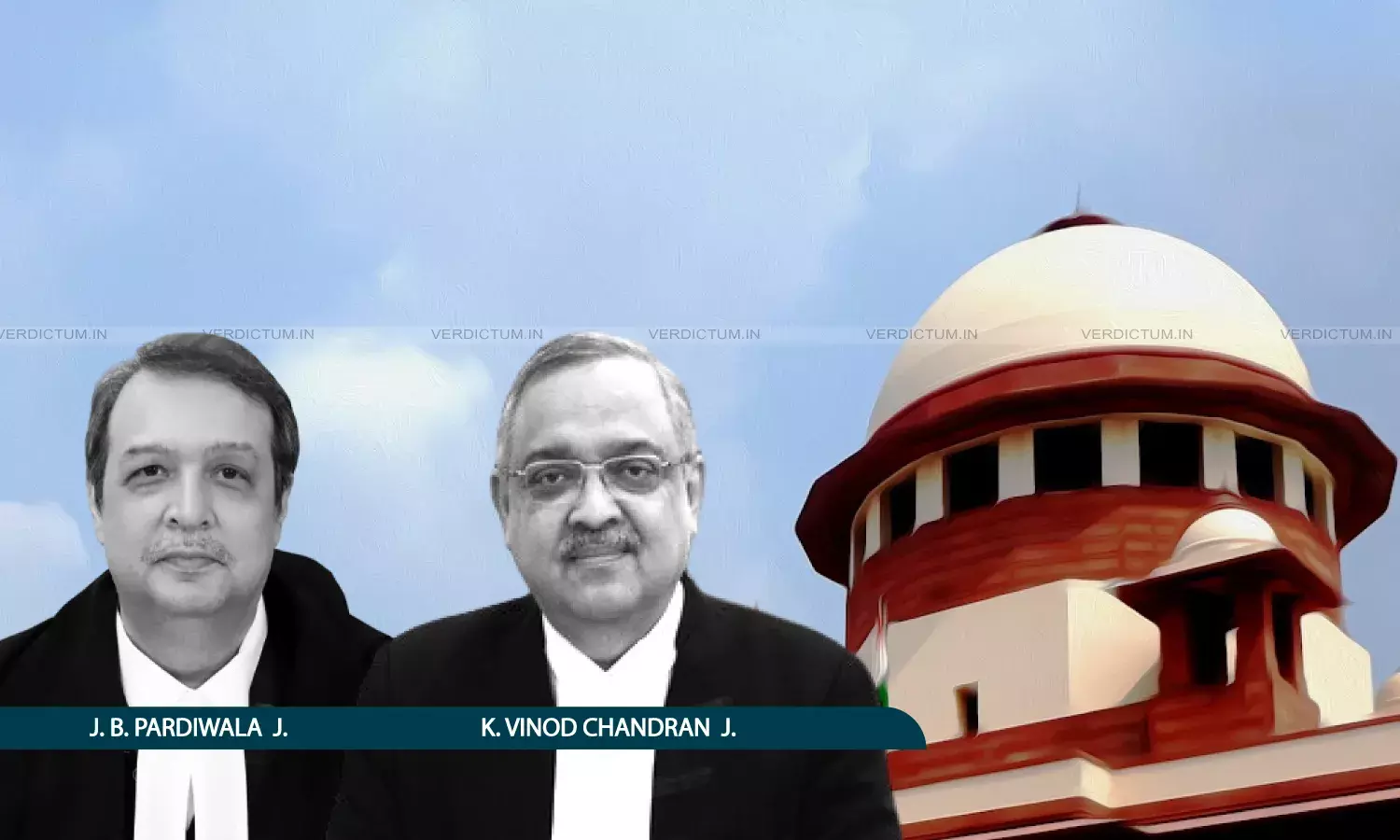
Justice J. B. Pardiwala, Justice K. Vinod Chandran, Supreme Court
The Supreme Court has set aside a Madhya Pradesh High Court order quashing a rape case solely based on a compromise and directed the trial to proceed.
The Court, however, separately granted anticipatory bail to the accused, subject to conditions imposed by the Trial Court.
The Court was hearing a special leave petition seeking anticipatory bail in a case involving alleged offences under Sections 64(1), 331(2) and 351(3) of the Bharatiya Nyaya Sanhita, 2023, and Sections 3(1)(w)(i), 3(1)(w)(ii) and 3(2)(v) of the Scheduled Castes and Scheduled Tribes (Prevention of Atrocities) Act, 1989. During the proceedings, it was informed that the High Court had separately quashed the complaint after accepting a compromise.
A Bench of Justice J.B. Pardiwala and Justice K. Vinod Chandran observed: “The present case is one of rape, and we should confess that we were inclined to grant anticipatory bail. However, quashing of a case under Section 482 relying solely on a compromise, especially when it is a non-compoundable offence, would be stepping outside the jurisdiction under Section 482 that too in violation of the power conferred under Section 320. We are not only concerned with the settlements which could be arrived at on coercion by the accused but also apprehensive of the multiplicity of such false complaints being made, with the lure of a future settlement being arrived it.”
Senior Advocate Warisha Farasat appeared for the petitioner, while Advocate Pashupathi Nath Razdan appeared for the respondents.
Background
The accused approached the Supreme Court against a Madhya Pradesh High Court order concerning his claim for anticipatory bail. After the Supreme Court issued notice, it was informed that the High Court had accepted a compromise and quashed the complaint by exercising its inherent powers in a separate proceeding.
In an earlier order dated September 3, 2026, the Supreme Court expressed concern over the quashing of a rape allegation merely on compromise. It called for the records of both High Court proceedings, directed that notice be issued to the complainant and stated that she should be given legal assistance if necessary.
On the next date, the Court directed that the complainant be provided video-conferencing facilities. It subsequently interacted with her through the office of the District Legal Services Authority, Rajgarh, Pachore.
Court’s Observations
Compromise Jurisdiction Does Not Extend To Serious Offences
The Court examined the precedents relied upon by the High Court and distinguished cases arising from personal, civil or commercial disputes from prosecutions involving serious offences.
The Bench noted that Madan Mohan Abbot v. State of Punjab (2008) and Jagdish Chanana v. State of Haryana (2008) concerned personal disputes. Shiji v. Radhika (2011) arose from a scuffle connected with a pathway dispute, while Anita Maria Dias v. State of Maharashtra (2018) concerned commercial transactions.
The Court stated that Narinder Singh v. State of Punjab (2014) and Anita Maria Dias had distinguished the High Court’s inherent jurisdiction from its statutory power to compound offences. Those decisions cautioned against invoking inherent powers for heinous offences involving mental depravity or offences such as murder, rape and dacoity, the Bench added.
Referring to Gian Singh v. State of Punjab (2012), the Court observed: “Gian Singh (supra) was a decision of a three Judge Bench which reiterated that the scope under Section 482, Cr. PC to quash criminal proceedings, involving non-compoundable offences is distinct and different from the compounding powers under Section 320. When the parties have settled their disputes, unless the offences are heinous and serious like that of mental depravity, murder, rape, dacoity etc. or under the Prevention of Corruption Act, the power under Section 482, Cr. PC could be invoked.”
The Bench also distinguished Shambhu Kharwar v. State of Uttar Pradesh (2024), where a rape case arising from an alleged breach of promise to marry was quashed after the allegations themselves indicated that the relationship was consensual.
Interaction With Complainant Reinforced Court’s Concern
The Court observed that its interaction with the complainant justified its concern about settlements arising either from coercion or an expectation of financial payment.
The Bench clarified that the truth of the allegations and the circumstances surrounding the purported settlement had to be examined during the trial. It expressly refrained from offering an opinion on their merits.
The Court observed: “Our apprehension was justified, the victim in the same breath says that she was coerced into settlement, that she is not ready for a settlement and that she requires money for settlement. She categorically stated that she made a complaint and stated the truth therein. However, that will have to be examined in a trial and we are unable to express any opinion at this point. We make it clear that the observations made by us need not regulate the trial, but we cannot but reiterate our caution insofar as false accusations being raised on the lure of a financial settlement and also on the other hand settlements, motivated by coercion.”
The Court reiterated that it could not approve the quashing of a case involving a serious offence merely because a settlement had been placed before the High Court.
Trial Restored While Anticipatory Bail Granted
The Court treated the validity of the High Court’s quashing order separately from the accused’s entitlement to anticipatory bail. It set aside both High Court orders but granted the accused protection from arrest while restoring the prosecution.
The Bench held: “We, hence, though not directly concerned with it, set aside the order passed by the High Court in Misc. Criminal Case No.15763 of 2026 and direct the trial to be proceeded with. Insofar as the present petition is concerned, we set aside the order in Criminal Appeal No.2110 of 2026 impugned herein and direct the petitioner herein to be released on anticipatory bail on such conditions as imposed by the Trial Court. The petitioner shall cooperate with the investigation and shall appear before the Trial Court as and when summoned.”
Conclusion
The Apex Court set aside the High Court’s order quashing the complaint on compromise and directed the criminal trial to proceed. It clarified that its observations would not regulate or influence the trial.
The Court also set aside the High Court order concerning anticipatory bail and directed that the petitioner be released on conditions imposed by the Trial Court. It required him to cooperate with the investigation and appear before the Trial Court whenever summoned.
The special leave petition was disposed of, and all pending applications were rejected.
Cause Title: Gopal Lodhi v. State of Madhya Pradesh and Another (Neutral Citation: 2026 INSC 1164)
Appearances
Petitioner: Senior Advocate Warisha Farasat; Advocates Fozia Rahman, Sikander A. Siddiqui, Kausubh Chauturvedi, Aafreen and Amita Singh Kalkal
Respondents: Advocate Pashupathi Nath Razdan