

Exclusive Jurisdiction Clause Prevails Over Twin Seat-Venu Choice In Arbitration Agreement, Forum Non Conveniens Principle Will Not Apply: Supreme Court
The Court said that an exclusive jurisdiction clause in favor of Hyderabad courts overrides a dual-seat provision and establishes the clear supervisory jurisdiction of the Telangana High Court.

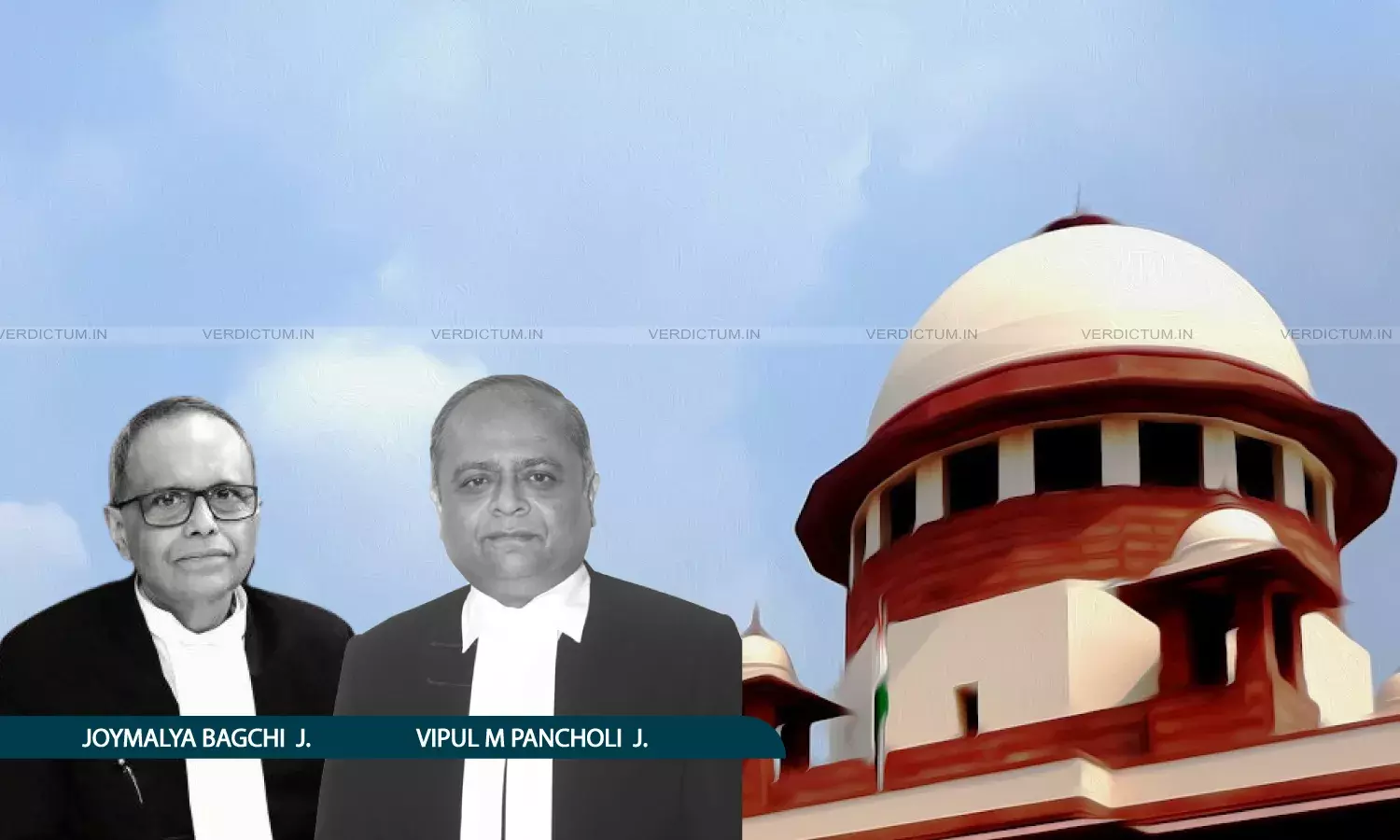
Justice Joymalya Bagchi, Justice Vipul M Pancholi, Supreme Court
The Supreme Court held that when a twin seat or venue is prescribed, a subsequent stipulation granting exclusive jurisdiction to a specific court unequivocally establishes that forum's supervisory control over the proceedings. The Court held that the principles of forum non conveniens need not be invoked in such cases.
The Bench held that party autonomy is of paramount importance, thereby distinguishing the three-judge bench precedent in Arif Azim Company Limited v. Micromax Informatics FZE (2025 SC) and affirming the valid exercise of jurisdiction by the Telangana High Court.
With this observation, the Apex Court dismissed the Special Leave Petitions filed by Bhartia Infra Projects Limited, which had challenged the Telangana High Court's orders referring its dispute with M/S Vishwa Samudra Engineering Private Limited to arbitration under Section 11(6) of the Arbitration and Conciliation Act, 1996.
The partial court working days bench of Justice Joymalya Bagchi and Justice Vipul M Pancholi observed, "A holistic reading of the clause would show that though twin Seat/Venue of arbitration, that is, either “Hyderabad, Telangana state or Guwahati, Assam State” is prescribed, the subsequent part of the clause unequivocally states that the courts in Hyderabad shall have exclusive jurisdiction over matters relating to or arising from this agreement."
Advocate on Record Syed Tabeer Riyaz appeared for the Petitioner, whereas Advocate on Record Kailas Bajirao Autade appeared for the Respondent.
Brief Facts of the Case
The petitioner preferred the present Special Leave Petitions assailing the judgment and orders passed by the Telangana High Court, whereby the High Court referred the dispute to arbitration under Section 11(6) of the Arbitration and Conciliation Act, 1996.
The primary grievance raised by the petitioner was that the Telangana High Court lacked the requisite jurisdiction to make the said reference, and that the Gauhati High Court was the appropriate forum to entertain the application. The petitioner contended that the work order was issued from Guwahati and the entire execution of the work took place within the territorial limits of Guwahati. Since the cause of action arose entirely in Guwahati, the petitioner approached the Gauhati High Court for the appointment of an arbitrator. It was further contended that the Telangana High Court failed to appreciate the settled law laid down in Arif Azim Company Limited v. Micromax Informatics FZE (2025 SC) and erroneously allowed the Section 11 application merely on the ground that it was filed earlier in time.
Observations of the Court
The Apex Court perused the arbitration agreement between the parties and observed that a holistic reading of the clause revealed a twin Seat/Venue of arbitration, namely Hyderabad, Telangana, or Guwahati, Assam. However, the Court highlighted that the subsequent part of the same clause unequivocally mandated that the courts in Hyderabad would have exclusive jurisdiction over all matters relating to or arising from the agreement.
The Bench observed that although the three-judge bench in Arif Azim Company Limited (supra) held that the principles of forum non conveniens would apply if two or more possible places were designated as a seat, such a proposition was inapplicable to the facts of the present case. The Court noted that the parties had themselves explicitly agreed to the exclusive jurisdiction of the Courts in Hyderabad within the arbitration clause itself.
"Such proposition of law though unexceptionable is inapplicable in the facts where the parties have themselves agreed to the exclusive jurisdiction of the Courts in Hyderabad in the arbitration clause itself. Party autonomy being of primary importance in interpretation of the arbitration agreement, we are of the considered view, the ratio in Arif Azim Company Limited (supra) is factually distinguishable where the supervisory jurisdiction of the Telangana High Court over the arbitration is clearly discernible from the clause itself", the Court observed.
The Court further said that party autonomy is of paramount importance in the interpretation of arbitration agreements.
Consequently, the Apex Court held that the ratio in Arif Azim Company Limited (supra) was factually distinguishable, as the supervisory jurisdiction of the Telangana High Court over the arbitration proceedings was clearly discernible from the face of the contract.
Finding no merit in the contentions of the petitioner, the Court declined to interfere with the impugned orders and dismissed the Special Leave Petitions.
Cause Title: Bhartia Infra Projects Limited v. M/S Vishwa Samudra Engineering Private Limited [SLP (C) NO(S). 19870-19871/2026]
Appearances:
Petitioner: Advocate on Record Syed Tabeer Riyaz, Advocate Ankur Khandelwal, Advocate Mohd Shahrukh Ali, Advocate Chirag Sharma, Advocate Alok Nayak.
Respondent: Advocate on Record Kailas Bajirao Autade, Advocate Prasad Hegde, Advocate B Veera Swamy Raju, Advocate Siri Swathi Katragadda.
Click here to read/download the Order