

Supreme Court To Examine If “Pay And Recover” Applies When Policy Was Cancelled Before Accident
While staying the award against the insurer, the Court left the claimants free to recover the awarded amount from the owner/driver of the offending vehicle.

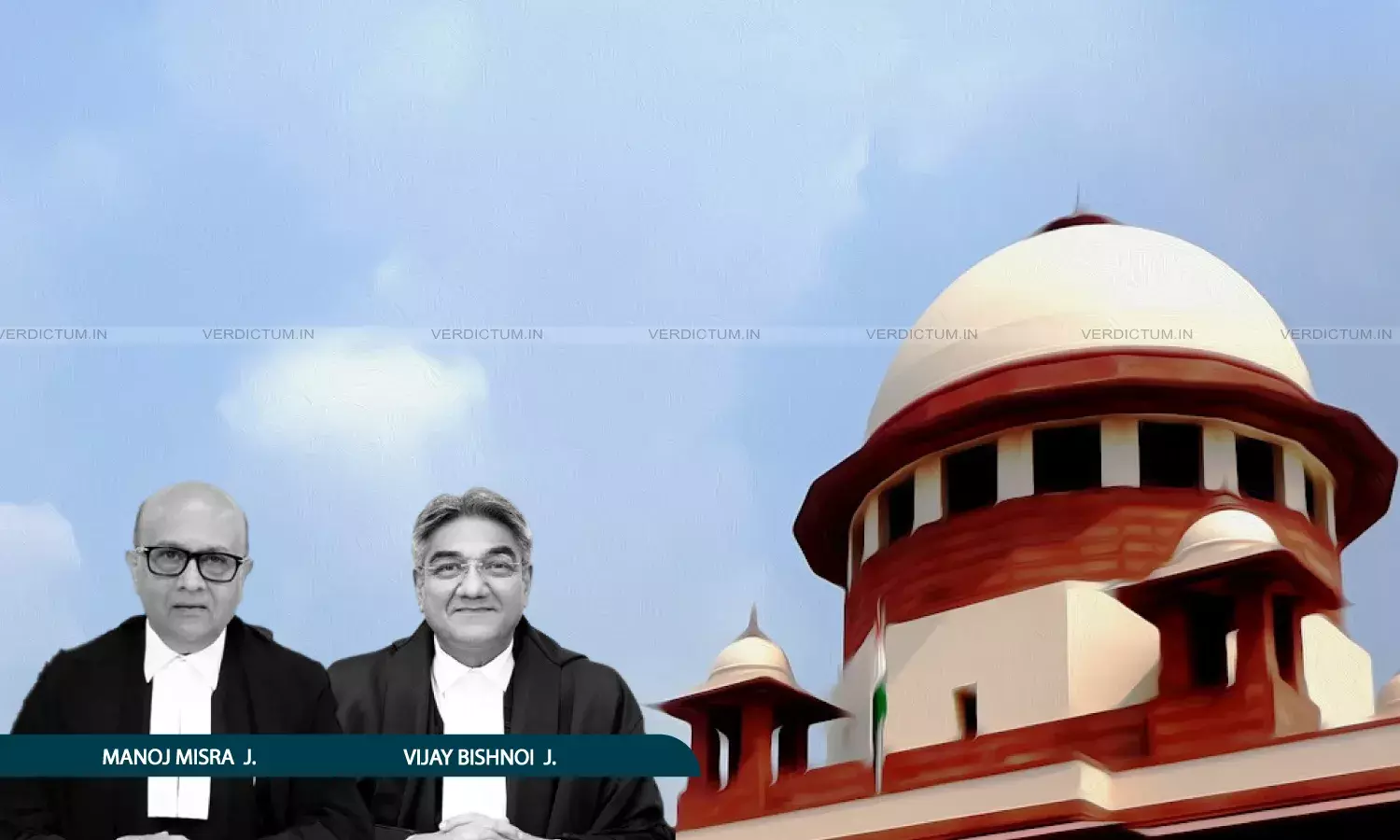
Justice Manoj Misra, Justice Vijay Bishnoi, Supreme Court
The Supreme Court has agreed to examine whether the pay and recover principle can be applied against an insurer where the insurance policy was cancelled before the date of the accident.
It issued notice on a special leave petition filed by IFFCO-Tokio General Insurance Company Limited against a judgment of the Punjab & Haryana High Court, and stayed the award against the insurer in the meantime.
The petitioner submitted that the pay and recover principle can only be applied where there is a subsisting insurance policy. It contended that the High Court’s reliance on the three-Judge Bench decision in Oriental Insurance Co. Ltd. v. Inderjit Kaur(1998) was not warranted, as the vehicle was found not to be insured on the date of the accident policy was cancelled prior to the date of the accident.
The Bench of Justice Manoj Misra and Justice Vijay Bishnoi recorded, “The submission on behalf of the petitioner is that pay and recover principle can only be applied where there is a subsisting insurance policy. Here, the Motor Accident Claims Tribunal while deciding issue (va) has recorded a specific finding that the vehicle was not insured and this finding has been confirmed by the High Court in paragraph 20 of its judgment.”
Advocate Manish Kumar appeared for the Petitioner, while Advocate-on-Record Sachin Saini appeared for Respondent No.3.
Brief Facts
The claimant, Harkaur, was going from her house towards Dhana road to fetch grass when, near the Indane Gas Godown, Bhiwani, a car being driven rashly and negligently at a very high speed struck her from behind. She fell down on the side of the road and sustained injuries on her right foot. The driver fled the spot. An FIR was lodged against him, and a charge sheet was later filed.
The claimant filed a claim petition under Section 166 of the Motor Vehicles Act, 1988, impleading the driver, the owner and IFFCO-Tokio General Insurance Company as the insurer of the offending vehicle.
An insurance policy had initially been issued for the vehicle, but the premium was never realised by the insurer. The cheque issued by the owner towards the premium was dishonoured for insufficiency of funds, and the insurer issued a cancellation letter to the insured, whereby the policy stood cancelled on account of non-realisation of premium.
The Motor Accident Claims Tribunal held that the offending vehicle was not covered under a valid and subsisting policy on the date of the accident. It awarded compensation of Rs.1,51,000/- with interest at 6% per annum, and fastened the liability on the driver and owner. The driver and owner appealed to the High Court.
Impugned Judgment
The High Court upheld the Tribunal’s finding that the accident occurred due to the rash and negligent driving of the appellant-driver. It was noted that once an FIR has been lodged and a charge sheet filed, it constitutes prima facie evidence of negligence, and that the standard of proof in MACT proceedings is one of preponderance of probabilities.
On the insurer’s liability, the High Court affirmed the Tribunal’s finding that the vehicle was not insured on the date of the accident. It observed, “Once the cheque issued towards premium stood dishonoured and the policy had been cancelled prior to the date of accident after due intimation to the insured, no concluded and enforceable contract of insurance survived between the insurer and the insured on the date of occurrence.”
The High Court, however, held that the matter did not rest there. It observed, “Even in cases where the insurer succeeds in establishing a valid defence qua the insured, the interests of third-party claimants under the benevolent scheme of the Motor Vehicles Act cannot be defeated.”
Relying on Inderjit Kaur, where the larger Bench held that the insurer would remain liable vis-a-vis third parties notwithstanding the dishonour of the premium cheque, the High Court directed the insurance company to satisfy the award in the first instance, with liberty to recover the amount from the owner and driver of the offending vehicle. The award was modified to that extent.
Accordingly, the Supreme Court issued notice and directed that the award against the petitioner shall remain stayed in the meantime, but left the claimants at liberty to recover the awarded amount from the owner/driver of the offending vehicle.
Cause Title: IFFCO-Tokio General Insurance Company Limited v. Baljeet & Ors. [SLP (C) Diary No. 63646/2026]
Appearances:
Petitioner: AOR Gopal Singh, Adv. Manish Kumar, Adv. Ian Xavier Pereira
Respondents: AOR Sachin Saini, AOR Niteen Kumar Sinha, Adv. Akshit Mehta, Adv. Amit Kumar, Adv. Pooja Soni