

Given The Young Age There Is Possibility Of Reformation: Supreme Court Modifies Sentence Of Rape Convict
The Supreme Court was considering an appeal filed by the appellant-convict against the judgment of the Delhi High Court.

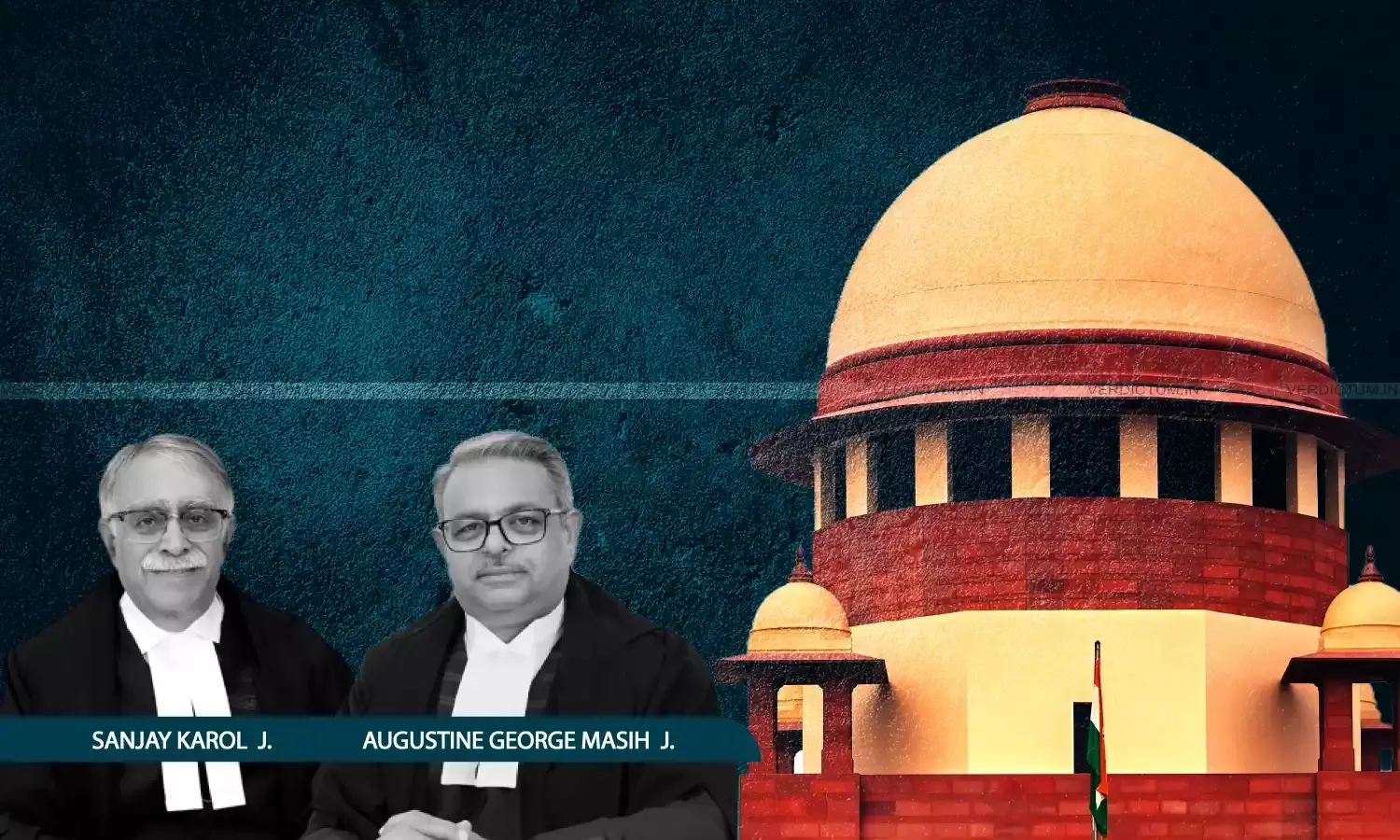
While modifying the sentence of a rape convict from life imprisonment to 20 years with the benefit of remission, the Supreme Court has laid down a list of illustrative aspects to consider for the imposition of sentence.
The Apex Court was considering an appeal filed by the appellant-convict against the judgment of the Delhi High Court, which affirmed the finding of conviction and sentence in a case registered under Section 376-D of the Indian Penal Code, 1860. The sentence awarded was rigorous imprisonment for life, that is, for the remainder of natural life.
The Division Bench of Justice Sanjay Karol and Justice Augustine George Masih noted: "In the present case, the appellant convict has no criminal antecedents; was of only 25 years when the offence was committed; given the young age there is a possibility of reformation. The State has neither brought on record anything to show that the same would not be possible, nor has it contravened the statement made on behalf of the appellant that in the nearly ten years (including remission) that he has been convicted, he has maintained a good conduct."
AOR Vardhman Kaushik represented the Appellant while Additional Solicitor General Kankamedla Ravindra Kumar represented the Respondent.
Factual Background
A call was received at the Police Station by the first informant ‘benami’ that two accused persons had committed rape on the victim when she took a rickshaw from the Delhi Railway Station at night-time on the assurance that the driver would drop her off at her home but instead of doing so, he took her to a deserted place where another person was already present and they proceeded to commit the offence.
Reasoning
The Bench, at the outset, mentioned that the offence committed against the victim was grave. Dealing with the aspect of sentence, the Bench stated, “When a sentence is imposed on an offender, it is done so with trifold purpose i.e. punitive, deterrent and protective. The overall objective is to rid the society of criminal proclivity. The same is done by ensuring that the sentence imposed is proportional to the offence or in other words not overly influenced by the possibility of reformation and instead, striking a judicious balance between the interest of the victim, society and the accused, after following the due process of law.”
The Bench took note of the precedents wherein the sentence was modified by the Court either from capital punishment to rigorous imprisonment for life or to an otherwise fixed term.
The Bench stated that the offence was heinous and was not only against the victim but against society at large. “Despite much evolution, sociologically and psychologically, to break away from the chains of patriarchal thought, incidents such as these are only continuing unabashedly. Various amendments have been brought in over the years in the law, and while they may have had positive impact to some extent, the urgency to root out such offences cannot be simmered down even for a bit till these incidents are recorded only in history and are viewed with collective disdain”, it added.
The Bench further stated, “It also must be observed that the offence under which the appellant-convict has been sentenced, Section 376D IPC was substituted by way of the 2013 Criminal Law Amendment being Act 13 of 2013 which was brought in the aftermath of the horrifying Nirbhaya incident that took place on the streets of the capital. There it has been made clear that for this offence, minimum sentence is of twenty years, and the maximum is that has been imposed upon the appellantconvict i.e., life imprisonment for the remainder of natural life. It appears quite plainly that considering the nature of the offence, the Legislature first made it an independent offence and then also provided for a minimum punishment. The Court, therefore, has no other alternative and must, upon convicting, impose at least the minimum sentence.The judicial discretion in reducing the same by recording ‘adequate and special reasons’ which was given in proviso to the unamended Section 376 has been taken away.”
The Court also added that sentencing should be:
(a) Be in accordance with the nature and gravity of the crime;
(b) Adequately protect the interest of the society;
(c) Take into account the deterrent purpose of punishment;
(d) Consider the motive behind the crime, if any;
(e) Give due weight to the conduct of the accused;
(f) Examine whether the crime in question was pre-meditated or not;
(g) Keep in view the age of the accused and whether he has engaged in any similar offence in past for which he has been duly convicted;
(h) Account for the number of victims of the offence;
(i) Not consider the religion, race, caste or creed of the offender as a factor;
(j) Consider the possibility of reformation of the accused. It is the duty of the State to establish that the same does not exist; and
(k) The abuse of trust or misuse of personal relationship, if any.
Partly allowing the appeal, the Bench modified the sentence to 20 years with the benefit of remission.
Cause Title: Ehsaan v. State of National Capital Territory of Delhi (Neutral Citation: 2026 INSC 720)
Appearance
Appellant: AOR Vardhman Kaushik, Advocates Kavya Shukla, Mayank Sharma, Arindam Sarin, Priya Nair
Respondent: Additional Solicitor General Kankamedla Ravindra Kumar, Advocates Devraj Bhattacharjee, Prashant Singh II, Gaurang Bhushan, Udit Dedhiya, AOR S.N.Terdal, AOR Mukesh Kumar Maroria