

Professional Clearing Members Owe No Statutory Duty To Verify Debit/Credit Positions For Trading Member On Default: Supreme Court
The Apex Court also held that NCL's settlement guarantee committee lacked power to order restitution of liquidated securities, sets aside SAT orders.

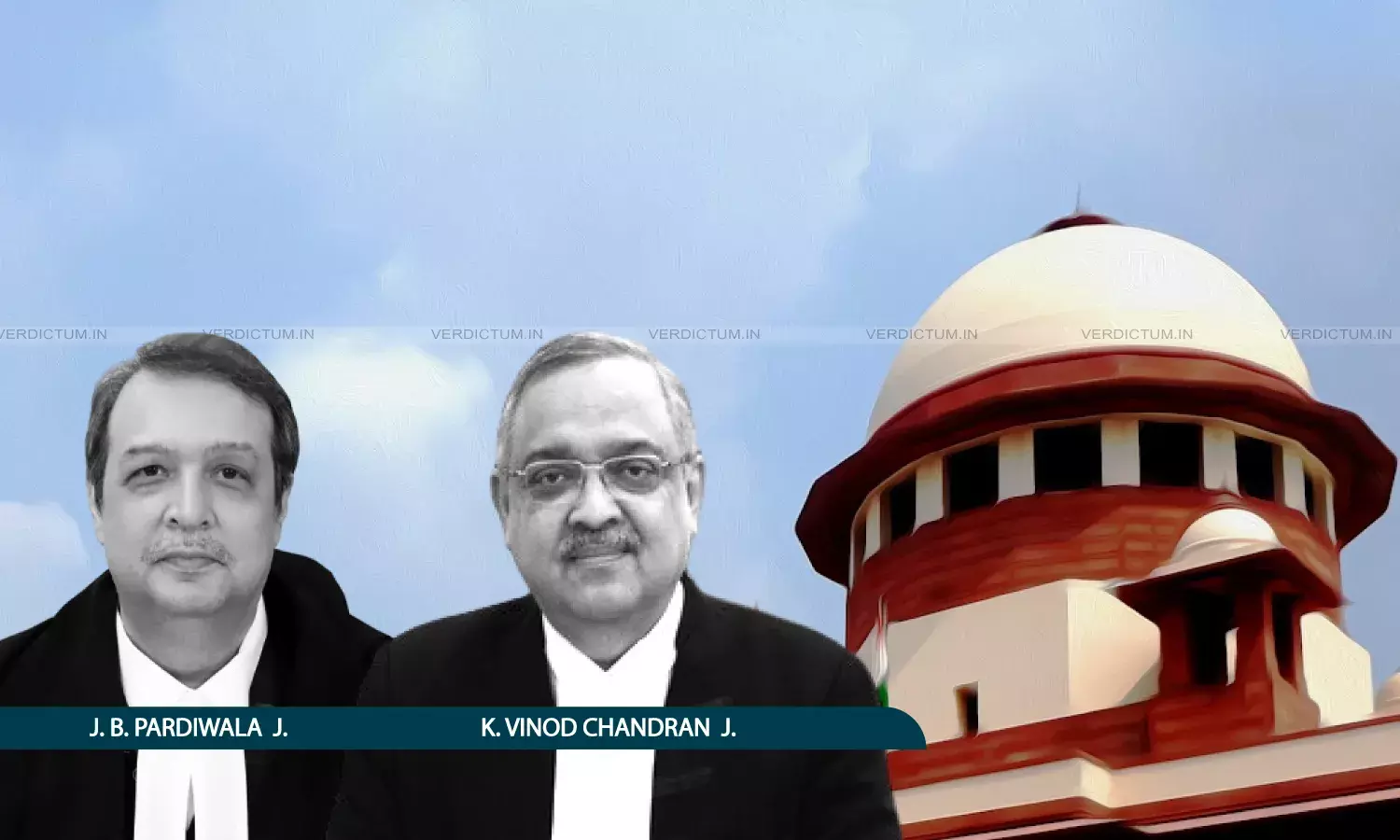
Justice J. B. Pardiwala, Justice K. Vinod Chandran, Supreme Court
The Supreme Court has held that Professional Clearing Members (PCMs) in the Futures & Options segment cannot be saddled with a statutory obligation to verify the debit/credit positions of a Trading Member's individual clients before liquidating collaterals furnished by the Trading Member on default. The Court found that the regulatory framework, as it stood during the period in question, did not provide the PCM visibility of such individual client positions, and that the absence of privity of contract between the PCM and the Trading Member's clients was a valid defence against claims of restitution.
The Bench further ruled that the Member and Core Settlement Guarantee Fund Committee (MCSGFC) constituted by NSE Clearing Ltd. had no jurisdiction to direct restitution of liquidated securities, since Section 9(3)(b) of the Securities Contracts (Regulation) Act, 1956 expressly bars stock exchange byelaws from prescribing any penalty involving payment of money, a power reserved exclusively for SEBI under Section 11B of the SEBI Act and Section 12A of the Securities Act. Consequently, the orders of the Securities Appellate Tribunal upholding such restitution were set aside.
A Division Bench comprising Justice J.B. Pardiwala and Justice K. Vinod Chandran observed, “…we are of the definite opinion that there was no statutory violation committed by the PCM and their plea of having no privity of contract with the constituents of the TM as also no statutory obligation to verify the debit/credit positions of the individual clients of the TM is perfectly in order. More onerous is the fact that the TM was indulging in a Ponzi scheme wherein the investors willingly enrolled themselves, executing affidavits of undertakings and furnishing securities to the TM in his status as a DP & DAS, which was out right illegal, the illegality being known, both to the TM and its constituents”.
Senior Advocates Shyam Divan, Niranjan Reddy and Amar Nath Saini appeared for the appellant and Senior Advocates Arvind P. Dattar, Meenakshi Arora appeared for the respondent.
The appeals arose from the liquidation, by PCMs, of securities furnished as collateral by defaulting Trading Members, including Anugrah Stock & Broking Private Limited, which was found to have run an unauthorised Portfolio Management-type scheme promising assured returns.
When the Trading Members defaulted, the PCMs sold the pledged securities to recover dues, without ascertaining whether individual clients of the Trading Member had outstanding debit balances. Several such clients, having no debit balance themselves, lost their securities and sought compensation.
The investors' claims before SEBI, SAT and the High Court were unsuccessful. The MCSGFC, however, directed the PCMs to restitute the liquidated securities, imposing nominal penalties as well, holding the PCMs guilty of inadequate due diligence. The SAT affirmed these directions, reasoning that the power to order restitution was inherent in the larger disciplinary power of expulsion, and additionally invoking its own procedural rules to justify the direction.
Examining Regulation 1.7 and 4.5.4 of the NCL's F&O Regulations along with successive SEBI circulars of 2008, 2016 and 2019, the Court found that client-wise, real-time visibility of debit/credit positions was introduced only through SEBI's 2021 circular on segregation and monitoring of collateral at the client level, well after the liquidations in question.
The Court observed that, "…we have to accept the contention of the PCM/Appellants that they had no visibility of the debit/credit positions of individual clients whose securities were furnished as collaterals by the TM to the CM. The absence of privity of contract, with the constituents of the TM, has also to be reckoned in favour of the PCMs; which even if not available as of now, by the Circular of 2021 of the SEBI, there is an obligation cast on the PCM to segregate client collaterals, the debit/credit positions being visible in the daily reports and liquidate only those with debit positions”.
It rejected reliance on Indian Council for Enviro-Legal Action, distinguishing the "polluter pays" doctrine, and held that, “…What is relevant in directing restitution and also grant of interest, is that the retention of the thing or money; by the person from whom it is sought to be restituted, should be unjust/illegal; which we have found does not emanate from the facts and circumstances of this case and no violation perse of the statutory regulatory mechanism arise. We are neither able to find a remedy of restitution, flowing naturally in the facts of this case nor are we persuaded to permit it, in view of the specific statutory prohibition with respect to the penalties permitted under Section 9(3)(b) of the Securities Act”.
Cause Title: Edelweiss Custodial Services Limited v. NSE Clearing Ltd. & Anr. (Neutral Citation: 2026 INSC 941)
Appearances:
Appellant: Shyam Divan, Niranjan Reddy and Amar Nath Saini, Senior Advocates.
Respondent: Arvind P. Dattar, Senior Advocate, Meenakshi Arora, Senior Advocate.