

She Is My Temple, My Mosque, My Kaaba & Kashi: Supreme Court Quotes Hindi Poem To Denounce Female Foeticide; Calls For Strict Enforcement Of PCPNDT Act
The Bench noted that progress since the mid-1990s remains incomplete and uneven; welfare schemes alone cannot replace widespread change in mentality.

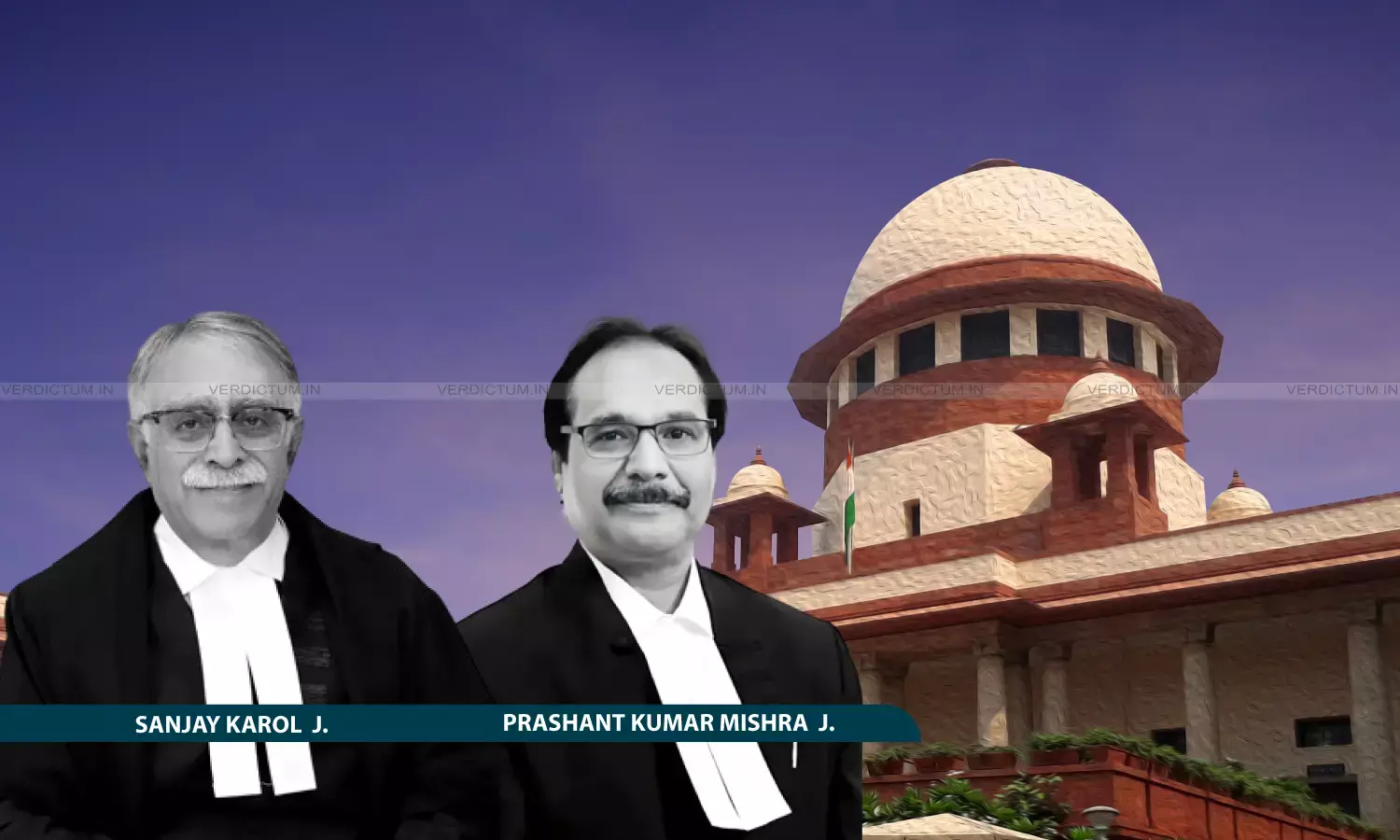
Justice Sanjay Karol, Justice Prashant Kumar Mishra, Supreme Court
The Supreme Court, invoking celebrated poetess Subhadra Kumari Chauhan's moving lines from “Balika ka Parichay” has strongly denounced the practice of female foeticide, calling for strict implementation of the Pre-Conception and Pre-Natal Diagnostic Techniques (Prohibition of Sex Selection) Act, 1994.
While evaluating the nation's demographic trajectory, the Court observed that while the current sex ratio scenario is markedly better than it was in the mid-1990s, the official data does not support complacency. The Bench noted that despite a myriad of central and state welfare initiatives aimed at the survival, education, and financial security of the girl child, the progress made remains visibly incomplete and uneven across different states.
Consequently, the Court ruled that the strict enforcement and structural integrity of regulatory legislation like the PCPNDT Act remain absolutely essential. The Bench emphasized that such statutory safeguards cannot be diluted until a genuine, widespread change in societal mentality replaces deep-seated patriarchal biases with true gender equality, ultimately ensuring that the fundamental right to be born is never questioned.
A Division Bench comprising Justice Sanjay Karol and Justice Prashant Kumar Mishra observed, “In the larger context of this appeal, we are reminded of the words of Subhadra Kumari Chauhan in the poem ‘Balika ka parichay’.It powerfully describes the beautiful joy of a mother upon the birth of her daughter…Well, to our mind the objective of the Pre-Natal Diagnostic Techniques (Prohibition of Sex Selection) Act, 19941 is to enable a woman to feel the joy that has been described above”.
“…the integrity and strict enforcement of welfare-oriented legislation such as the PCPNDT Act remain essential along with efforts continued and earnest, till the time there is a widespread change in mentality and what till now, is perceived as the ‘inherent weakness’ of the woman, is replaced by true equality, when there will dawn a realization that efforts such as these are no longer required. This is not to say that the laws protecting women within legislation such as IPC/BNS will no longer be required but at least, there will no longer be a question on whether a girl child deserves to be born”, the Bench further observed.
Advocate Makarand D. Adkar appeared for the appellant and Senior Advocate Aniruddha Joshi appeared for the respondent.
While citing, ‘Yatra naryastu pujyante ramante tatra dewatah’ (where woman is worshipped, there is abode of God), the Bench noted, “From our own scriptures, the once much cherished, but now largely forgotten value is also worth reminding ourselves”.
The matter originated from a search and seizure operation conducted at a sonography center belonging to the appellant, against a medical practitioner, where the competent authority uncovered multiple blanks and errors in the mandatory Form 'F' records.
Pursuant to an investigation and an appearance before the Advisory Committee, which found prima facie material exposing statutory infractions, criminal proceedings were initiated against the doctor. The appellant argued that the blanks were technical, inadvertent, and lacked criminal intent, while also challenging the administrative competence of the inspecting Civil Surgeon.
For the background, the Judicial Magistrate First Class took cognizance of the offences and issued process under Section 204 CrPC for violations under Section 23 of the Act.
The appellant challenged this order through a Criminal Revision Petition before the Sessions Court and subsequently via a criminal writ petition before the Nagpur Bench of the Bombay High Court.
Both the courts rejected the challenges, noting that the District Civil Surgeon possessed the lawful authority by notification and that maintaining the forms was a non-delegable duty.
Dismissing the final appeal, the Supreme Court noted that the statutory text of the proviso to Section 4(3) explicitly presumes any inaccuracy in records to be a contravention of sex-selection prohibitions unless proven otherwise by the person conducting the ultrasonography.
The Bench observed that while various state and central welfare schemes like Beti Bachao Beti Padhao, the Sukanya Samriddhi Account, and Tamil Nadu's Cradle Baby Scheme have generated awareness, the continuous "behind the curtains" prevalence of sex selection necessitates zero-tolerance toward statutory dilutions.
Noting the schemes, and the statistics, the Bench said, “These schemes are indicative of continued efforts to eradicate the systemic bias suffered by the girl child in an inherently patriarchal system. Much progress has been made, and yet, much is left to be desired. In sum, while the situation is markedly better than it was in the mid-1990s, the data does not support complacency. The statistics referred to above show that the progress made is incomplete and uneven…”, the Bench said.
The Court concluded that because medical records are often the sole source available to ensure an establishment is not engaged in sex determination, the columns of Form 'F' are entirely mandatory, and the lapses must be evaluated thoroughly during the trial.
In its operative directions, the Court dismissed the criminal appeal after finding it entirely bereft of merit, thereby clearing the path for the Trial Court to proceed with the prosecution in accordance with law.
All pending interim applications were concurrently ordered to be disposed of by the Bench.
Cause Title: Dr. Ramesh v. State of Maharashtra & Anr. (Neutral Citation: 2026 INSC 635)
Appearances:
Appellant: Makarand D. Adkar, Pravin Waman Satale, Rishabh Jain, Rajiv Shankar Dvivedi, AOR, Advocates.
Respondent: Aniruddha Joshi, Sr. Adv., Siddharth Dharmadhikari, Aaditya Aniruddha Pande, AOR, Shrirang B. Varma, Advocates.