

Scope Of Reference To Third Judge U/S 392 CrPC Limited To Points Of Dissent? Supreme Court Refers Sajjan Singh Judgment To Larger Bench
The Bench observed that unanimous concurrent findings cannot be reopened by a referee judge merely due to the fortuitous filing of a composite appeal.

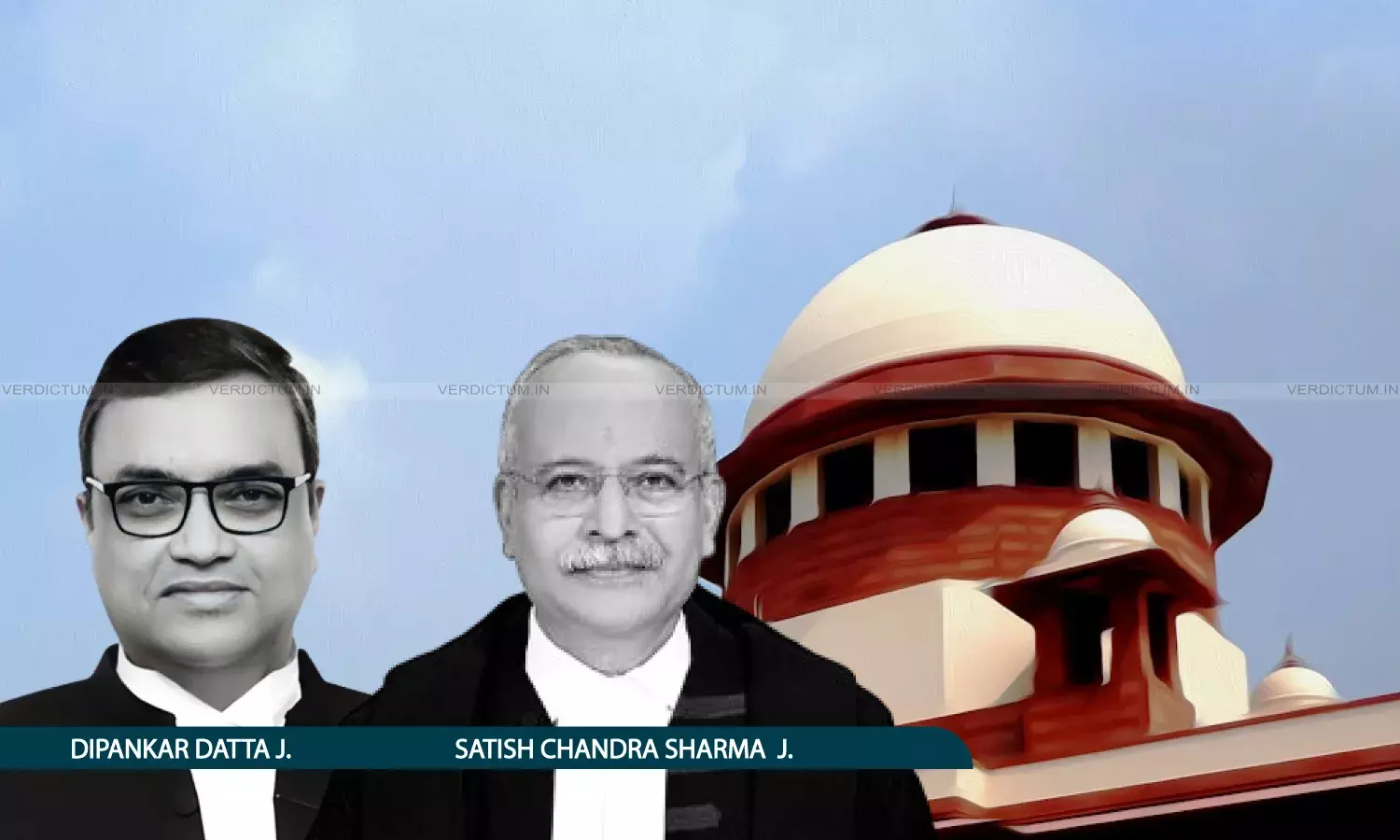
Justice Dipankar Datta, Justice Satish Chandra Sharma, Supreme Court
The Supreme Court has referred its 26-year-old precedent in Sajjan Singh v. State of Madhya Pradesh (1999) 1 SCC 315 to a larger Bench to authoritatively determine the jurisdiction of a referee judge under Section 392 CrPC.
While making the reference, the Court questioned whether a third judge can reopen unanimous concurrent findings of guilt against co-accused when a Division Bench splits only on the culpability of one specific accused. The Bench observed that a referee judge’s scope must be strictly restricted to the points of dissent, rather than treating a single composite appeal as an opportunity to review the entire case afresh.
In the analysis, the Court highlighted that the current interpretation under Sajjan Singh leads to highly irrational and unequal outcomes in criminal appellate procedure. The Bench noted that allowing a referee judge to disturb unanimous findings simply because the co-accused filed a joint appeal creates an unconstitutional disparity against those who file separate appeals. By focusing on the intentional statutory shift in language from the 1898 Code to the 1973 Code, the Court said that judicial discipline and comity require that concurrent decisions of a Division Bench remain final and untouched by a referee judge.
A Division Bench comprising Justice Dipankar Datta and Justice Satish Chandra Sharma observed, “Finally, what remains is the question of judicial discipline, propriety and comity. A mechanical application of the law laid down in Sajjan Singh (supra) would render these integral components of a just and fair criminal justice delivery system redundant. Thus, while recording our respectful disagreement with the view expressed in Sajjan Singh (supra), we refer the question as to whether Sajjan Singh (supra) lays down correct law for decision to a larger Bench of such strength, as the Hon’ble the Chief Justice may constitute. However, we prefer to reserve our answers to the questions [(ii) and (iii)] formulated in paragraph 8 (supra)”.
Advocate Mudit Sharma appeared for the appellant and Senior Advocate Sidharth Luthra appeared for the respondent.
Pertinently, the legal questions that emerged from the scope and ambit of Section 392 of the 1973 Code, which the Bench had to adjudicate upon, were:
- (i)Whether, in view of a division of opinion between the two Judges of a Division Bench hearing an appeal under Chapter XXIX of the 1973 Code, the third Judge before whom the appeal is laid is obliged to deliver his opinion agreeing with either one of the two opinions or is such Judge empowered to give an opinion which is at divergence with the opinions penned by the two Judges who heard the appeal?
- (ii)Whether the third Judge is obliged to render his opinion confined to the points of disagreement between the two Judges only, or that such Judge is competent and empowered in law to differ with the conclusions unanimously reached by both the Judges of the Division Bench and give his independent opinion which is at variance with such unanimous conclusion?
- (iii)Whether the third Judge, upon the appeal being laid in terms of Section 392 of the 1973 Code, not bound by the unanimous conclusions of the two Judges of the Division Bench; if not, and in case of disagreement with the concurrent findings of the two Judges, should the third Judge not refer the appeal to be re-heard and decided by a larger Bench?
The Court explicitly answered question (i) by clarifying that a referee judge’s options are legally narrow; while they can direct additional evidence to be taken to cure a specific procedural defect, they generally cannot fabricate a completely divergent third path on the existing evidence and must choose between the two conflicting opinions to resolve a tie.
However, the Bench explicitly reserved its answers on questions (ii) and (iii), which formed the core of the dispute. Under the judicial discipline, a two-judge Bench cannot directly overrule a coordinate two-judge precedent in Sajjan Singh. Therefore, while the Bench spent considerable length explaining why Sajjan Singh creates unconstitutional disparities and irrational outcomes, they deferred making a final binding declaration and instead referred the entire matter to the Chief Justice of India to constitute a larger Bench to test the precedent's correctness.
“Answering the first question need not detain us for long. The options open for the referee Judge, when seized of a reference under section 392 of the 1973 Code are not too wide. If a Judge of a Bench of two-Judges, while hearing an appeal, is inclined to maintain a conviction while the other Judge is not so inclined, the third Judge may accept either opinion and it is the third Judge’s opinion that the statute requires to be placed before the Division Bench for rendering the final judgment”, the Bench had noted.
For the facts, a joint trial where the IInd Additional Sessions Judge, Lucknow, convicted three siblings, Anil, Ajay, and Atul Rastogi, under Sections 148 and 302/149 IPC, sentencing them to life imprisonment for a 1991 murder. The siblings subsequently challenged this decision before the Allahabad High Court by filing a composite criminal appeal.
As per the history of the matter, Justice Bhanwar Singh and Justice Devi Prasad Singh delivered separate opinions.
Both judges concurrently upheld the conviction and life sentences of Anil and Ajay Rastogi, however, they differed on the culpability of Atul Rastogi; Justice Bhanwar Singh favored his acquittal, while Justice Devi Prasad Singh sought to maintain his conviction.
Due to this singular dissent, the composite appeal was referred to a third judge, where the referee judge not only acquitted Atul but went on to independently re-evaluate the entire evidence to reverse the concurrent findings against Anil and Ajay, ultimately acquitting all three siblings.
This prompted independent challenges before the apex court by both the original complainant and the State of Uttar Pradesh.
“…what does not escape our attention is the fortuitous circumstance of filing of a composite appeal by the siblings. Supposing that instead of a composite appeal, the siblings had filed three separate appeals against the common judgment of conviction recorded by the ASJ and the appeals of Ajay and Anil were dismissed either by a common judgment or separate judgments of the Judges comprising the Division Bench. The fate of Ajay and Anil would be sealed, unless they successfully invoke the jurisdiction of this Court under Article 136 of the Constitution”, the Bench said.
“However, had the Judges while dismissing the appeals of Ajay and Anil then proceeded to record individual opinions in respect of Atul and such opinions were divergent, it is only the appeal of Atul that would call for a reference to the third Judge in terms of Section 392 of the 1973 Code and not the unanimous dismissal of the appeals of Ajay and Anil. Can any litigant take advantage of a fortuitous circumstance like this? Would the approach not result in derivation of an advantage by those filing a composite appeal on the one hand and disadvantage for those convicts who choose to file separate appeals and not a composite appeal? Is it not discrimination, breaching Article 14 of the Constitution? Our research does not reveal any authoritative decision of this Court on the point and, therefore, the need is felt for a deeper study of the issues”, the Bench further said.
Consequently, the Court reserved its definitive answers on the core procedural questions and directed the Registry to place the matter before the Chief Justice of India to constitute a larger Bench of appropriate strength to test the correctness of the Sajjan Singh precedent.
The final determination of the present criminal appeals has been deferred until the larger Bench delivers its authoritative opinion on the reference.
Cause Title: Dr. Rakesh Kumar Gupta v. State of Uttar Pradesh & Ors. (Neutral Citation: 2026 INSC 632)
Appearances:
Appellant: Mudit Sharma, Advocate.
Respondents: Chandrika Mishra, Advocate Sidharth Luthra, Senior Advocate.