

Probationer’s Termination Is Stigmatic Only If Foundation Is Finding Of Misconduct Visiting Civil Consequences: Supreme Court Upholds Discharge Of IISc Associate Professor
The Court held that the veil can be lifted only to see whether unsuitability is the real ground, not to re-appreciate suitability, and that a grievance or complaint, without more, is not the foundation.

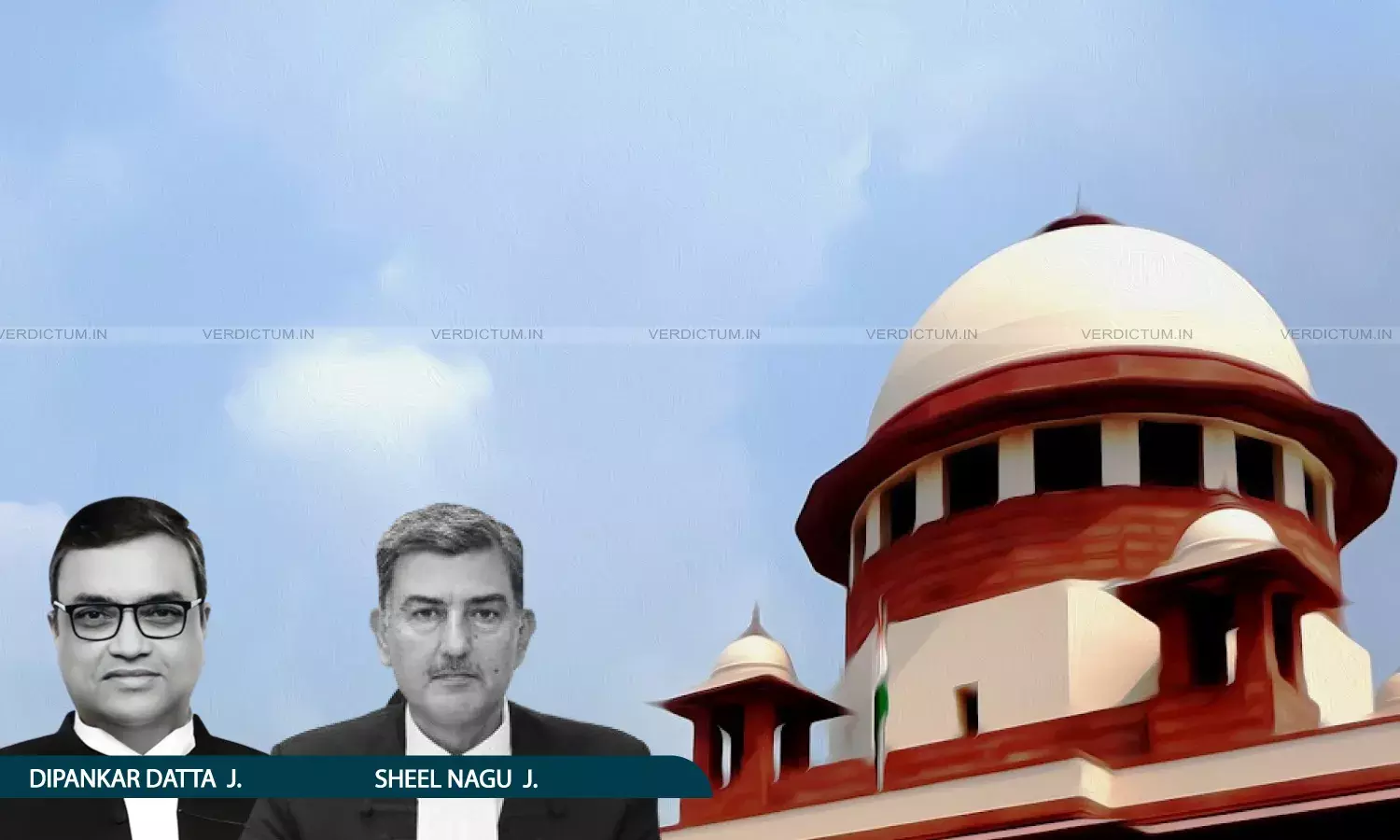
Justice Dipankar Datta, Justice Sheel Nagu, Supreme Court
The Supreme Court has held that the termination of a probationer’s service is stigmatic only if the foundation of the order is a finding of misconduct and that foundation, in substance, visits the probationer with civil consequences likely to affect his prospects of future employment. The Court held that mere use of words such as “unsatisfactory” or “unsuitable” does not amount to stigma, and that a grievance, a complaint or an adverse perception, without more, does not make misconduct the foundation.
Upholding the discharge of an Associate Professor by the Indian Institute of Science (IISc) during probation, the Bench laid down a framework for deciding whether a probationer’s discharge is punitive or simple. The Court asks whether the termination was the outcome of a bona fide assessment of suitability, or a punishment for a specific act visited without the protection of an inquiry. The veil may be lifted only within circumscribed limits, to see whether unsuitability is the real ground or a cloak for punishment, and not to re-appreciate suitability.
A Bench of Justice Dipankar Datta and Justice Sheel Nagu observed, “It cannot be gainsaid that termination of a probationer’s service by ordering his discharge by an ostensibly innocuous/non-stigmatic order, whatever the language used, imports an element of unsuitability either on account of ineptitude or misconduct or moral turpitude or otherwise. However, the implicit unsuitability, even if explicit in the termination order, does not make it stigmatic, thereby converting a simple termination into a punitive order. Mere use of a word like ‘unsatisfactory’ or ‘unsuitable’ does not amount to stigma. The taint of stigma gains traction where the order imputes something over and above mere unsuitability for the job…”.
“…To separate the grain from the chaff, three questions in sequence need to be answered. First, does the order on its face, carry any imputation against the probationer? Second, if the order is innocuous on its face, does the material placed disclose that the foundation thereof is a finding of misconduct and not a mere assessment of suitability? Third, does that foundation, in substance, visit the probationer with civil consequences likely to affect his prospects of future employment? Only if the answers to both the second and third questions are in the affirmative does the taint of stigma gain traction. A grievance, a complaint, or an adverse perception, without more, remains chaff”, the Bench noted further.
Senior Advocate Jayant Bhushan appeared for the appellant, while Senior Advocate S. S. Ramdas appeared for the Institute, and Senior Advocate Shanthkumar Mahale appeared for the respondent no. 3.
“The inquiry, therefore, is not whether the order is innocuous in form but whether, on a fair reading of the record as a whole, the termination was the outcome of a bona fide assessment of suitability, or a punishment for a specific act visited without the protection of an inquiry. If it is the former, the order must stand as termination simpliciter; if the latter, it cannot survive without compliance with due process – where Article 311(2) of the Constitution applies, by an inquiry thereunder, and in other cases, by an inquiry in accordance with the applicable service rules and the principles of natural justice”, the Bench had also noted.
In the present matter, the appellant was appointed Associate Professor at the Institute’s Centre for Earth Sciences on a five-year contract, with the first year on probation, and joined on April 15, 2011. A Committee recommended in 2012 that his probation be extended by a year, which the Institute accepted. A newly constituted Committee recommended on March 26, 2013 that his services be discontinued.
By an office memorandum of April 10, 2013 under Regulation 13.5, which permits termination on notice without assigning reasons during probation, his services ended on May 9, 2013. The Karnataka High Court’s Single Judge dismissed his writ petition on October 22, 2013, and a Division Bench dismissed his writ appeal on November 23, 2013. He approached the Supreme Court in 2016, when his contractual term had practically expired. The Court noted that he could, at best, salvage honour and reputation, so the issue was essentially academic.
The appellant argued that the termination was punitive in substance, driven by the bias of the Chairman of the Centre, and that the extension of probation breached Regulation 13.3. He also challenged Regulation 13.5 as arbitrary.
Reviewing precedents on the subject matter, the Court held that the motive-foundation distinction cannot be applied mechanically. It must turn on whether alleged misconduct was the trigger or the ground of condemnation. It set out three questions: whether the order carries an imputation on its face, whether the foundation is a finding of misconduct, and whether it visits civil consequences. Stigma gains traction only if the second and third are answered affirmatively.
Applying this, the Court found no inquiry into misconduct and no finding of guilt. It held that a probationer cannot demand reasons in every discharge and that Regulation 13.5 was not shown to be arbitrary. It found nothing to show bias or that the decision was founded on a specific charge. The extension of probation, accepted without challenge in court, gave no ground for relief.
Cause Title: Dr. G. Srinivasan v. Union of India & Ors. (Neutral Citation: 2026 INSC 1218)
Appearances:
Appellant: Jayant Bhushan, Sr. Counsel.
Respondent: S. S. Ramdas, Sr. Counsel, Shanthkumar Mahale, Sr. Counsel. Counsel for the Union of India are not recorded in the judgment.