

Breaking|Supreme Court Directs Separate Adjacent Space For Friday Namaz In Bhojshala-Kamal Maula Complex Dispute, Agrees To Hear Appeals Against MP HC Verdict
The Bench ordered the arrangement near the Dhar complex to ensure peaceful Friday prayers without prejudice to either side as it agreed to hear the appeals.

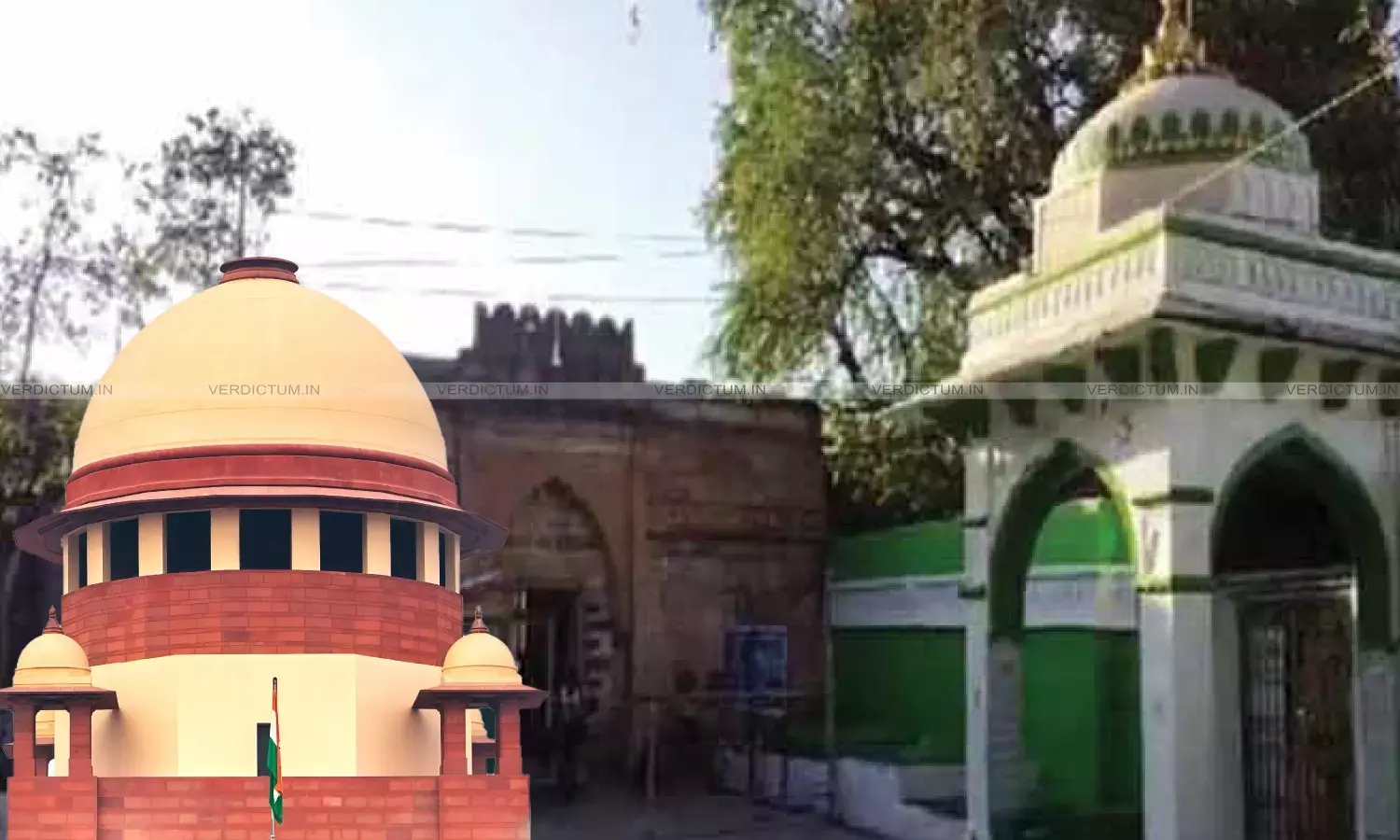
The Supreme Court in the Bhojshala-Kamal Maula complex dispute directed that a separate, adjacent open space be provided to the Muslim community to offer Friday Namaz between 1:00 PM and 3:00 PM.
The ad-hoc interim measure, passed without prejudice to the rights of either side, came after the petitioners challenged a May 15, 2026, Madhya Pradesh High Court judgment that declared the disputed 11th-century monument a Hindu temple and quashed the long-standing 2003 ASI order allowing bi-weekly shared worship.
The Court also ordered that if any structural alterations are carried out by the Archaeological Survey of India (ASI), they shall not be given effect without the explicit leave of the Supreme Court.
Yesterday, the Court agreed to hear plea after Muslim appellants submitted that the pleas needed to be heard on an urgent basis.
The Bench of Chief Justice Surya Kant, Justice Joymalya Bagchi and Justice V Mohana said, "List on so and so date before the bench...Meanwhile, as an interim measure and without prejudice to the rights of both sides, it is directed that a separate open space adjacent /near to the subject premises is to be provided to the Appellants and others of the community for offering namaz on Fridays between 1 to 3 pm...The arrangement shall be ad hoc in nature, subject to the output of the Petition."
Senior Advocates Salman Khurshid, Huzefa Ahmadi, Abhishek Manusinghvi, and Advocate Nizam Pasha appeared for the Petitioners, while Solicitor General Tushar Mehta and Senior Advocate Guru Krishna Kumar appeared for the Respondents.
Senior Advocate Huzefa Ahmadi argued that the High Court had overlooked highly disputed questions of fact and decided the matter without any cross-examination of Archaeological Survey of India (ASI) members. He questioned how the High Court could suddenly nullify a long-standing arrangement where Muslims offered Friday prayer,s and Hindus prayed on Tuesdays. Ahmadi contended that the writ petition itself was entirely non-maintainable and should not have been entertained.
Senior Advocate Singhvi, appearing for Mutawalli, argued that India possessed deep layers of history, but warned that constantly unearthing those layers would lead to an endless cycle. Citing Mahatma Gandhi’s philosophy that "an eye for an eye makes the whole world blind," he explained that this exact rationale drove the enactment of the Places of Worship (Special Provisions) Act, 1991.
He pointed out that the Act’s Statement of Objects and Reasons (SOR) explicitly made a unique, one-time exception for Ayodhya and drew a strict line against any further historical disputes to prevent national chaos.
Addressing the merits of the case, Singhvi contended that the impugned order bypassed the statutory mandate through an erroneous interpretation of the law. He asserted that Section 3 of the 1991 Act imposed a complete bar on changing the religious character of a place of worship.
While the impugned order relied on Section 4(3) to let the ancient monuments system operate, Singhvi argued that this subsection only provided an exception to Sections 4(1) and 4(2), but left the absolute bar under Section 3 entirely untouched.
To establish the historical character of the site, Singhvi presented documentation showing a continuous, uninterrupted 700-year history of daily Namaz. He referenced official survey records from 1907, 1908, and 1927–1928, alongside post-1947 Khasra Khatauni records and an MP Waqf Act notification. Furthermore, he highlighted a 1935 gazette issued by the princely state of Dhar, which explicitly recognized the site's religious usage.
He said, "By the order dated 12th May 1997, they allowed Namaz at fixed times along with Basant Panchami every year. It continued from 12th May 1997. Then, there is the most important order, which I am asking to be replicated today in the interim arrangement until Your Lordships hear this matter. From 7th April 2003, Namaz is allowed on Fridays from 1:00 PM to 3:00 PM. Basant Panchami is celebrated the whole day, and Hindus can use it on Tuesdays from sunrise to sunset. This arrangement has been going on uninterrupted with the deepest humility, from 2003 onwards."
He urged the bench to replicate this exact 2003 formula, which had functioned peacefully and uninterrupted for over two decades.
Finally, Singhvi criticized the procedural history that led to the current dispute. He argued that the impugned order completely ignored a previous ruling by a coordinate bench, which had already deemed a direct recourse to a civil suit impermissible while a related writ appeal remained pending. He also noted that the Mutawalli he represented was denied a full hearing.
Concluding his remarks, Singhvi invoked the constitutional values of secularism and fraternity from the Preamble, arguing that these two principles cross-fertilize one anotherrequireuired the strict enforcement of the 1991 Act's statutory protections.
CJI Kant remarked, "These are very sensitive matters. What is happening in Court No. 1 is very sensitive; it may create unnecessary, wrong impressions or send the wrong messages. We should be extremely careful in using language or sending any messages."
Noting that the issue of the interim arrangement was coming before the bench for the first time, the CJI highlighted the High Court's order and the challenges faced by the State in maintaining law and order. He suggested that the existing arrangement remain in place and stated that the matter could be listed before an appropriate Bench within 10 to 15 days.
Solicitor General Tushar Mehta opposed any immediate relief, pointing out that the petitioners had approached the top court two months after the High Court passed its order on May 15, 2026. He argued that significant developments had occurred in the interim and warned of administrative issues, stating that an interim order could not be granted to virtually restore the previous status quo.
Senior Advocate Meenakshi Arora highlighted a 1995 mutual agreement, known as a Sahmati, under which both communities had agreed to share the site as a place of worship. She noted that both sides had continuously acted upon this understanding for over three decades.
Arora also challenged the maintainability of the case, recalling that a Single Judge of the High Court had previously ruled that a writ petition was not maintainable and that the parties should instead go to a civil court. She emphasized that this earlier order had attained finality after being approved by the Supreme Court. She questioned how a new writ petition could be entertained while a civil suit was already pending.
To conclude her arguments, Arora drew a historical parallel to the Hagia Sophia in Istanbul, noting that a church turned mosque was ultimately preserved without active worship.
While CJI Surya Kant explicitly disagreed with the comparison but declined to comment further at that stage, he concluded by stating that the bench was inclined to grant a full hearing to examine all the raised issues.
Then Singhvi said, "Please just continue the interim arrangement. If there is an interim order or a status continuing under the High Court's earlier order, let that continue...this has been altered only by the impugned order."
The Court said, "Let us not pass any order which creates tension. We can hear day to basis and resolve the issue. ASI orders had created issues at the site."
Then Senior Advocate Huzefa Ahmadi argued that the balance of convenience favored preserving the site's long-standing status quo. He pointed out that the High Court’s own order acknowledged the structure had functioned as a mosque since 1400.
To support this, Ahmadi presented a 1935 Royal Proclamation that guaranteed uninterrupted Namaz and declared that the site would remain a mosque. He further cited official 1951 and 1952 government records confirming its status as a mosque, and highlighted a 1955 decision by the local Collector that officially denied the Hindu Sabha permission to conduct puja at the complex.
The Court reviewed of the High Court's directions, noting that the April 7, 2003 Archaeological Survey of India (ASI) order—which had restricted Hindu worship at Bhojshala—stood quashed. Under the High Court's order, the entire structure was handed over to the Government of India and the ASI for administration, preservation, and the regulation of religious practices, with a strict prohibition on any structural changes unless supervised by the ASI.
The Court then turned the bench's attention to "Direction No. 7," which concerned the allocation of an alternate site.
Justice Bagchi said, "Mr. Salman Khurshid was there last time, and while working out the 2003 ASI direction. The issue that fell for our consideration was Basant Panchami. The Basant Panchami Pooja had been sought to be performed. There is an idol there, and the pooja was going on...Mr. Jain's concern was that there would be devotees, and if namaz was offered simultaneously, those offering namaz will be disturbed. Equally, the devotees would also want to perform their worship in a proper and pious manner. So with the assistance of the state administration, an arrangement was made out that an adjacent area was used for the Friday namaz, at the same time the puja continued."
Senior Advocate Huzefa Ahmadi argued that the balance of convenience favored preserving the long-standing status quo, noting that the 2003 ASI arrangement had functioned peacefully for nearly two decades before the High Court's May 1,5, 2026 order. He proposed that an area be earmarked for Friday Nemphasisingsizing the deep religious significance of the complex's pulpit,ulpit where prayers had been offered since 1935.
Ahmadi criticized the High Court for not staying its own order, which allowed the State and the ASI to immediately exclude Muslims from the property and present them with a *fait accompli*. Rebuffing claims that the petitioners were disruptively changing the status quo, he questioned who had actually disrupted the peace, given that the community had offered prayers at the site since the 1500s.
"Whenever players are offered without the equities being crystallised or any prejudice being caused to contentions of modification in future, that the prayers be offered in a place adjacent to the mosque", Justice Bagchi orally remarked.
On May 15, the Madhya Pradesh High Court ruled that the disputed Bhojshala-Kamal Maula Mosque complex in Dhar district is a temple dedicated to Goddess Saraswati. It simultaneously quashed a decades-old ASI order that had allowed the Muslim community to offer Friday prayers at the site. In May 2022, the High Court had issued notice in the matter.
The High Court had also said that the Centre and the Archaeological Survey of India (ASI) can decide on the Bhojshala complex's administration and management. The Hindu community considers Bhojshala a temple dedicated to Goddess Saraswati, while the Muslim side calls the 11th-century monument the Kamal Maula Mosque. The disputed complex is protected by the ASI. The Muslim side has filed appeals against the high court verdict. The Court quashed the April 7, 2003, Archaeological Survey of India (ASI) order that had restricted Hindu worship to specific days and permitted Friday namaz for the Muslim community.
Previously, the Supreme Court had refused to review the survey report, videography and objections made by the Maulana Kamaluddin Welfare Society in the dispute pertaining to the Bhojshala Temple-Kamal Maula Mosque.
In January 2026, the Supreme Court allowed Hindu prayers from sunrise to sunset on Basant Panchami on Friday at the disputed Bhojshala-Kamal Maula Mosque in Madhya Pradesh's Dhar district, while permitting Muslims to offer namaz from 1 pm to 3 pm on the day.
Cause Title: Jebran Ansari v. Union of India and Ors. [Diary No.- 33643/2026] and Quazi Moinuddin v. Hindu Front of Justice and Ors. [Diary No. -32281/2026]