

Supreme Court Directs NCDRC To Report On Case Pendency, Disposal Rates & Bench Strength; Expresses Concern Over 'Quality Crisis' In District Forums
It directed the President of the NCDRC to submit a report on case pendency, bench strength and average disposal of matters.

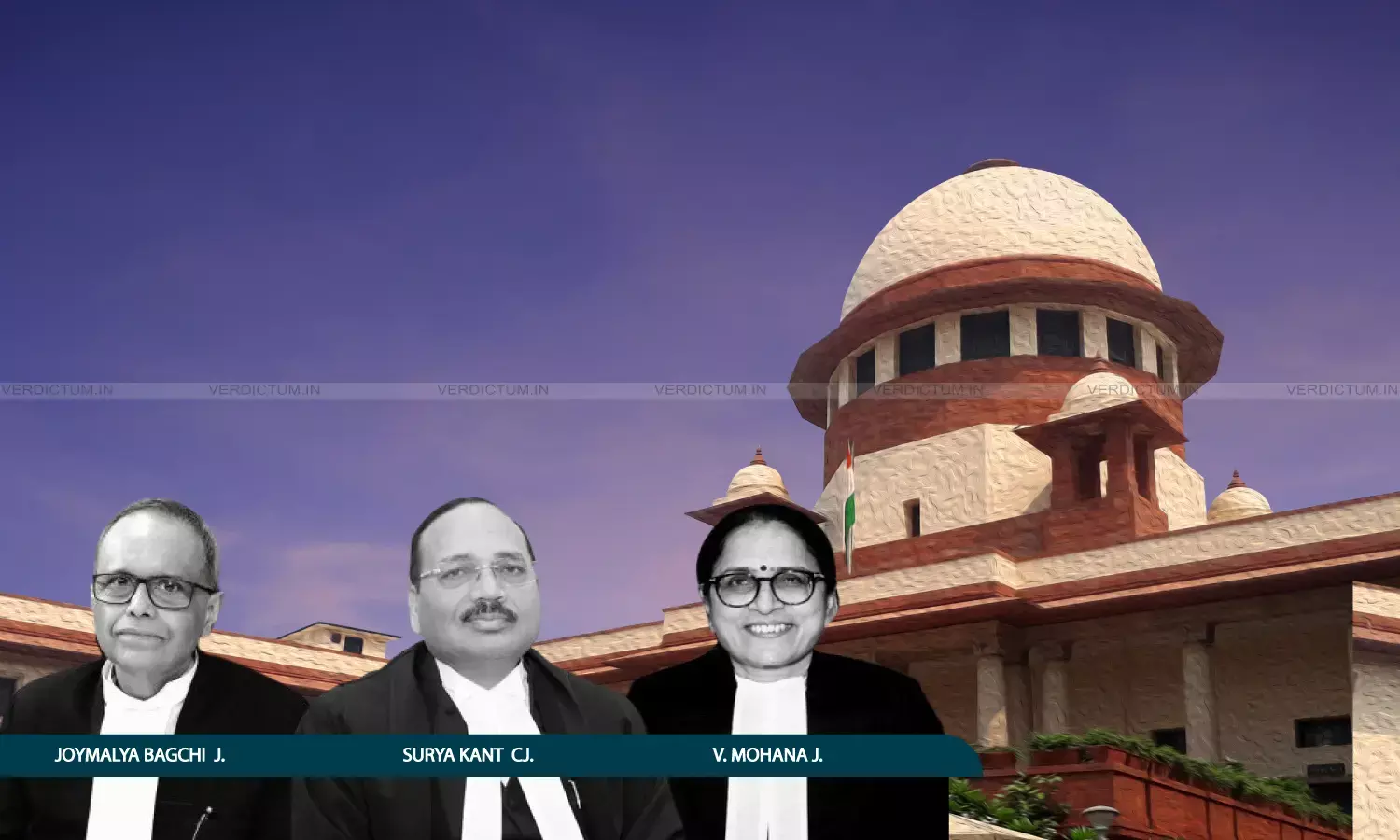
The Supreme Court has directed the President of the National Consumer Disputes Redressal Commission to submit a detailed report on case pendency and bench strength, while highlighting the performance and lack of accountability across consumer forums in the country.
The Court also ordered that the Amicus Curiae will furnish information separately with respect to the pendency of cases before the State Consumer Commissions and the vacancies. It said that the information should also indicate the year-wise pendency, specifically highlighting the oldest pendency.
The Bench of Chief Justice Surya Kant, Justice Joymalya Bagchi and Justice V Mohana ordered, "A news item has been reported in which the following issues have been highlighted with respect to the dismal and poor performance of the consumer commissions, including the National Consumer Commission...The inordinate delay in the disposal of pending matters, especially when hearings are not taking place for years. We request the President of the National Consumer Commission to send a report with respect to: i) The total pendency of cases; ii) The total composition of the commission; iii) Average disposal of matters by different benches; iv) The estimated time likely to be taken in the disposal of pending matters; and v) The need for increasing the strength of the commission. We will appreciate it if the report is sent within two weeks."
Senior Advocate Gopal Sankaranarayanan appeared as Amicus Curiae.
The Court also directed the Presidents of the State Commissions to provide this information to the Amicus. The Departments of Consumer Affairs of the State Governments were also asked to assist the Amicus in the collation of this information.
The Amicus was also asked to contact Mr Anupam Mishra, Joint Secretary in the Department of Consumer Affairs, who was earlier appointed as the nodal officer to assist this Court to get the requisite information.
CJI Kant said, "There is a very disturbing news item in Times of India or somewhere about the poor functioning of the Consumer Commissions. Yes, the matters are of 2019, 2020. It was listed only once in 2022, and till now, mid-2026, not a single date has been given. If this is the performance of the commission, then what kind of special and expert fora have we constituted for consumer redressal?"
Advocate from the Office of Senior Advocate Gopal Sankaranarayanan submitted, "This is exactly why Your Lordships had taken cognizance. There was another matter relating to the vacancies and inadequacy in district commissions and state commissions all across the country. That other matter is also there; that has not been coming up for the last couple of years at least."
CJI Kant said, "Now the vacancy part has been completely forgotten. We are now on the first facility—more and more facilities, but there is no performance."
Advocate pointed out that a related suo motu matter—In Re: Inaction of Central/State Governments in Filling Up Vacancies in Consumer Commissions had not come up for hearing for nearly two years. While earlier directions issued by the apex court had initially spurred significant progress in filling vacancies across district and state commissions, the Amicus submitted that the momentum had plateaued, leaving severe staffing and infrastructural deficits unaddressed.
CJI Kant added, "The moment you start paying per-case disposal, you will see how the disposal will multiply. The moment you keep on adding more and more infrastructure, perks, and facilities, then unfortunately this is the outcome."
The Court observed that if pendencies continue to pile up at the NCDRC, increasing its bench strength and establishing regional circuit benches in high-volume regions could prove necessary.
Furthermore, the Bench questioned whether consumer commissions were turning into "rehabilitation centres" for retired judges operating without institutional accountability, emphasizing that performance evaluation of commission members is imperative.
CJI Kant also remarked, "The problem is, unfortunately, this aspect has not really been dealt with. In the District Consumer Forums, there is a quality crisis. They don't bother about what the nature of the complaint is and how it will be decided on merits...In the State Commissions, our impression is that there are probably not many arrears. But whatever matter is decided ultimately lands up in the National Commission, and this is how the arrears are piled up. The article—because I read it—indicates that after 2019, appeals were only listed once in 2022."
Previously, the Court had directed all state governments to immediately pay the salaries and perquisites of chairpersons and members of state and district consumer redressal bodies as per existing rules.
The Court had also warned that if the Centre failed to take a decision on the amendment, it would consider exercising its powers under Article 142 of the Constitution.
Cause Title: In Re Pay and Allowance of the Members of the U.P. State Consumer Dispute Redressal Commission [Writ Petition(s)(Civil) No(s). 1144/2021]