

No Plea Of Lack Of Funds Shall Be Entertained: Supreme Court Directs Immediate Construction Of Washrooms For Women Lawyers Across All Courts
The Court directed that a proposal shall be put up before the States for the allocation of special funds for the construction of washrooms, where water and sanitation facilities shall also be made available.

The Supreme Court took serious note of the deplorable lack of basic amenities for female legal professionals, issuing a series of stringent, time-bound directives to all States and Union Territories to rectify the infrastructure deficit across High Courts, district courts, and taluka courts.
The Court directed all Advocate Generals to submit a ground-level fact-finding report within two weeks, to be followed by immediate state proposals for special budget allocations.
Fastening absolute responsibility onto the Public Works Departments (PWD) to commence construction within four weeks of the report, the apex court firmly ruled out the defense of financial constraints, explicitly declaring that the non-availability of funds cannot be used as an excuse to violate a fundamental human right guaranteed under Article 21 of the Constitution.
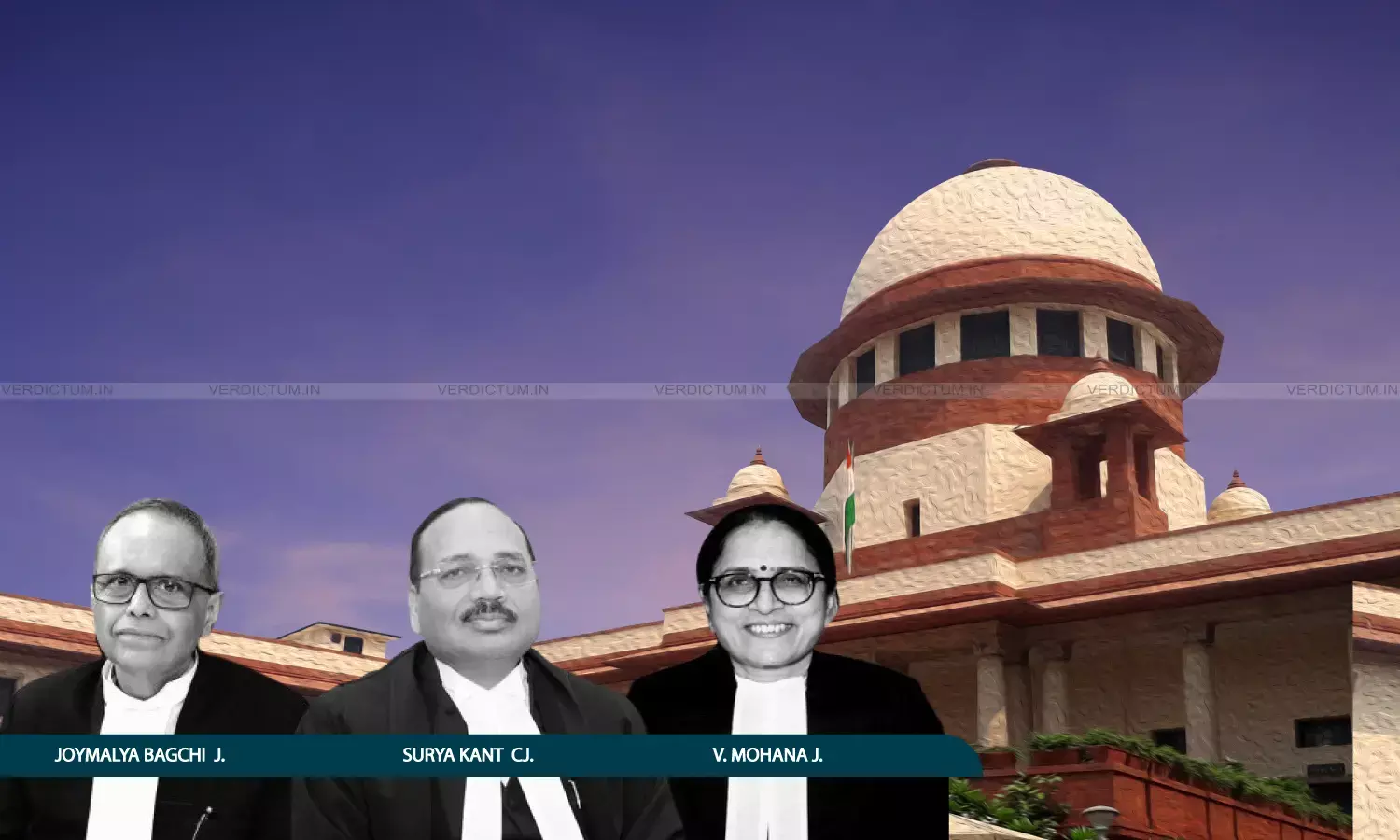
The Bench of Chief Justice Surya Kant, Justice Joymalya Bagchi and Justice V Mohana directed, "Regarding the non-availability of basic amenities, particularly washrooms for lady members of the Bar Associations in high courts, district courts, as well as taluka courts, we have requested all the Advocate Generals to obtain a fact-finding report with respect to such infrastructure. They shall do the needful within two weeks. Thereafter, a proposal shall be put up before the state governments for the allocation of special funds for the construction of washrooms, where water and sanitation facilities shall also be made available. It shall be the responsibility of the PWD departments in all the states to ensure that the construction of washrooms with all facilities shall commence immediately, and within four weeks from the date of submission of the report by the Advocate General to the state government."
"Let us make it clear that the non-availability of funds is no justification for the non-construction of basic amenities, which are applicable under Article 21 of the Constitution. A status report by each state government shall be filed within a period of six weeks. We make it clear that there shall be no leniency in terms of the time schedule prescribed here for the state governments. These washrooms have to be attached to the operating ladies' bar rooms as well, not on the other end of the corridor where antisocial elements keep standing", the Court ordered.
During the proceedings, the Attorney General for India R. Venkataramani, submitted before the Bench that addressing the corpus fund issue required balancing several factors due to varying state dynamics. He informed the Court that he had held preliminary discussions with the Advocate Generals of Telangana and Patna, and proposed to convene a comprehensive meeting of all Advocate Generals to determine a minimum common denominator applicable across states. The Bench stressed that the Union of India must lead by example to encourage liberality among states, emphasizing the pressing need to financially sustain young lawyers during their initial years of practice.
AG Venkataramani submitted, "Since I'm summoned here, I must discharge my responsibility. What I thought was a very huge task as far as the corpus fund issue is concerned, several balancing factors will have to be taken into account. I had a word with the Advocate General from Telangana and from Patna...I thought I'll convene a meeting of all the Advocate Generals and take a feed from all of them. We need to talk to all the Advocate Generals, and maybe all of them will have to be very liberal. Different states may have different stories too."
Chief Justice Kant said, "They won't be liberal only when the Union of India will lead them by example...We must do something for the young lawyers when they really need it."
One Counsel submitted, "...in addition to the funds issue, from Karnataka, we have filed an application for intervention and impleading in several taluk courts on the infrastructure issue. In Karnataka, even women's toilets and washrooms are not there."
Chief Justice said, "Mr. Attorney General, sir, get an immediate report of all the district and taluka courts in Karnataka. Depending upon the urgent requirements, please request the State Government to sanction a special budget allocation of funds, and tell your PWD department to simultaneously start work at all places."
Chief Justice Kant asked, "How are the conditions in Bihar, Mr. Sanjay?"
Counsel for Bihar submitted, "In Bihar, my Lord, the conditions are good. Rather, my Lord, infrastructure—there is a toilet infrastructure getting developed, and in different districts and subordinate courts, it has already been done. And my Lord, it will be containing toilets for male advocates, female advocates, and also physically challenged advocates. So, the things are going on. The day I received the notice, I immediately talked with the chief executive, and then I was intimated that we will be filing..."
Chief Justice said, "Some of the states—I have knowledge of the shady conditions the lady lawyers are working in, and particularly in district courts. I don't want to name them in open court because otherwise it will be as if they are being branded with a negative impression by the court. But what we will do is that we will request all the learned Advocate Generals to please obtain a status report, the factual position at the ground level."
Expressing profound dismay, CJI Kant lamented the shabby and poor conditions under which female legal professionals were forced to work. Justice V Mohana concurrently observed that if the infrastructure inside the judiciary remained so dismal, the conditions in other public sectors could only be imagined as worse.
Addressing the perennially cited issue of financial constraints, the apex court firmly ruled out the defence of a resource crunch. The CJI remarked that the unavailability of funds could not be accepted as an excuse when a fundamental human right was at stake.
The bench suggested that state governments could generate the required revenue through lawful means, such as imposing an extra excise tax on liquor or cigarettes, and assured that the court would legally uphold such measures. In response, AG R Venkataramani proposed convening a meeting with all state Advocate Generals to discuss the financial corpus, while also floating the idea of a social media tax to raise revenue.
Consequently, the Supreme Court laid down a strict, multi-stage timeline for execution. The court directed the AG to convene an immediate meeting with the Advocate Generals and Standing Counsels of all States and Union Territories to deliberate on the funding mechanism.
Furthermore, the court ordered all state Advocate Generals to conduct a rigorous, ground-level fact-finding enquiry into the status of women's washrooms within two weeks and submit formal proposals to their respective state governments.
The bench mandated that the Public Works Department (PWD) of each state assume absolute responsibility for the project, ensuring that the actual construction of washrooms commenced within four weeks of the Advocate General's report.
The apex court concluded its order by warning that no plea regarding a revenue deficit would be entertained, and directed every State and Union Territory to file a comprehensive compliance and status report within six weeks, strictly prohibiting any deviation from the timeline. Additionally, the bench also deliberated upon the creation of a welfare corpus for young lawyers during the proceedings.
Cause Title: Sarika Tyagi v. Union of India & Ors. [W.P.(C) No. 770/2026]