

Convict Found To Be Minor On Date Of Offence Covered Under Juvenile Justice Act Even If Crime Preceded Its Commencement: Supreme Court Sets Aside Life Sentence
The Apex Court held that the finding of juvenility does not erase a conviction recorded on merits, but renders the adult sentence legally ineffective under the Juvenile Justice framework.
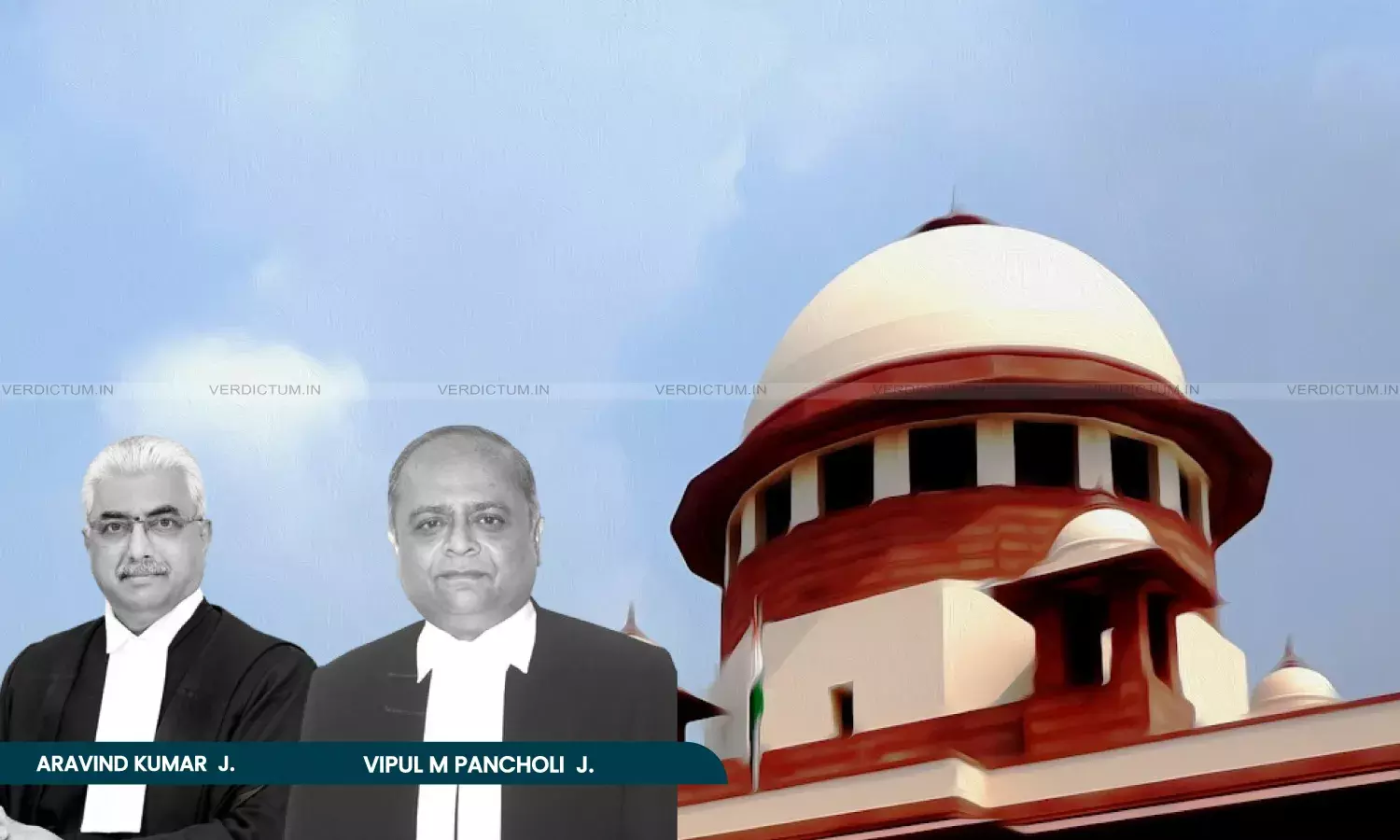
The Supreme Court has held that a person who was below eighteen years of age on the date of an offence committed even before April 1, 2001 is entitled to the benefit of the Juvenile Justice (Care and Protection of Children) Act, 2000.
The Court accordingly affirmed an appellant’s conviction under Sections 302/34 and 392/34 of the IPC, but set aside the life sentence, seven-year rigorous imprisonment, fine and default stipulations imposed on him, after accepting that he was a juvenile on the date of the offence.
The Court was hearing a criminal appeal against a Punjab and Haryana High Court judgment which had affirmed the appellant’s conviction and sentence in a murder and robbery case arising from the hiring of a taxi, the disappearance and death of its driver, and recovery of the vehicle and personal articles.
A Bench of Justice Aravind Kumar and Justice Vipul M. Pancholi observed: “The statutory position is settled by Hari Ram v. State of Rajasthan; Dharambir v. State (NCT of Delhi); and Jitendra Singh @ Babboo Singh v. State of U.P., whereby this Court recognized that a person below eighteen on the date of an offence committed even before 1st April, 2001 receives the benefit of the 2000 Act; This Court further held that a conviction on merits need not be annulled merely because the person was tried by a regular court; and however the adult sentence cannot survive.”
Accepting the declaration of juvenility, the Bench held: “We accordingly accept the declaration of juvenility. The sentence of life imprisonment and the sentence of seven years' rigorous imprisonment, together with the fine and default stipulations imposed by the Trial Court, cannot operate against the appellant.”
Advocate Prabhati Nayak appeared for the appellant.
Background
The prosecution case was that the deceased, a taxi driver, was hired by the appellant and two co-accused for a journey to Sonepat. He did not return. His decomposed body was later recovered from a sugarcane field, and the accused were subsequently apprehended while allegedly attempting to dispose of the taxi.
The Trial Court convicted the accused under Sections 302/34 and 392/34 IPC, relying on circumstantial evidence, including last-seen evidence, recovery of the taxi, and discovery of the deceased’s driving licence and tiffin carrier. The High Court dismissed the appeal and affirmed the conviction and sentence.
During the pendency of the appeal before the Supreme Court, an order of the Juvenile Justice Board declaring the appellant juvenile on the date of offence was placed on record. The Court was therefore required to examine both the conviction on merits and the legal consequence of juvenility.
Court’s Observations
The Supreme Court first considered the conviction on merits and reiterated the governing test for circumstantial evidence.
The Court observed: “A conviction based entirely on circumstantial evidence can be sustained only when each circumstance relied upon is firmly proved; the proved circumstances form a complete chain; and the chain is consistent only with the guilt of the accused and inconsistent with a reasonable hypothesis of innocence.”
On the last-seen circumstance, the Court said it could not ordinarily sustain a murder conviction by itself, but found that it was corroborated in the present case.
The Bench noted: “The circumstance of last seen cannot ordinarily, by itself, sustain a conviction for murder. In the present case, however, it does not stand alone. PW-13 was not a chance witness unfamiliar with the accused. He was the deceased's brother, was present at the taxi stand, knew the three accused and saw deceased Hari Om depart with them in the taxi on the morning of 10th August, 1998.”
The Court treated the recovery of the taxi as the most significant corroborative circumstance. It observed: “The most significant corroborative circumstance is the recovery of the very taxi from the joint possession of the three accused at Taraori on 15th August, 1998 accompanied by its registration and insurance papers, when they were said to be attempting to dispose of it. This was not an innocuous or remote recovery.”
While referring to the accused’s failure to explain possession of the taxi, the Court clarified that Section 313 CrPC or Section 106 of the Evidence Act could not substitute the prosecution’s burden. It stated: “The absence of an explanation under Section 313 Cr.P.C. cannot fill a gap in the prosecution case or relieve the prosecution of its primary burden.”
The Court, however, added that once foundational circumstances were independently proved, the absence of explanation could operate as an additional link: “Once the foundational facts of last seen and recent, unexplained possession of the taxi belonging to deceased were independently proved, and the failure to furnish any plausible account became an additional link and not a substitute for proof.”
On recoveries under Section 27 of the Evidence Act, the Court held that the discoveries of the driving licence and tiffin carrier provided corroboration. It observed: “The admissible circumstance is not the narrative of the crime contained in the police statement, but the fact that information supplied by persons in custody led to the discovery of articles connected specifically with Hari Om at the indicated place.”
The Court also rejected the challenge to identification of the body merely because it was decomposed. The Bench noted: “The decomposition prevented facial recognition, but PW-13 and PW-18 identified the clothes and such remaining features as were available. More importantly, the identity was objectively reinforced by the disappearance of Hari Om with the taxi, the recovery of that taxi from the accused, and the subsequent discovery of his driving licence.”
On medical evidence, the Court accepted that the cause of death could not be precisely ascertained, but held that this did not override the surrounding circumstances. It observed: “That unquestionably limits the medical corroboration available to the prosecution. Yet it is not affirmative evidence that Hari Om died naturally, accidentally, or before he left Bhiwani.”
The Court therefore found no reason to disturb the conviction. It held that the cumulative circumstances established the deceased’s departure with the accused, his disappearance, recovery of the body along the route, recent unexplained possession of the taxi, and discovery of personal articles.
Turning to juvenility, the Court explained the effect of Section 7A of the 2000 Act. It observed: “Section 7A of the Juvenile Justice (Care and Protection of Children) Act, 2000 permits a claim of juvenility to be raised before any court at any stage, even after final disposal. Where the person is found to have been a juvenile on the date of the offence, the court is required to forward the matter for an appropriate order under the Act and the sentence imposed by the regular criminal court is deemed to have no effect.”
The Court then explained the role of Section 20 in pending proceedings before regular courts. It stated: “Section 20 specifically addresses proceedings pending before a regular court. It authorises the court to record or maintain a finding that the juvenile committed the offence, but prohibits an adult sentence and requires the matter to be dealt with under the juvenile justice framework.”
The Bench noted that the Juvenile Justice Board had accepted the appellant’s date of birth and found that he had not completed eighteen years on the date of the offence. It also recorded that he had already undergone detention beyond the maximum period permissible for a juvenile under Section 15(1)(g) of the 2000 Act.
The Court further held that sending the matter back to the Board would serve no purpose. It observed: “Ordinarily, the matter would be forwarded to the Board for the appropriate disposition. That exercise has already been completed: the Board has passed an order, found that the appellant had undergone more than the statutory maximum and directed his release. A fresh remand would be empty formality and contrary to the rehabilitative object of the enactment.”
The Bench also extended the protection of Section 19 of the 2000 Act, holding that the appellant would not suffer any disqualification attached to the conviction.
Conclusion
The Supreme Court partly allowed the appeal. It affirmed the appellant’s conviction under Sections 302/34 and 392/34 IPC, but set aside the adult sentences, fine and default stipulations imposed by the Trial Court and affirmed by the High Court.
The Court accepted the Juvenile Justice Board’s finding that the appellant was a juvenile on the date of the offence. Since he had already undergone detention exceeding the maximum period permissible under the 2000 Act and had been released, the Court directed that he would not be required to surrender and that his bail bonds, if subsisting, would stand discharged.
The Court also directed that the appellant shall not suffer any disqualification attached to the conviction in terms of Section 19 of the 2000 Act, and that the Juvenile Justice Board shall ensure compliance with consequential statutory requirements concerning the records.
Cause Title: Dinesh Kumar v. The State of Haryana (Neutral Citation: 2026 INSC 842)
