

U.P. Panchayat Raj Election Disputes| Party Entitled To Make Claim For Cross-examination Of Witness By Giving Sufficient & Justifiable Reasons: Supreme Court
The appeal before the Supreme Court was filed by the appellant, a returned candidate, in the election to the post of Pradhan of Gram Panchayat.

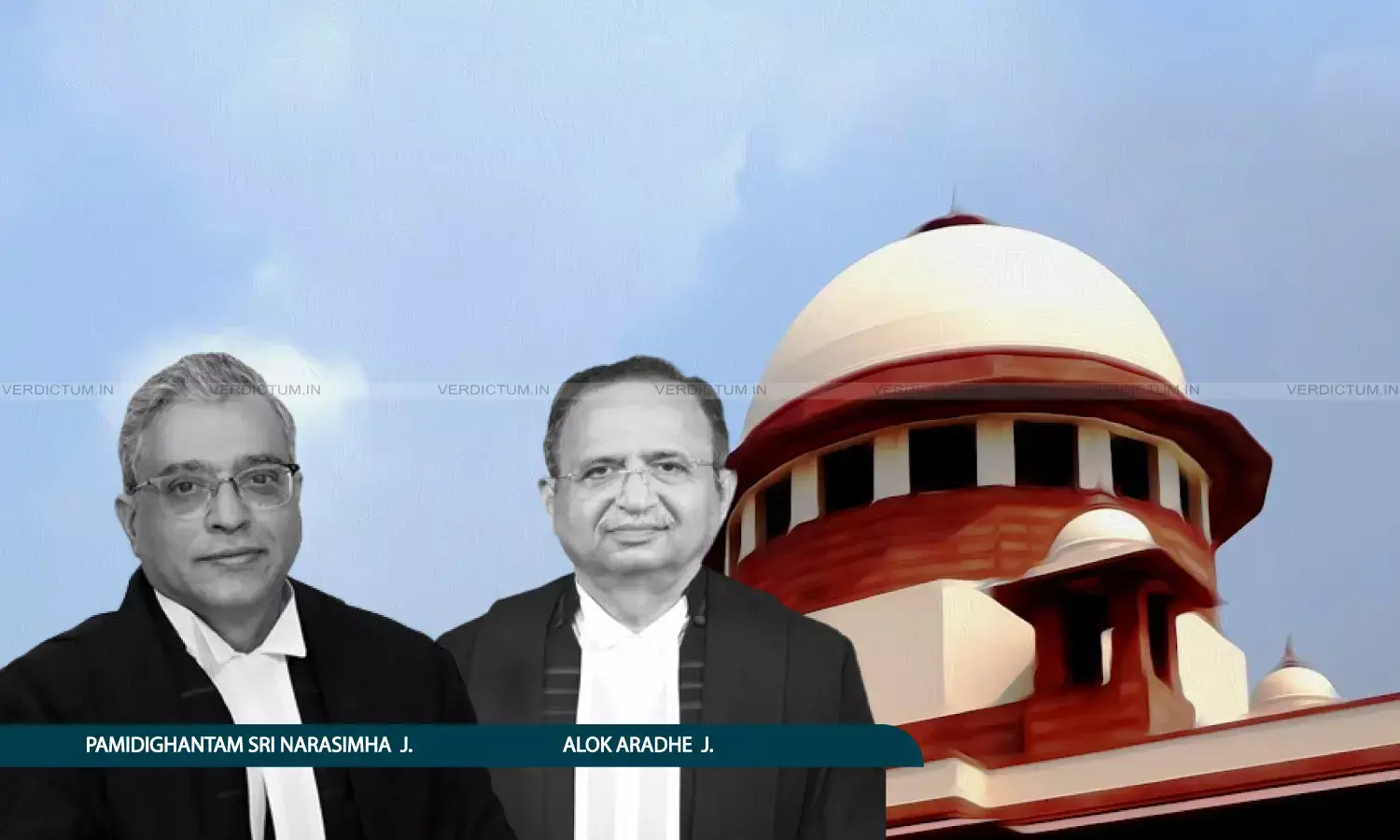
Justice Pamidighantam Sri Narasimha and Justice Alok Aradhe, Supreme Court
The Supreme Court has held that in U.P. Panchayat Raj Election Dispute Matters, a party seeking cross-examination of a witness is entitled to make such a claim by giving sufficient and justifiable reasons for the same.
The appeal before the Apex Court was filed by the appellant, a returned candidate, in the election to the post of Pradhan of Gram Panchayat.
The Division Bench of Justice Pamidighantam Sri Narasimha and Justice Alok Aradhe held, “In conclusion, we hold that a party seeking cross-examination of a witness is entitled to make such a claim by giving sufficient and justifiable reasons for the same. Under Rule 4, the Sub-Divisional Officer, acting as Election Tribunal, is empowered to consider the request and on being satisfied may permit cross-examination. In the present case, the appellant has not given any reason to justify cross-examination of the witnesses. The Divisional Officer, acting as Election Tribunal, has rightly denied cross-examination. The conclusions of the Election Tribunal as also of the High Court warrant no interference.”
Senior Advocate S.R. Singh represented the Appellant, while Advocate Ghanshyam Singh represented the Respondent.
Factual Background
Elections to the office of Pradhan, Gram Panchayat Parwa, were notified by the State Election Commission on March 26, 2021. Pursuant thereto, the elections were conducted on April 26, 2021, with eight candidates, including the appellant and first respondent, contesting for the said post. Upon counting the votes, it was found that the appellant had secured 286 votes, whereas the first respondent had secured 285 votes. The Appellant was declared elected on April 3, 2021, and a certificate was issued in his favour by the competent authority. Aggrieved by the declaration of appellant as returned candidate, the first respondent instituted an Election Petition under Section 12-C of the U.P. Panchayat Raj Act, 1947, before the Prescribed Authority/Sub-Divisional Officer, Sadar, Mirzapur.
The appellant entered the contest in the said proceedings by filing his written statement and disputing the assertions made in the election petition. The controversy proceeded to trial before the Election Tribunal. The appellant moved an application seeking permission to cross-examine the aforesaid witnesses, asserting that such cross-examination was necessary to test the veracity and credibility of their statements and to enable an effective adjudication of the election dispute. The Election Tribunal rejected the appellant’s application for cross-examination. The appellant’s writ petition was approached by the Allahabad High Court by filing a writ petition, which came to be dismissed. The High Court held that, in view of proviso (ii) and (iv) of Rule 4 of the U.P. Panchayat Raj (Settlement of Election Disputes) Rules, 1994, the Election Tribunal was not bound to permit cross-examination.
Reasoning
The Bench noted that Rule 4(1) expressly postulates that an election petition “shall be tried… as nearly as may be, in accordance with the procedure applicable under the Code of Civil Procedure, 1908”. “The proviso, no doubt, relaxes certain procedural rigours by permitting the Tribunal not to record evidence in full and to confine itself to such material as it deems relevant. However, the expression “as nearly as may be” is indicative of a legislative intent to preserve the essential features of a trial, while allowing flexibility in matters of form and procedure. The proviso cannot, therefore, be read in a manner that obliterates substantive safeguards inherent in a fair trial ”, it added.
The Bench noted that the High Court had proceeded on the premise that clauses (ii) and (iv) of the proviso constitute a “complete code” governing evidentiary procedure before the Election Tribunal, thereby excluding the application of the provisions of the Code of Civil Procedure relating to cross-examination. As per the Bench, an interpretation, was unduly restrictive and overlooked the distinction between procedural flexibility and denial of a substantive right, apart from the crucial distinction between ‘statement of a witness’ and ‘evidence’.
The Bench referred to the judgment in Muddasani Venkata Narsaiah v. Muddasani Sarojana (2016), the Bench underscored that cross-examination is “a matter of substance and not of procedure”, and that failure to cross-examine a witness ordinarily leads to an acceptance of the truth of his testimony. “It is equally well settled that the requirement of cross-examination is not inflexible and must be assessed in the context of the nature of the dispute”, it added.
As per the procedure for the purpose of determining election-related disputes under Rules, 1994, Rule 4 modifies the requirement of recording evidence. The Bench noted there is a discretion vested in the Sub Divisional Officer acting as Election Tribunal to consider whether cross-examination is necessary or not.
Dealing with the facts of the case, the Bench stated, “The High Court affirmed the decision of the Election Tribunal and dismissed the writ petition. However, High Court also made an observation that proviso (ii) and (iv) of Rule 4 of Rules, 1994 form a complete code in themselves as far as recording of evidence is concerned, and therefore provisions for cross-examination in Code of Civil Procedure, or Evidence Act, 1882 has no applicability. By this observation, the High Court seems to suggest that there is no right of cross-examination at all. We are not in agreement with this observation, as such a conclusion is contrary to a plain reading of Rule 4.”
The Bench agreed with the conclusion reached by the Election Tribunal, as affirmed by the High Court, declining the appellant’s request for cross-examination, since the application filed by the appellant failed to disclose any grounds necessitating such cross-examination. Thus, holding that the Sub Divisional Officer, acting as Election Tribunal, had rightly denied cross examination, the Bench dismissed the civil appeal.
Cause Title: Dinesh Kumar v. Surta Nath @ Surat Nath & Ors. (Neutral Citation: 2026 INSC 485)
Appearance
Appellant: Senior Advocate S.R. Singh, Advocates Sushant Kumar Yadav, Mangal Prasad, Prateek Yadav, Anurag Singh, Rana Yashvir Singh Chauhan, Prithvi Yadav, Radha Rajput, Anusha Yadav, AOR Ankur Yadav
Respondent: Advocate Ghanshyam Singh, AOR Rajnish Kumar Jha