

Accused’s Guilt Can’t Be Presumed Merely Because Complaint Of Collusion Was Raised Against Investigating Officer: Supreme Court
The Supreme Court was considering an appeal filed by 5 convicts in a case of murder which allegedly occurred in broad daylight.

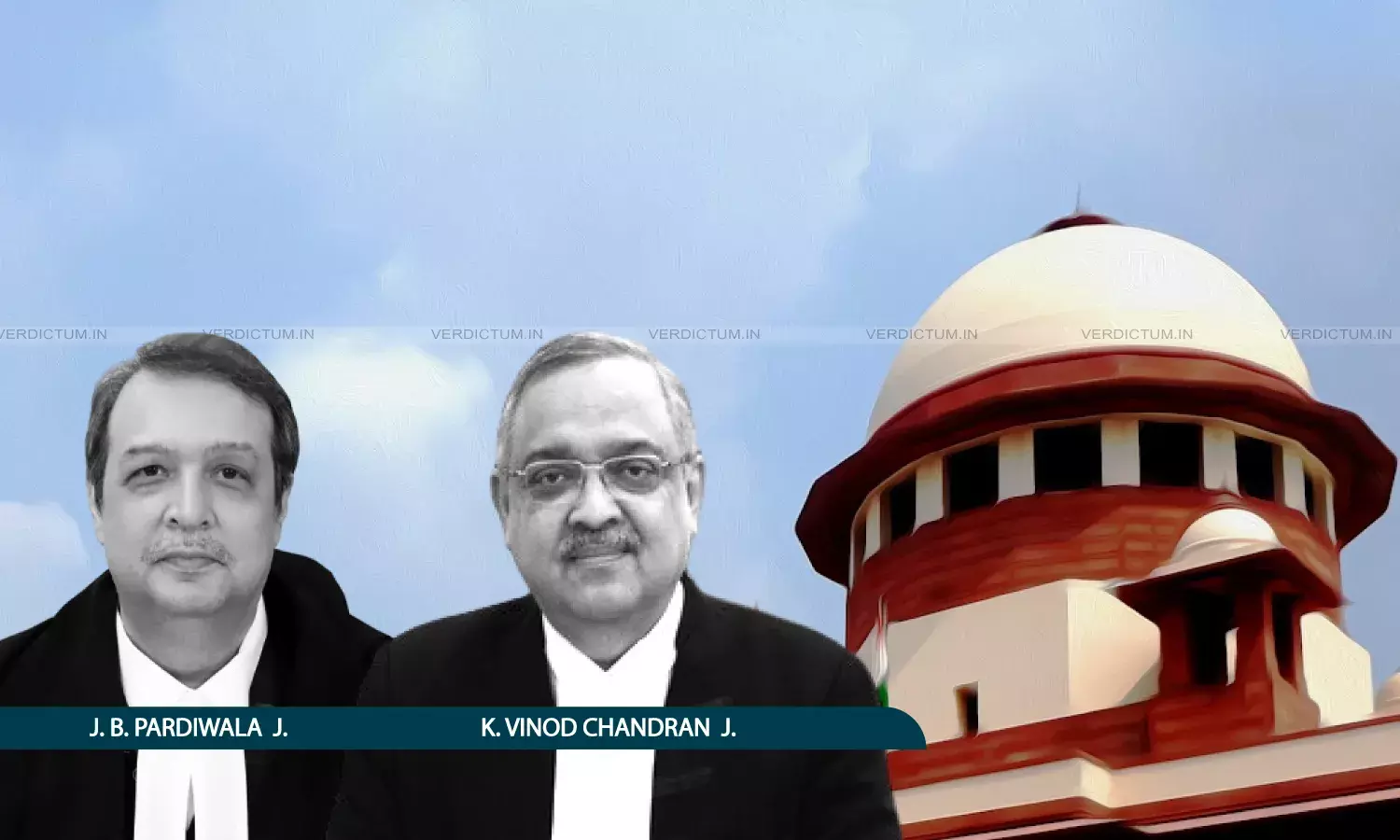
Justice J. B. Pardiwala, Justice K. Vinod Chandran, Supreme Court
While granting acquittal to 5 murder convicts, the Supreme Court has held that a faulty investigation cannot inure to the benefit of the accused but when there is no reliable evidence, merely because the Investigating Officer (IO) was recalcitrant or a complaint of collusion was raised against him, the Court cannot presume the guilt of the accused.
The Apex Court was considering an appeal in a case of murder which occurred in broad daylight presumably on an election day leading to the conviction of six accused. Five of them had appraoched the Court since the first accused had served his term and was released on remission.
The Division Bench of Justice J.B. Pardiwala and Justice K. Vinod Chandran held, “The case is not of a faulty investigation but of no investigation having been carried out. Even the inquest was carried out before the FIS was recorded; making it pre-meditated. The High Court egregiously erred in looking at a complaint against the I.O not produced in the trial, to find the evidence led to be clinching insofar as the culpability of the accused. A faulty investigation cannot inure to the benefit of the accused, but when there is no reliable evidence, merely because the I.O was recalcitrant or a complaint of collusion was raised against him, the Court cannot presume the guilt of the accused. There is complete lack of evidence in the present case and the testimonies, as we observed, do not inspire confidence.”
Senior Advocate Rajiv Nanda represented the Appellant while AOR Manish Kumar represented the Respondent.
Factual Background
The deceased, along with four others- a son, an employee, a nephew and a villager was proceeding to his fields, when the accused allegedly ambushed the party, started indiscriminate firing with exhortation made to kill all and the deceased was shot in the back. The victim succumbed to the gunshot injury, and the persons who accompanied him started running away. A patrol car came with a Magistrate, which was presumed to be roaming around on the election day, when the accused too ran away. The victim was taken to the hospital, where he was declared dead. The prosecution went to trial with nine witnesses. The accused were convicted under Sections 302 and 307 read with Section 149 of the Indian Penal Code, 1860 (IPC). A1, A4 and A6 were also convicted under Section 148 of the IPC and Section 27 of the Arms Act, while A2, A3 and A5 were convicted under Section 147 of the IPC.
Reasoning
On a perusal of the facts of the case, the Bench noted that no cartridges were recovered from the spot and none from the patrol party was examined. It was noticed that though there was blood-stained earth collected from the scene of occurrence, it was not sent for chemical analysis.
“The prosecution story thus is incomplete and there is suspicion as to the scene of occurrence. But for the testimonies there is no tell-tale evidence collected from the scene to establish the ambush, firing and the murder itself. The eyewitnesses were all close to the deceased, who, as we will presently see had an axe to grind against the accused”, it stated while also adding, “Though related witnesses cannot be always categorised as interested witnesses, here coupled with the fact that the I.O, PW9 admits that the inquest was carried out first and then the First Information Statement (FIS) obtained, the entire narration becomes suspect. This creates a doubt about the scene of occurrence, which the eyewitnesses had not identified clearly in their prior statements.”
Dealing with the aspect of motive, the Bench noted that the prosecution alleged that a girl from the village of the accused was kidnapped by a boy from the village of the deceased. The girl was said to be the sister of the third accused appellant. The past Mukhiya of the village from where the girl was kidnapped, the father of the first appellant, along with the other accused, had approached the deceased to help them to trace the girl and boy. It was alleged that the ex-Mukhiya was angered by the refusal of the deceased to help him. One other motive alleged was that the nephew of the deceased had stood against the ex-Mukhiya in the elections.
The Bench found nothing to prove the kidnapping of the girl as the witnesses alleged nor anything to indicate a political rivalry between the deceased and the first accused’s father. “More importantly though the motive is alleged on A1’s father, he has not been arrayed as an accused in the case. The motive also does not inspire confidence so as to convict the accused for murder”, it added.
The Bench further took note of the fact that the I.O’s testimony was contrary to what the Government Advocate argued, of the victims having gone on a ridge. As per the Bench, the High Court peremptorily came to the finding that the accused, armed with a variety of weapons, ambushed the victim and fired indiscriminately, causing the death of one person, thus proving the common intention/object to commit murder of the deceased, based only on the eye-witness testimony.
The Bench found that the eyewitnesses were all related witnesses and their presence could have been established by their clothes, which would have been blood- stained if they carried the victim in the patrol car to the hospital. “Their presence is doubtful and they had a running dispute with the accused, coupled with the non-examination of independent witnesses puts the prosecution case under a cloud and makes it highly doubtful”, it stated.
Holding that the prosecution could not establish the culpability of the accused beyond reasonable doubt, the Apex Court allowed the appeals and acquitted the convicts.
Cause Title: Dhrub Singh Etc. v. The State of Bihar (Neutral Citation: 2026 INSC 935)
Appearance
Appellant: Senior Advocates Rajiv Nanda, Siddharth Dave, AOR Pankaj Kumar Mishra, AOR Adarsh Kumar Tiwari, Advocates Jemtiben AO, Arundhuti Mukherjee, Vartika Maurya, Akanksha Raj Mishra, Amritesh Anand, Vinit Pathak,Sagar Khaushik, Rajeev Kumar Dubey,Anand Mishra
Respondent: AOR Manish Kumar, Advocates Divyansh Mishra, Kumar Saurav