

FIR Was A “Post-Investigation Document”: Supreme Court Acquits 3 Accused In 1977 Murder Case
The Bench said that delay in dispatching FIR to magistrate, though not fatal by itself, assumes significance when coupled with other suspicious circumstances.

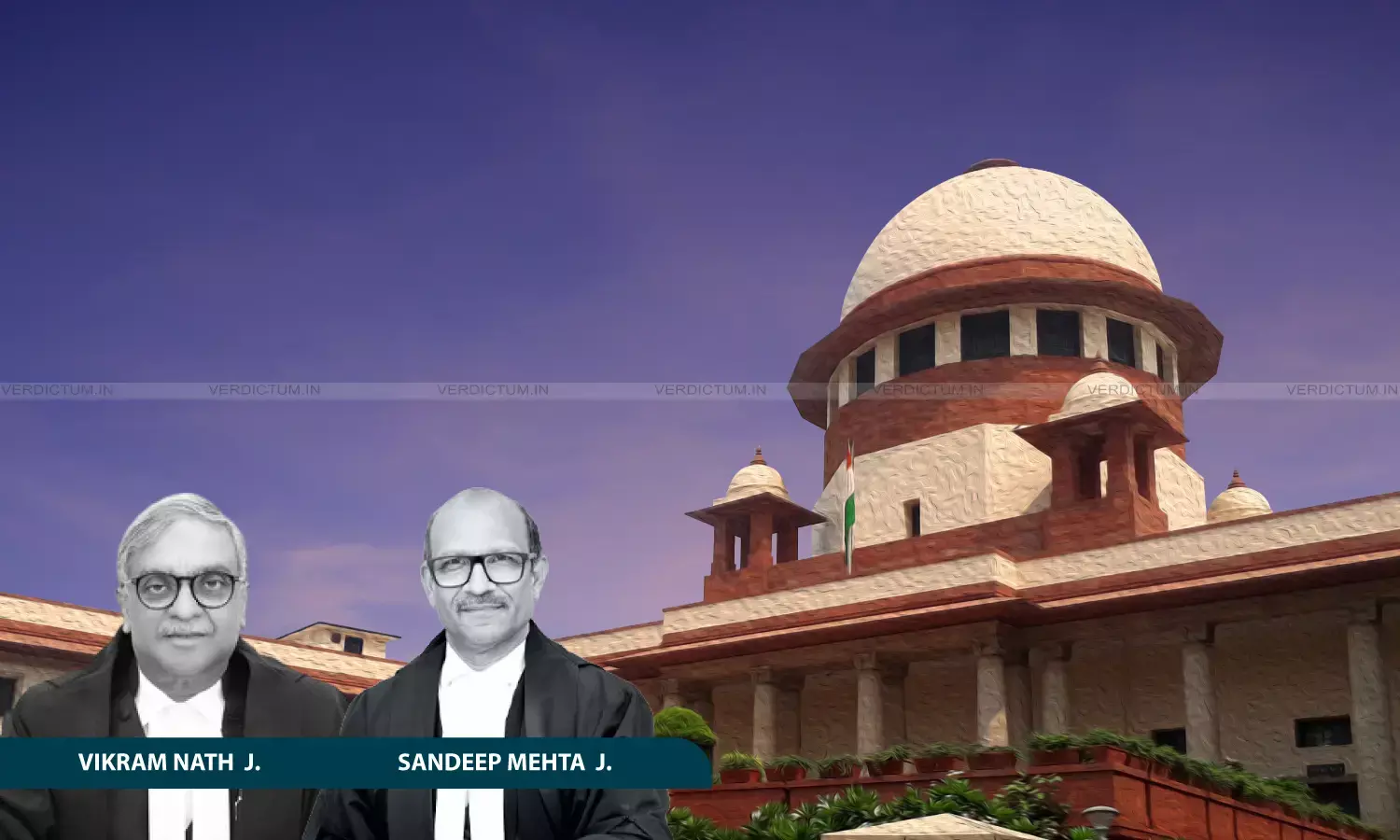
Justice Vikram Nath, Justice Sandeep Mehta, Supreme Court
The Supreme Court has acquitted three persons convicted of murder nearly forty-five years ago, holding that the First Information Report in the case was, in fact, a post-investigation document prepared after the incident had already been probed, rather than a spontaneous complaint recorded at the time alleged by the prosecution.
The Court reiterated that mere delay in transmitting an FIR to the jurisdictional Magistrate does not, by itself, vitiate a prosecution case. However, where such delay is accompanied by other circumstances suggestive of fabrication, ante-timing or deliberation, it ceases to be a procedural irregularity and becomes a substantive factor casting doubt on the genesis of the prosecution story.
The Bench was hearing a batch of criminal appeals arising from a 1981 judgment of the III Additional Sessions Judge, Gonda, and a 2011 judgment of the Allahabad High Court, Lucknow Bench, affirming the conviction.
A Bench comprising Justice Vikram Nath and Justice Sandeep Mehta observed, “…The facts taken together convince us that the FIR (Exhibit Ka-14) is a post investigation document. These circumstances are, by themselves, sufficiently clinching to establish that the prosecution version of the occurrence having taken place on 28th June, 1977 was a subsequent fabrication devised to lend credibility to the prosecution case and to support the cooked-up story that Raghav Ram (PW-1), Ram Nath (PW-2) and Nand Lal Singh (PW-4) had actually witnessed the incident”.
“…Mere delay in forwarding the FIR to the Magistrate cannot, by itself, be treated as fatal to the prosecution case nor can such delay, in isolation, be made the sole basis for discarding an otherwise credible prosecution version. However, where allegations of ante-timing, ante-dating and fabrication are not merely speculative but find substantive support from attendant circumstances appearing on the record, and are coupled with surrounding facts generating genuine suspicion regarding the fairness and integrity of the investigation, such delay acquires considerable significance…”, the Bench further noted.
Senior Advocate M C Dhingra appeared for the appellant and Namit Saxena, AOR appeared for the respondent.
According to the prosecution, the deceased was way-laid and assaulted by six persons armed with "kanta", "ballam" and "lathi" on the evening of June 28, 1977, while returning home with the complainant and other witnesses.
The trial court convicted the accused persons under Sections 147/148 and 302 read with 149 IPC, sentencing them to life imprisonment, and the High Court dismissed their appeal. Two of the appellants died during the pendency of proceedings before the High Court and this Court, and their appeals stood abated.
Examining the record, the Court noted that the dead body had remained unattended at the spot throughout the intervening night despite the police station being barely 3½ miles away; the inquest was completed only the next morning; and the post-mortem was conducted nearly 48 hours after the alleged occurrence, without explanation.
“…The delay in conducting the inquest proceedings, the unexplained delay in undertaking the post-mortem examination, the material contradictions regarding the circumstances in which the FIR came to be lodged, and, most importantly, the fact that the chik FIR, though purportedly registered on 28th June, 1977, reached the Court of the jurisdictional Magistrate only on 30th June, 1977, collectively cast a serious cloud of doubt over the prosecution narrative…”, the Bench said.
“No other reliable evidence has been brought on record to bring home the charges against the accused-appellants. Having regard to the cumulative effect of the discussion made above, we are persuaded to hold that the prosecution has failed to establish beyond reasonable doubt that the and connected matters occurrence took place in the afternoon of 28th June, 1977 or in the manner alleged by the so-called eyewitnesses. Consequently, their presence at the crime scene becomes not merely doubtful but highly improbable, and the prosecution case cannot be sustained on such uncertain and unreliable evidence”, the Bench further said.
Setting aside the conviction, the Court acquitted the surviving appellants, Hira Lal, Raj Bux and Subedar, of all charges, discharging their bail bonds. The plea of juvenility raised on behalf of one appellant was left unexamined in view of the acquittal on merits.
“Once a reasonable doubt arises regarding the presence of the alleged eye-witnesses and the truthfulness of the prosecution version regarding the genesis and timing of the occurrence, the very substratum of the prosecution case stands eroded. The entire edifice of the prosecution story, being founded upon the testimony of these witnesses, stands breached and cannot be sustained. The trial Court as well as the High Court fell in error in overlooking these vital infirmities and in relying upon the highly doubtful testimony of the so-called eyewitnesses to affirm the guilt of the accusedappellants…”, the Bench noted.
Cause Title: Deo Prasad And Anr. v. State Of Uttar Pradesh (Neutral Citation: 2026 INSC 707)
Appearances:
Appellants: Jabar Singh, Parmod Kumar, Shubham, M/S. V. Maheshwari & Co., AOR, Sharmila Upadhyay, AOR, M C Dhingra, Sr. Adv., Gaurav Dhingra, AOR, Shashank Singh, Randhir Kumar Ojha, AOR, Advocates.
Respondent: Namit Saxena, AOR.