

Employee Who Accepted Consequences Of Resignation Cannot Later Challenge Technical Defect In Its Acceptance: Supreme Court
The Apex Court also held that ratification by the competent authority cures a defect of authority retrospectively, while a resignation accepted under a governing statute need not remain open for withdrawal merely because communication or relieving follows later.
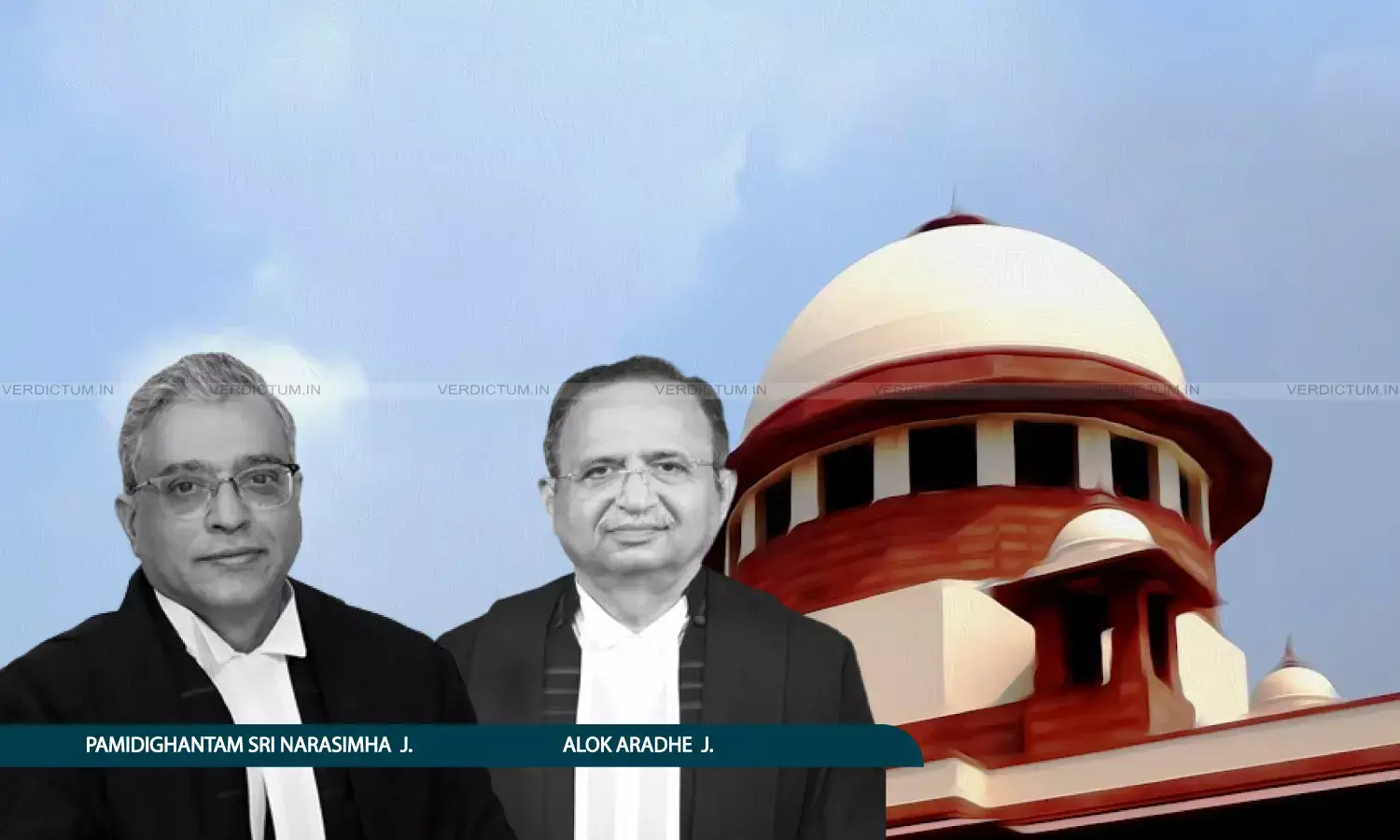
Justice Pamidighantam Sri Narasimha and Justice Alok Aradhe, Supreme Court
The Supreme Court has held that an employee who has acted upon his resignation, accepted the benefits flowing from it, and used the consequential service certificate to secure another appointment cannot later challenge the resignation on a technical defect in the mode of its acceptance.
A Bench of Justice Pamidighantam Sri Narasimha and Justice Alok Aradhe, while observing that “an employee who has acted upon, and accepted the consequences of his own resignation cannot later found a challenge on a technical infirmity in the mode of its acceptance”, allowed Delhi Technological University’s appeal and set aside the direction for reinstatement.
Advocate Avnish Ahlawat appeared for Delhi Technological University, while the employee appeared in person.
Background
The Court was hearing connected proceedings arising from two High Court judgments concerning the same employee’s resignation from two institutions, Delhi Technological University and National Institute of Technology, Calicut. The common questions concerned the right of an employee to withdraw a resignation and the effect of ratification by the competent authority where the first acceptance was by an officer not competent to accept it.
In the DTU matter, the employee had resigned and later sought waiver of notice period, requesting that his resignation be accepted with effect from an advanced date. The acting Vice-Chancellor accepted the resignation, and the employee was relieved. He accepted his no-dues certificate, last pay certificate and experience certificate. Nearly four months later, he sought to withdraw the resignation, arguing that it had not been accepted by the Board of Management, which was the competent authority. The Board later ratified the acceptance.
The Delhi High Court directed reinstatement, though the Division Bench denied back wages because the employee had taken gainful employment in the meantime. DTU challenged the reinstatement before the Supreme Court, while the employee challenged denial of back wages.
The connected NIT Calicut matter arose after the employee joined as Deputy Registrar, submitted a resignation, and then sought to withdraw it after selection on deputation with another public body. The Kerala High Court Division Bench had upheld the rejection of his withdrawal request and denied reinstatement.
Court’s Observations
The Court agreed that under Section 23(2)(ix) of the Delhi Technological University Act, 2009, the Board of Management was the competent authority to accept resignation from administrative posts. The acting Vice-Chancellor, holding only additional charge, did not have validly delegated power to accept the resignation.
However, the Court held that the High Court failed to properly consider the legal effect of subsequent ratification by the Board.
The Bench stated: “Ratification, in its ordinary legal signification, denotes the confirmation or adoption, by a person or body possessing the requisite authority, of an act earlier done on its behalf without such authority, or done irregularly, so that the act is treated as valid from its inception. Black’s Law Dictionary describes ratification as ‘the confirmation of a previous act done either by the party himself or by another’. The doctrine finds its origin in the maxim ratihabitio mandato aequiparatur, a subsequent ratification is equivalent to a prior command, refined further by the maxim omnis ratihabitio retrotrahitur et mandato priori aequiparatur, which imports the principle of relation-back: a ratified act is deemed valid from the date of the original, unauthorised act, and not merely from the date of ratification.”
Summarising the doctrine, the Court held that ratification makes a previously invalid act valid, operates retrospectively, and can be done only by the authority legally empowered to perform the act. It clarified that express approval by resolution or decision is sufficient and that a fresh order is not necessary.
The Court then held that even where resignation is initially accepted by an officer without authority, it may become a completed and irrevocable transaction if both sides treat it as final and alter their positions accordingly.
The Bench observed: “A resignation, even where accepted in the first instance by one not clothed with authority to accept it, may nonetheless become a consummated and irrevocable transaction where both sides have, by their conduct, treated it as final and altered their positions upon that footing. In such a case, an employee is precluded, not by any doctrine of curative ratification, but by the ordinary principle against approbation and reprobation, from later impugning the very transaction he brought about and from which he has already taken the entire benefit.”
Applying this to the facts, the Court found that the employee had himself requested waiver of notice period and acceptance of resignation from an earlier date. DTU acted on that request, relieved him, and issued the relevant certificates, which he accepted.
The Court stated: “Tested on the touch stone of this principle, the fault in this matter lies squarely at the respondent’s own door, and not merely in the accepting officer’s want of authority. It was the respondent who initiated the process by tendering resignation and then went further, of his own volition, to request waiver of the notice period and acceptance with effect from an advanced date 31.05.2016 rather than the original date of 31.08.2016, he himself had proposed.”
The Bench added that the defect in acceptance was part of the University’s internal administration and was raised only months later.
It noted: “The fact that the officer who signed the acceptance held only additional charge, and was not the BOM, is a defect in the University’s internal administration of which the respondent was not even aware, and did not complain of, until 22.09.2016, nearly four months later. The resignation thus stood consummated by the conduct of the parties, and in particular by the respondent’s own conduct.”
The Court also took note that the employee later joined NIT Calicut on the strength of the experience certificate issued by DTU.
The Court held that once the Board ratified the acceptance, the ratification related back to the original acceptance date. Therefore, there was no subsisting resignation left for withdrawal when the employee wrote to DTU nearly four months later.
The Bench held: “The respondent’s letter of withdrawal dated 22.09.2016, addressed nearly four months after he had already ceased to be in service and had accepted all consequential benefits flowing therefrom, cannot be equated with the withdrawal of a resignation yet to take legal effect. Once ratified, the acceptance related back to 25.05.2016, the date his resignation accepted by the In-charge Vice-Chancellor, there was, in point of law, no resignation left in existence which he could have withdrawn on 22.09.2016.”
Accordingly, the Court held that the Delhi High Court’s direction for reinstatement could not be sustained.
In the connected NIT Calicut matter, the Court examined Statute 30 of the NIT First Statutes, 2009, and held that resignation became effective on acceptance by the appointing authority. Communication of acceptance or completion of notice period was not a condition for legal efficacy.
The Court observed: “The proviso to Statute 30 of the NIT First Statutes, 2009, is explicit that resignation ‘shall take effect only on the date on which the resignation is accepted by the appointing authority’. It imposes neither any requirement of communication as a condition of efficacy, nor does it make effectiveness of acceptance of resignation contingent upon expiry of the notice period.”
The Bench held that the notice period only regulated the actual relieving date and did not keep the acceptance in abeyance.
The Court also upheld NIT Calicut’s refusal to permit withdrawal of resignation, noting that the employee had recorded that he was not interested in continuing at the Institute and sought withdrawal only after selection elsewhere.
The Bench stated: “On this material, the competent authority’s conclusion, recorded in order dated 07.01.2019, that the respondent had no genuine intention of continuing in service and that the request for withdrawal was opportunistic, was a plausible and rational view. It is not for a court, exercising jurisdiction under Article 226 of the Constitution, to substitute its own view of the sufficiency of such reasons for that of the competent authority, in the absence mala fides, perversity, or a demonstrated violation of law.”
The Court further held that the general right to withdraw a prospective resignation yields where special statutory or regulatory provisions govern the field.
Conclusion
The Supreme Court allowed DTU’s appeal, set aside the Delhi High Court judgment insofar as it directed reinstatement, and dismissed the employee’s writ petition. It also dismissed the employee’s appeal seeking back wages against DTU.
In the connected NIT Calicut matter, the Court dismissed the employee’s challenge and upheld the Kerala High Court Division Bench’s decision refusing reinstatement. No order as to costs was passed.
Cause Title: Delhi Technological University v. B.S. Rawat (Neutral Citation: 2026 INSC 797)
