

Power Generating Utility Cannot Recover Depreciation From Consumers Beyond Approved PPA Period: Supreme Court
The Court held that Regulation 6.32 of the DERC (Terms and Conditions for Determination of Generation Tariff) Regulations, 2011 does not confer an absolute right upon a generating utility to recover depreciation from consumers even after the generating asset ceases to supply electricity under the approved Power Purchase Agreement framework.
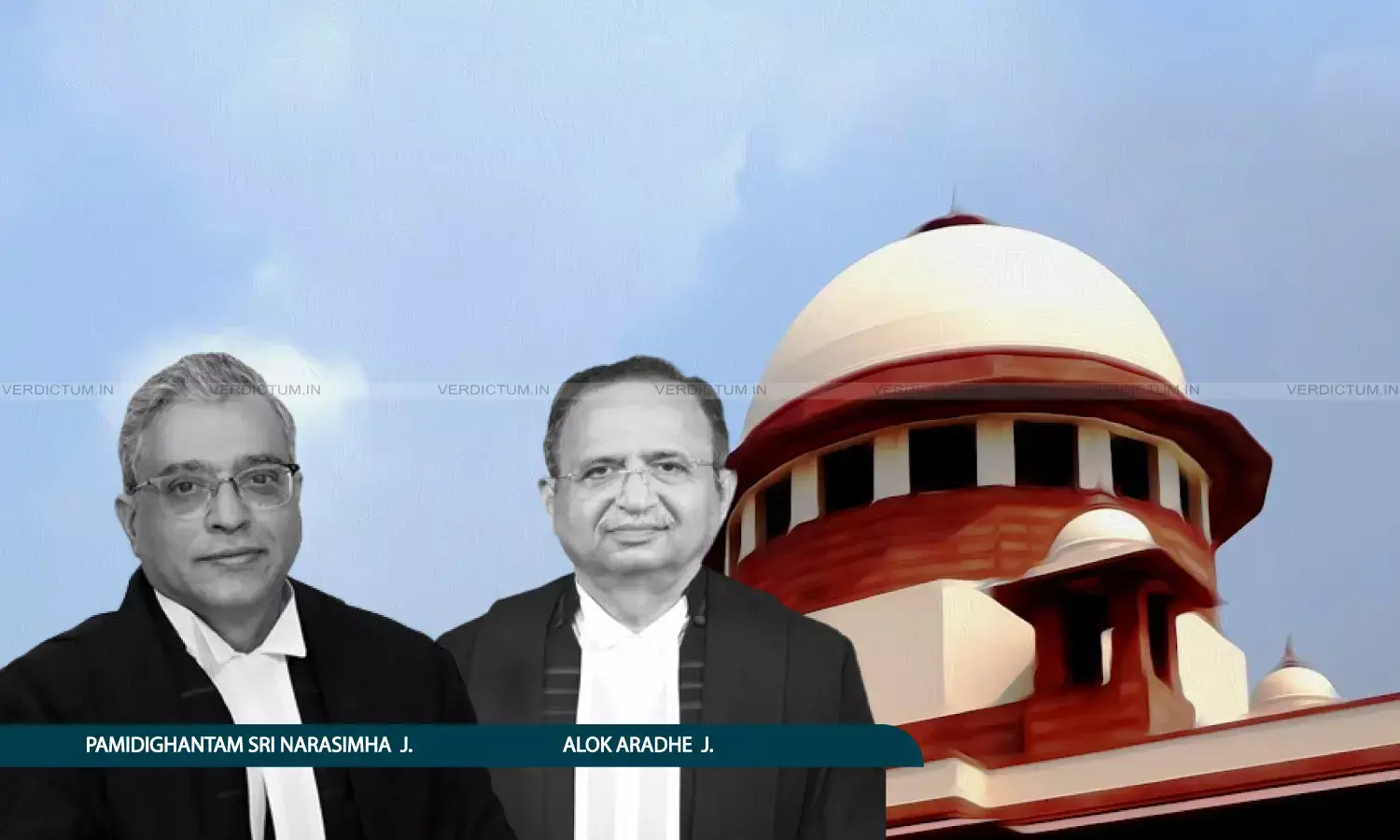
Justice Pamidighantam Sri Narasimha and Justice Alok Aradhe, Supreme Court
The Supreme Court has held that a power generating utility cannot recover depreciation charges from consumers beyond the period during which electricity was actually supplied under the approved Power Purchase Agreement (PPA).
The Court observed that Regulation 6.32 of the DERC (Terms and Conditions for Determination of Generation Tariff) Regulations, 2011 must be harmoniously construed with the broader statutory framework safeguarding consumer interests.
The Court was hearing an appeal filed by the Delhi Electricity Regulatory Commission challenging the judgment of the Appellate Tribunal for Electricity (APTEL), which had directed that the entire capital cost of a gas-based power plant be recovered through depreciation over its fifteen-year useful life, notwithstanding the admitted position that the plant had ceased supplying electricity after March 2018.
A Bench of Justice Pamidighantam Sri Narasimha and Justice Alok Aradhe observed: “Regulation 6.32 of the 2011 Regulations does not, and cannot, override the broader statutory and regulatory framework and the same does not confer an absolute and unconditional right upon the generating utility to recover depreciation from the consumers even for a period when the asset is free to supply electricity.”
The Bench further held: “The consumers cannot be required to pay for a service which they no longer receive.”
Background
The respondent-company established a temporary 108 MW gas-based power plant pursuant to approvals granted for augmenting the electricity supply in the National Capital Territory in the lead-up to the Commonwealth Games 2010. The project was conceived as a short-term measure with an operational tenure of five to six years.
The Commission subsequently granted in-principle approval to the project, and the respondent entered into an intra-company arrangement for the sale and purchase of electricity generated by the plant. The plant achieved commercial operation in open cycle mode and in combined cycle mode.
The Commission approved operation and electricity supply from the plant only up to March 2018, thereby fixing a six-year operational and tariff recovery framework. The Commission also determined the capital cost of the plant after prudence checks and accepted its technical useful life as fifteen years.
The respondent thereafter sought true-up of expenditure and annual revenue requirements. The Commission allowed depreciation only up to the operational period and declined to permit recovery of the remaining depreciable value from consumers since the plant had ceased supplying electricity.
The Appellate Tribunal for Electricity set aside the Commission’s order and held that since the Commission itself had accepted a useful life of fifteen years, the respondent was entitled to recover depreciation over the entire useful life under Regulation 6.32 of the 2011 Regulations.
Aggrieved thereby, the Commission approached the Supreme Court.
Court’s Observation
The Supreme Court framed three questions, including whether depreciation must necessarily be allowed over the entire technical useful life of an asset, irrespective of the period during which electricity is actually supplied, and whether Regulation 6.32 conferred an absolute right to recover depreciation over the full useful life of the asset.
The Court first examined the scheme of Sections 61 and 62 of the Electricity Act, 2003 and observed that tariff determination is not merely a mathematical exercise but a “regulatory balancing act” between cost recovery for utilities and protection of consumer interests.
The Bench noted that Section 61(d) specifically mandates safeguarding consumer interests while permitting recovery of electricity costs reasonably.
The Court further observed that the Commission had already permitted depreciation amounting to ₹83.34 crores during the six-year operational period approved under the PPA framework. Referring to the facts of the case, the Bench observed that, admittedly, no electricity was supplied to consumers beyond March 2018, and therefore, consumers could not be burdened with tariff charges thereafter.
The Court also noted that the Commission had clarified that the respondent company was free to treat the plant as a merchant generating station and sell electricity elsewhere or even dispose of the asset. The Bench therefore held that there was no legal impediment preventing the respondent from commercially exploiting the plant independently after expiry of the approved supply framework.
While interpreting Regulation 6.32 of the 2011 Regulations, the Court reiterated that statutory provisions and regulations cannot be read in isolation. The Court held that Regulation 6.32 prescribing depreciation over the useful life of an asset must be harmoniously construed with Regulation 4.1, which confines tariff entitlement to the period approved under the PPA.
The Bench observed that the Commission’s earlier order approving operation only till March 2018 had attained finality since it was never challenged by the respondent-company.
The Court also held that the distinction between the “technical useful life” of the asset and the “regulatory recovery period” was substantive and not merely semantic. Criticising the approach adopted by APTEL, the Bench observed: “The True-up proceedings are intended to give effect to tariff framework and not to reopen or reconfigure it.”
The Court concluded that APTEL had erred in disregarding both the regulatory framework and the approval conditions restricting operational and tariff recovery rights to six years.
Conclusion
The Supreme Court answered all questions in favour of the Delhi Electricity Regulatory Commission and against the respondent-company.
Accordingly, the Court set aside the judgment passed by the Appellate Tribunal for Electricity and restored the Commission’s order restricting depreciation recovery to the approved operational period.
Cause Title: Delhi Electricity Regulatory Commission v. Tata Power Delhi Distribution Limited (Neutral Citation: 2026 INSC 461)
