

Magistrate Can Treat Protest Petition As Complaint Only When It Contains Specific Allegation Against Accused Persons & Witnesses’ List: Supreme Court
The Supreme Court was considering an appeal assailing the order of the Allahabad High Court dismissing the Application seeking quashing of the order taking cognisance,

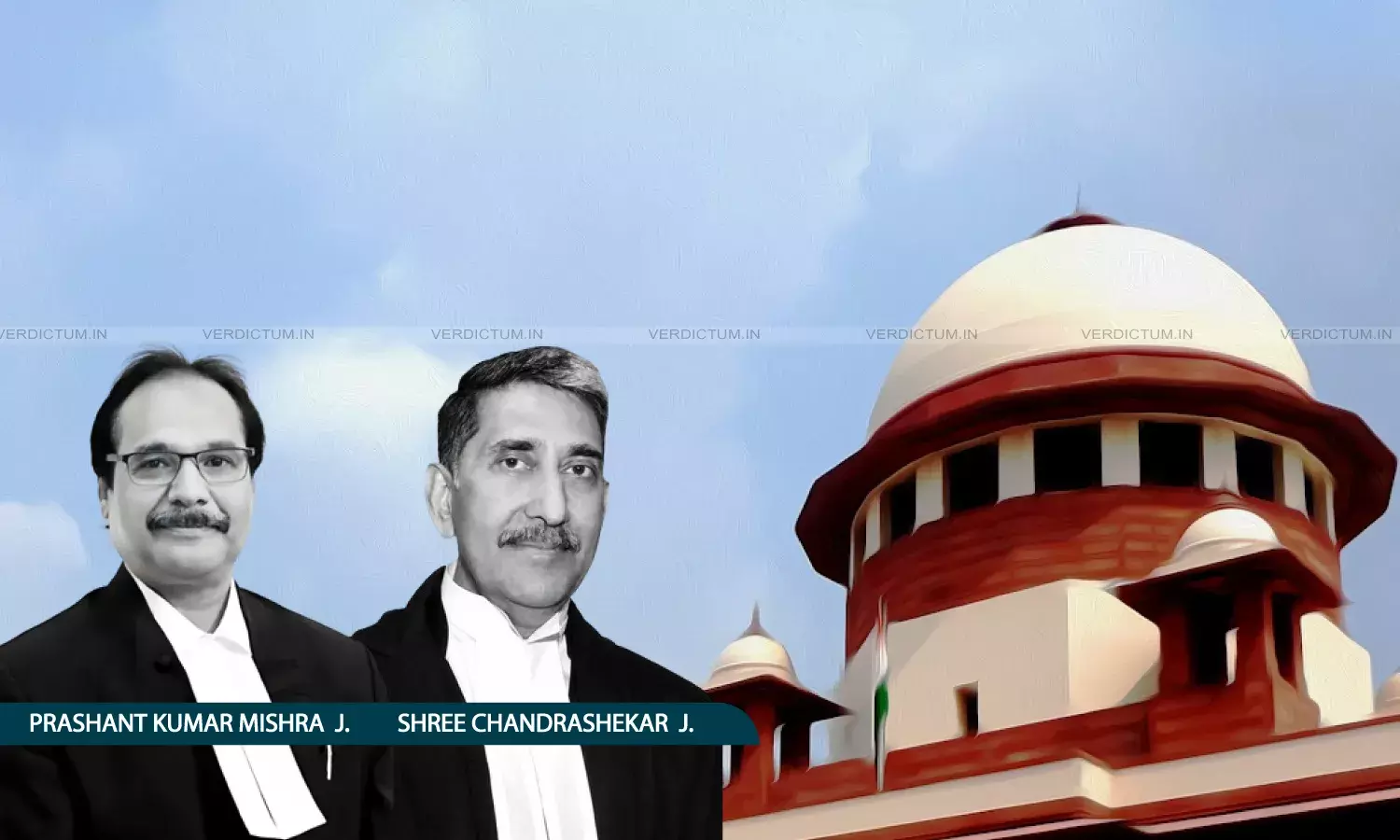
Justice Prashant Kumar Mishra, Justice Shree Chandrashekhar, Supreme Court
While quashing the entire proceedings against the accused appellant in a criminal case, the Supreme Court has observed that the Magistrate may treat a Protest Petition as a complaint to be dealt with under Chapter XV of the Code of Criminal Procedure, but it should contain a specific allegation against the accused person of committing the crime and a list of witnesses.
The Apex Court was considering an appeal assailing the order of the Allahabad High Court by which the Application seeking quashing of the order taking cognisance was dismissed.
The Bench comprising Justice Prashant Kumar Mishra and Justice Shree Chandrashekhar held, “The Chief Judicial Magistrate committed a serious error in law in taking cognizance of the offence and issuing summons to the appellant without satisfying himself whether the Protest Petition satisfies all requirements of a complaint which is defined under section 2(d) of the Code of Criminal Procedure. A complaint does not include a police report and it means an allegation made orally or in writing to a Magistrate that some person, whether known or unknown, has committed an offence and invites the Magistrate to take action under the law. The Magistrate may treat a Protest Petition as a complaint to be dealt with under Chapter XV of the Code of Criminal Procedure but it should contain a specific allegation against the accused person of committing the crime and a list of witnesses. Merely summing up the objections to investigation carried by the police does not take the form of a complaint as defined under section 2(d) of the Code of Criminal Procedure.”
Advocate Aarushi Singh represented the Appellant while AOR Akshay Amritanshu represented the Respondent.
Factual Background
A criminal case was registered in 2022 under sections 302, 352 and 504 of the Indian Penal Code based on a written information of one Pratima Singh, who is the sister of the deceased Abhishek Singh alias Mohit. The informant alleged that an altercation took place between her brother and the neighbour Gaurav Singh, who is the husband of the appellant. The cause of the occurrence was that the appellant’s husband was trying to divert the flow of drainage. She further alleged that the appellant instigated her husband, who started abusing her brother in vulgar language. The appellant and her husband both were carrying a stick, and one unknown person who was carrying a spade surrounded her brother and allegedly assaulted him mercilessly.
In the meantime, the villagers, including the uncle of the informant, intervened, but by that time her brother had succumbed to the injuries on the spot. In the opinion of the doctors, the immediate cause of death of Abhishek Singh was asphyxia due to antemortem hanging. The chargesheet was filed under sections 323, 504 and 506 of the Indian Penal Code. The chargesheet narrated the initial steps during the investigation and stated that no evidence was found to support the allegation of chasing the deceased towards the main road and beating him with the intention to kill.
Aggrieved by the dropping of the offence under section 302 of the Indian Penal Code against Gaurav Singh and the dropping of the name of the appellant in the chargesheet, the informant lodged a Protest Petition alleging that the post-mortem report did not reflect the correct cause of death and was contrary to the inquest report. The Chief Judicial Magistrate took cognisance of the offence and issued summons to a number of persons.
Reasoning
The Bench, at the outset, clarified the power of the Magistrate to take or not to take cognisance or to direct further investigation when a police report is forwarded to him. “The Magistrate has to independently apply his mind to the facts emerging from the police report and he can differ with the conclusions in the police report. The Magistrate takes cognizance of the offence under sub-section 1 to section 190 when he decides to accept the police report which is generally described as a chargesheet. There is also a catena of judgments1 that has approved the power of the Magistrate to take cognizance or direct further investigation where the police report is a closure report. However, it is beyond the power of the Magistrate to add any offence in the order taking cognizance when he accepts the chargesheet in toto”, it added.
On a perusal of the facts of the case, the Bench noted that the Chief Judicial Magistrate adopted a procedure which was not prescribed in the Code of Criminal Procedure. The Bench noted that in the order taking cognisance which ran into 70 typed pages of the paper book, the Magistrate embarked upon an exercise to find fault with the investigation. “In some cases a faulty investigation may give rise to a situation where the Magistrate exercises his power under sub-section 8 of section 173 of the Code of Criminal Procedure to direct further investigation. However, a defective investigation is not a ground for taking cognizance on a complaint which does not provide sufficient evidence to proceed further in the matter”, the Bench added.
The Bench further held that in a matter where the Magistrate was required to take a decision whether or not to accept the police report and then turn to the Protest Petition, he proceeded to write a dissertation on the duty of the Police and the Court appended with a catalogue of judgments. “It is really surprising that on a Protest Petition filed by the informant about 12 months after the chargesheet was filed against Gaurav Singh under sections 323, 504 and 506 of the Indian Penal Code and exonerating the appellant, the Chief Judicial Magistrate, Banda without following the procedure in law issued summons to the appellant and her husband to face the trial under section 302 r/w section 34, section 201 r/w section 34 and section 504 r/w section 120B of the Indian Penal Code”, it stated.
The Bench was not inclined to approve the manner in which the Magistrate proceeded on the Protest Petition and acted beyond his jurisdiction in issuing summons to the appellant. “The Order dated 25th March 2025 issuing summons to the appellant to face the trial under section 302 r/w section 34, section 201 r/w section 34, and section 504 r/w section 120B of the Indian Penal Code suffers from serious procedural irregularities which vitiate the entire proceedings against her”, the Bench held while allowing the appeal and quashing the entire criminal proceedings against the appellant.
Cause Title: Deepti Singh v. State of U.P. & Anr. (Neutral Citation: 2026 INSC 1264)
Appearance
Appellant: Advocates Aarushi Singh, Aditya Vaibhav Singh, AOR Vanya Gupta, Advocates Riya Parihar, Prabhat Rathore, Govind Vohra, Shivendra Singh
Respondent: AOR Akshay Amritanshu, Advocates Ajay Singh, Sarthak Srivastava, Utkarsh Rai, AOR Ajay Pal, Advocates Dr. Bhupinder, Mayank Dahiya, Sugandh Rathor, Vandana, Kuldeep Singh Kuchaliya