Non-Release Of Convict After Grant Of Parole And Furnishing Of Sureties Amounts To Illegal Detention: Supreme Court
The Court held that once parole had been granted and sureties furnished to the Court's satisfaction, continued incarceration of the convict becomes illegal detention, violating Article 21 of the Constitution.
The Supreme Court has held that the continued detention of a convict, despite a judicial order granting parole and the completion of verification of sureties, constitutes illegal detention, entitling the detenue to compensation under public law.
The Court observed that once a judicial order directing release remained operative and unstayed, the State was bound to obey it and could not delay implementation on the ground that it was considering filing an appeal.
The Court was hearing an appeal arising from a Rajasthan High Court order concerning a convict sentenced to four years’ rigorous imprisonment who was granted permanent parole by a Single Judge of the High Court on 5 November 2024.
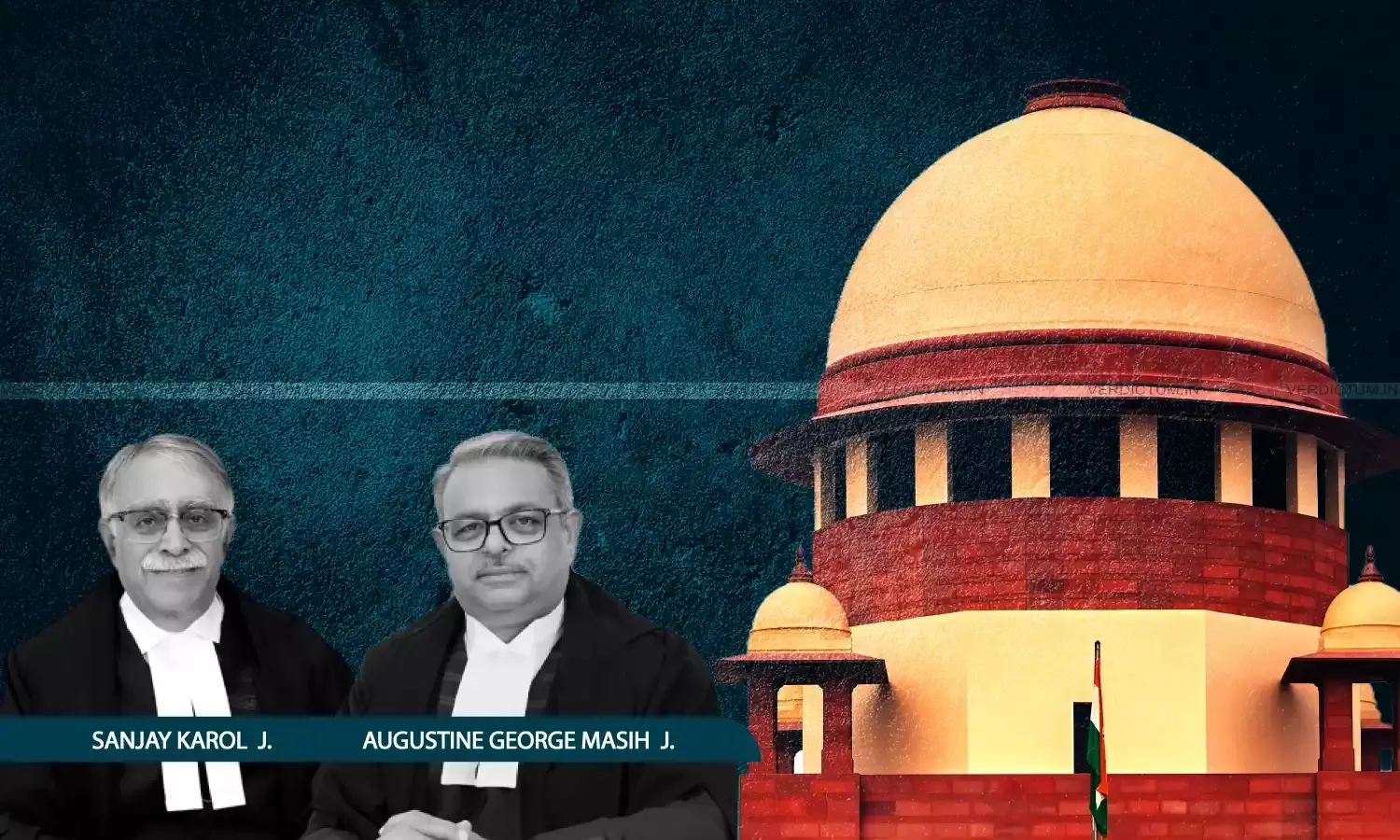
A Bench of Justice Sanjay Karol and Justice Augustine George Masih observed: “Once parole had been granted and sureties produced to the satisfaction of the concerned court, the non-release becomes illegal detention.”
The Bench further observed: “The liberty of an individual is not a trivial matter. The State cannot continue curtailing the same in the face of a court order, on account of its slow bureaucratic processes of taking decisions whether to file appeals in a particular matter or not.”
Advocates Tushar Bathija, Rishabh Dheer and Aishwarya Singh appeared for the appellant. Advocates S. Udaya Kumar Sagar, along with Advocates Kshitij Mittal and Mayank Sharma, appeared for the State.
Background
The appellant had been convicted for offences punishable under Sections 148, 448, 304 Part II, read with Sections 149 and 323 of the Indian Penal Code, 1860 and sentenced to rigorous imprisonment for four years by the Additional Sessions Judge, Alwar, in 1988. The conviction and sentence were affirmed by the Rajasthan High Court in 2021, following which the appellant was taken into custody on 23 December 2021.
After serving more than three years of imprisonment, the appellant applied for permanent parole on 3 December 2023. The application was rejected on 18 January 2024 because he had not availed the three stages of regular parole contemplated under Rule 9 of the Rajasthan Prisoners Release on Parole Rules, 1958.
The appellant challenged the rejection before the Rajasthan High Court. By order dated 5 November 2024, the learned Single Judge allowed the writ petition and directed his release upon furnishing a personal bond of ₹1 lakh along with two sureties of ₹50,000 each. Despite compliance with the conditions and verification of sureties on 13 November 2024, the appellant was not released. He consequently approached the Division Bench through a habeas corpus petition, whereupon the High Court directed his immediate release on 6 December 2024.
Before the Supreme Court, the appellant contended that the period of twenty-four days between verification of sureties and actual release constituted illegal detention in violation of Article 21 of the Constitution and sought compensation.
Court’s Observation
The Supreme Court first examined the meaning and scope of “illegal detention” and observed that detention becomes illegal when deprivation of liberty lacks lawful authority or violates constitutional safeguards and procedure established by law. The Court defined illegal detention in the following terms: “The deprivation of liberty by the State without lawful authority or in violation of provisions of the Constitution is illegal detention.”
The Court thereafter examined the nature and concept of parole by referring to various legal dictionaries, prison jurisprudence and precedents including Poonam Lata v. M.L. Wadhawan, State of Haryana v. Mohinder Singh and Sunil Fulchand Shah v. Union of India. The Court reiterated that parole constitutes conditional release and forms part of the reformative process intended to facilitate maintenance of social and familial ties.
Rejecting the State’s contention that the Single Judge’s order granting parole was contrary to Rule 9 of the Rajasthan Prisoners Release on Parole Rules, 1958, the Court observed that the State had never challenged the order itself. The Bench held that once the judicial order remained operative and unstayed, the State was bound to implement it.
The Court strongly reiterated the principle of “obey first, appeal later” and observed that mere contemplation of filing an appeal does not permit the State to ignore or postpone implementation of a judicial order. Referring to Atma Ram Properties (P) Ltd. v. Federal Motors (P) Ltd. and Karnataka Housing Board v. C. Muddaiah, the Court held that every judicial order continues to bind parties unless stayed, modified or set aside by a superior court.
The Bench observed: “A judicial order or decree remains in operation unless stayed, modified, or set aside; mere filing of an appeal or application would not, by itself, automatically keep the order in abeyance.”
The Supreme Court then undertook an elaborate discussion on the constitutional significance of the writ of habeas corpus and traced its origins from Magna Carta through various constitutional precedents, including Ghulam Sarwar v. Union of India, Kanu Sanyal v. District Magistrate and ADM Jabalpur v. Shivakant Shukla. The Court reiterated that habeas corpus remains one of the foremost constitutional safeguards protecting personal liberty against unlawful State action.
The Court rejected the State’s argument that the appellant, being a convict, could not claim parity with persons unlawfully arrested or acquitted persons. The Bench held that once a lawful order of release had been passed and complied with by furnishing sureties, continued incarceration ceased to have legal sanction irrespective of the status of the detenue.
The Court observed that compensation for illegal detention is a recognised public law remedy flowing from a violation of Article 21. The Bench referred extensively to precedents including Rudal Shah v. State of Bihar, Bhim Singh v. State of J&K, Nilabati Behera v. State of Orissa and S. Nambi Narayanan v. Siby Mathews.
The Court reiterated the principle laid down in Rudal Shah that Article 21 would lose substantive content if constitutional courts were confined merely to directing release without awarding monetary compensation for unlawful deprivation of liberty.
The Bench further observed: “Just because a person had been convicted does not mean that his rights weigh less on the scales of justice.”
The Supreme Court ultimately held that once verification of sureties had already taken place, there existed no justification whatsoever for continued detention of the appellant for twenty-four additional days. The Court held that administrative indecision regarding the filing of an appeal could not override the constitutional guarantee of personal liberty under Article 21.
Conclusion
The Supreme Court held that the continued incarceration of the appellant for twenty-four days after the grant of parole and completion of surety verification amounted to illegal detention in violation of Article 21 of the Constitution. The Court observed that the liberty of an individual cannot be subordinated to bureaucratic delay or administrative indecision regarding the filing of appeals against judicial orders.
Accordingly, the Court awarded compensation of ₹11 lakhs to the appellant to be deposited directly into his bank account by the State of Rajasthan and allowed the appeal.
Cause Title: Daudayal v. State of Rajasthan & Ors. (Neutral Citation: 2026 INSC 599)