

Decisions Of Highest Court To Be Followed, Without Which There Will Be Mayhem: Supreme Court Sets Aside APTEL’s Order
The Supreme Court was considering an appeal filed against the impugned order, which was passed in a petition seeking review of an order against the established orders of tariff fixation under the Electricity Act, 2003.

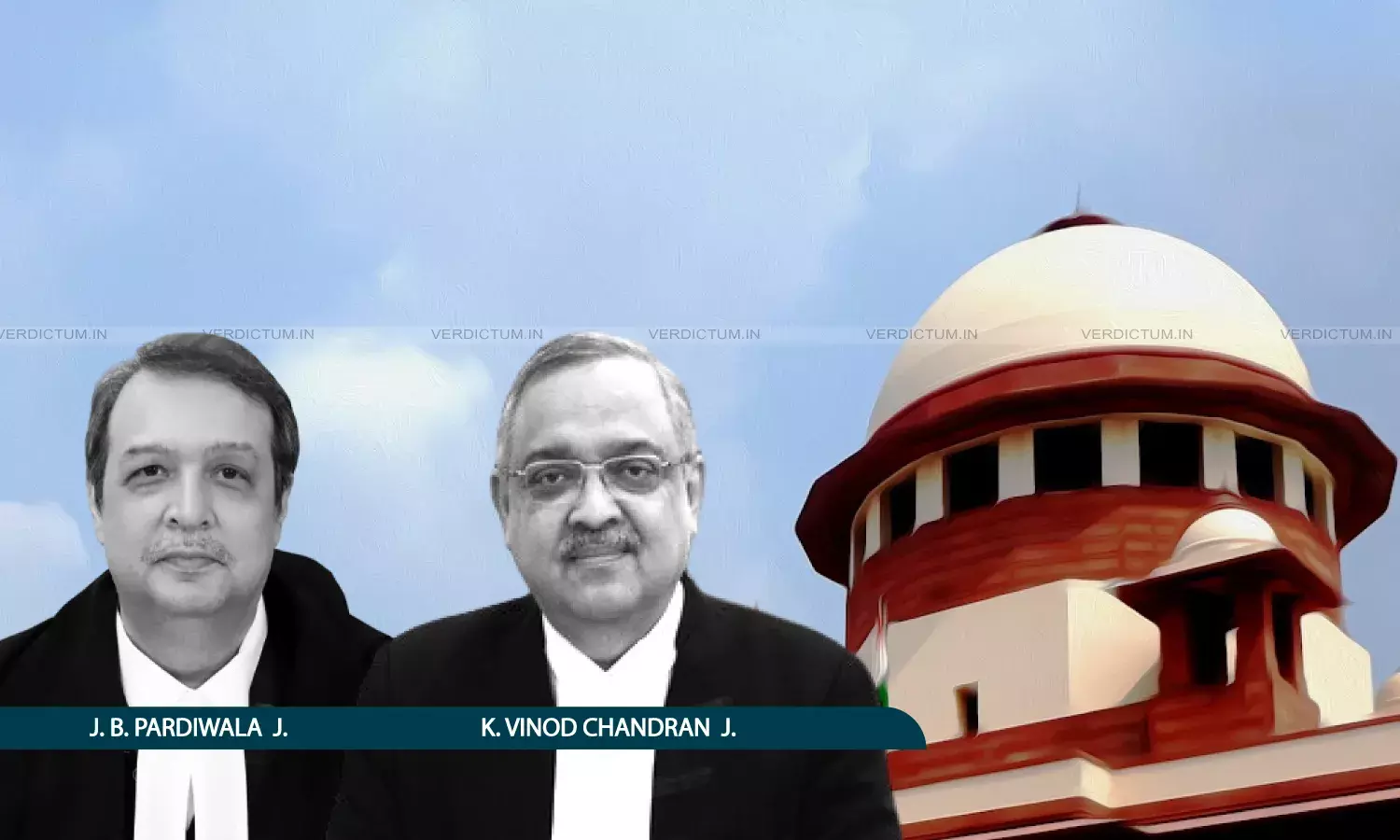
Justice J. B. Pardiwala, Justice K. Vinod Chandran, Supreme Court
While allowing an appeal filed by the Damodar Valley Corporation and imposing a cost of Rs 1.5 lakh on Steel Authority of India Limited, the Supreme Court has held that finality and closure are an expedient need in litigation. The Apex Court further held that Article 141 is a Constitutional imprimatur which ensures the decisions of the highest court of the land to be followed, without which there will be mayhem.
The Apex Court was considering an appeal filed against the impugned order, which was passed in a petition seeking review of an order of the year 2019, which was allowed in 2024, after more than five years. against the established orders of tariff fixation under the Electricity Act, 2003, also on the strength of a decision of this Court in Bhaskar Shrachi Alloys Limited & Ors. v. Damodar Valley Corporation & Ors (2018).
The Division Bench of Justice J. B. Pardiwala and Justice K. Vinod Chandran held, “Our judicial system with the hierarchy of Courts thrives on the sanctity of the decisions of the appellate, revisional and supervisory jurisdictions to be given due weightage. As far as Article 141 is concerned it’s a Constitutional imprimatur which ensures the decisions of the highest court of the land to be followed, without which there will be mayhem. We are conscious of the criticism that the Supreme Court’s decisions are supreme not because it is infallible but only because it is the final Court. However, finality and closure is the expedient need in litigation.”
“The Public Sector Undertaking has been ill-advised, and in that circumstance, we impose a cost of Rs.1,50,000/- (Rupees One Lakh and Fifty Thousand) on the Steel Authority of India Limited. The cost shall be paid to the Damodar Valley Corporation within a period of one month from today, failing which, interest @18% per annum shall be applied”, it added.
Senior Advocate Abhishek Manu Singhvi represented the Appellant while Senior Advocate Rajiv Shakdher represented the Respondent.
Factual Background
The respondent was a party in the earlier proceedings, which determined the tariff between April 1, 2006 and June 31, 2009, by allowing a two-year transition period to the Damodar Valley Corporation (DVC), the appellant, from April 1, 2004 to March 31, 2006. The Bench was concerned with the period 2009 to 2014, for which the Central Electricity Regulatory Commission (CERC) fixed the tariff of DVC based on the statutory provisions of the Electricity Act, 2003, the Damodar Valley Corporation Act, 1948 (DVC Act) and the Central Electricity Regulatory Commission (Terms and Conditions of Tariff) Regulations, 2009. The very same issue of whether the ‘Sinking Fund’ which refers to a portion of the profits appropriated for the purpose of redeeming the bonds issued by the DVC, was entitled to be factored into the tariff of the power generated and supplied by the DVC was considered and upheld in the cited decision of the Court, which considered the issue on the basis of the enactments above referred to and the Tariff Regulations of 2004.
The CERC, for the subsequent period, passed an order in the year 2013 when the matter was pending before the Court. When the orders were passed by the Appellate Tribunal for Electricity at New Delhi, in the appeal filed by the consumers, the above-cited decision was delivered. The Tribunal upheld the order of the CERC on its own reasoning and based on the binding precedent of the cited decision of this Court. None challenged the appellate order, and a review was filed by one of the appellants, which was pending before the Tribunal for 5 years, and was disposed of by the impugned order. The DVC filed the appeal in which a Public Sector Undertaking, Steel Authority of India Limited also intervened.
Reasoning
The Bench explained that Section 173 of the Electricity Act of 2003 gives overriding effect to the provisions of the Consumer Protection Act, 1986, Atomic Energy, 1962 or the Railways Act 1989 as against the provisions of the Electricity Act, 2003 and any rule or regulation made thereunder or any instrument by virtue of the Act of 2003.
“Section 174 clearly provides that the provisions of the Electricity Act of 2003 will have effect notwithstanding anything inconsistent in any other law for the time being in force; which we would think would normally include the DV Act of 1948, which was enacted long before the Act of 2003 came into force. Despite Section 58 of the DV Act, in which the absence of the words ‘any other law for the time being in force’ is striking and patently obvious, Section 174 would nullify the provisions in the DVC Act which are inconsistent with the Act of 2003, but it would not repeal the DVC Act and those provisions which are not inconsistent with the Act of 2003 remains in force”, it added.
The Bench explained that Section 40 is not inconsistent with the Electricity Act, since Section 61, which speaks of tariff regulations, empowers the appropriate commission to specify the terms and conditions for determination of tariff by taking into account various factors.
“We cannot but observe that the Tribunal has gone haywire; we are apologetic for the expression but we find no substitute to express our angst in allowing the review, that too, when the very same issue, for the earlier years, was settled by this Court in Bhaskar Shrachi Alloys Limited, based on which, the original order was passed by the Tribunal”, the Bench stated.
Reference was made to the judgment in State of West Bengal and Others v. Kamal Sengupta and Another (2008), which specifically considered the power of review conferred under the Administrative Tribunals Act, 1985, by Section 22(3)(f), which is in pari materia with Section 122(f) of the Electricity Act.
The Bench found the review to be illegal, totally misplaced and blatantly in breach of the principles of judicial discipline. The Bench noted that there were no appeals filed from the earlier order to the Court and one of the appellants before the Appellate Tribunal had filed for a review and waited for five years to get it heard. “We find the said action to be clearly an abuse of process of law and impose a cost of Rs.2,00,000/- (Rupees Two Lakh) on the 1 st respondent”, it ordered.
The Bench thus allowed the appeal and imposed a cost of Rs 1.5 lakh on Steel Authority of India Limited.
Cause Title: Damodar Valley Corporation v. Maithan Alloys Limited (Neutral Citation: 2026 INSC 1178)
Appearance
Appellant: Senior Advocates Abhishek Manu Singhvi, Vikas Singh, Venkatesh, Kanika Chugh, Shryeshth Ramesh Sharma, Ashutosh Kumar Srivastava, Priya Dhankhar, Nihal Bhardwaj, Deepeika Kalia, Priyansha Sharma, Adarsh Singh, Devishi Gupta, Sudeep Chandra, Khushi, AOR Nitin Saluja
Respondent: Senior Advocate Rajiv Shakdher, AOR Rajiv Yadav, Advocate Ujjwal Kumar, AOR Pawanshree Agrawal, Advocates Kamana Divya Sree, Kriti Jain, Solanki Das, Chinmoy Samajdar, Atul Tripathi