

Xerox India’s Activity Of "Kitting" Of Modules To Make Photocopier As Per Customer’s Specification Doesn't Fall Under Term "Manufacture" Under Central Excise Act: Supreme Court
The Supreme Court was considering an appeal filed by the Revenue against the order passed in a Central Excise Appeal.

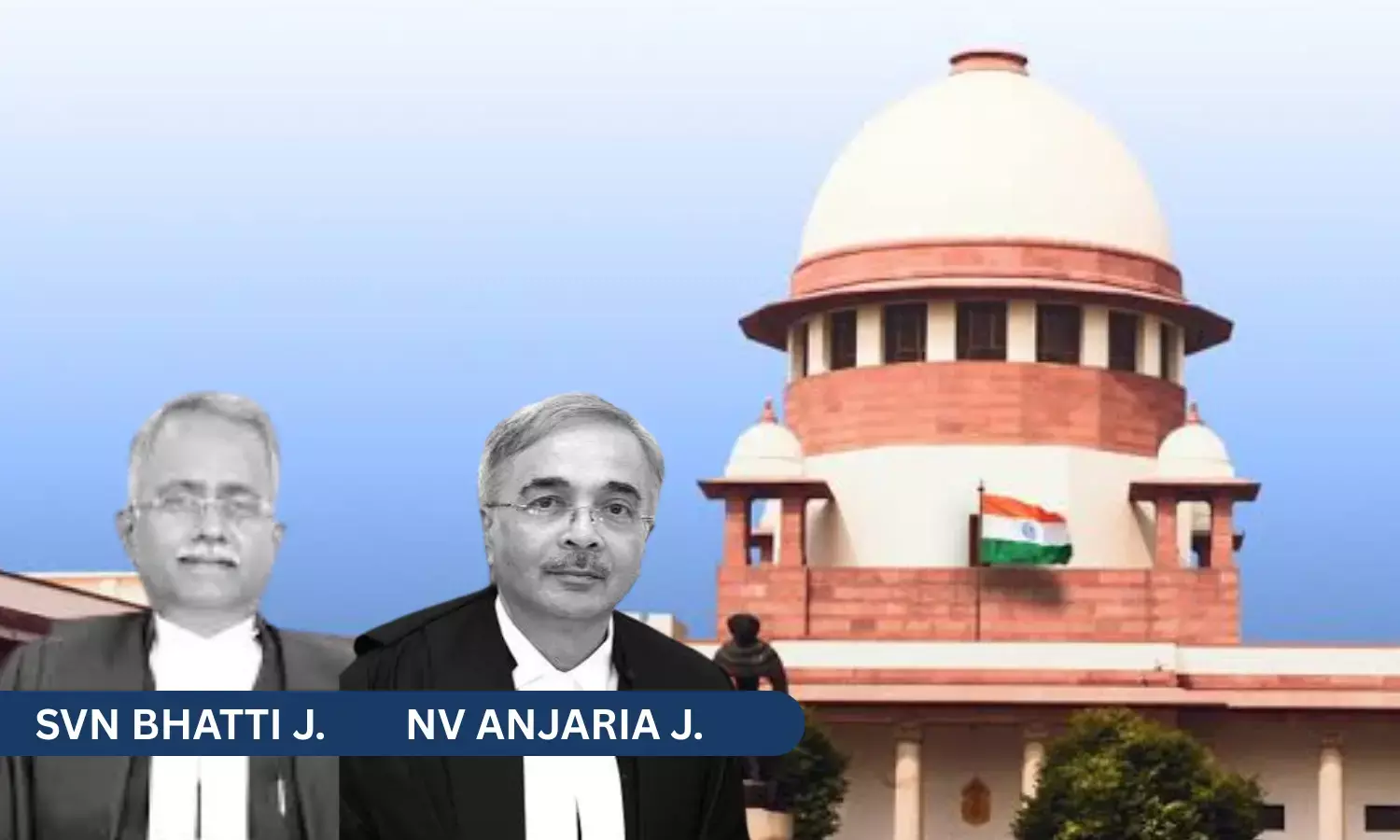
While upholding an order of the Customs Excise & Service Tax Appellate Tribunal (CESTAT), the Supreme Court has clarified that the subject activity of pinning and plugging different parts together, which is called kitting to make a complete set as per the customer’s specification, does not fall within the definition of ‘manufacture’ under Section 2(f) of the Central Excise Act.
The Apex Court was considering an appeal filed by the Revenue against the Order passed in a Central Excise Appeal.
The Division Bench of Justice S.V.N. Bhatti and Justice N.V. Anjaria held, “The Assessee claims the subject activity as “kitting” of modules to make a photocopier. The Assessee’s line of activity is subjected to the tests referred to in the decisions supra. Admittedly, the Assessee has imported the goods under Tariff Heading 8471 and paid Customs Duty against that Heading, which deals with automatic data processing machines and units thereof. The Assessee claims to have paid CVD for photocopiers alone. In the circumstances accepted by the Tribunal, the activity is one of pinning and plugging different parts together, which is called kitting to make a complete set as per the customer’s specification. Before concluding, we would like to refer to the finding recorded by the Tribunal, and are of the view that the activity in the case on hand does not fall within the definition of Section 2(f) of the C E Act.”
AOR B. Krishna Prasad represented the Appellant while Advocate V Lakshmikumaran represented the Respondent.
Factual Background
The Assessee M/s Xerox India Ltd. is engaged in the business of photocopiers, toners and photoreceptors. It also trades digital multi-functional printers, copiers and photocopiers-cum-printers, which fall under Tariff sub-head 8471.00. The Assessee has a warehouse at Hyderabad, State of Telangana, within the territorial jurisdiction of the Appellant, and another hub/warehouse in Rampur, State of Uttar Pradesh. The Assessee, by paying Customs and Countervailing Duty (CVD), imports parts, modules, and accessories of the said machines in complete knocked down (CKD) or semi-knocked down (SKD) condition from the warehouses of the Assessee’s sister concern. In the Appeals, the dispute between the Revenue and the Assessee related to the period between April, 2002 and November, 2006.
The Appellant/Revenue issued a Show Cause Notice (SCN) to the Assessee on the ground that the Assessee’s activity at the subject warehouse amounts to manufacturing within the meaning of Section 2(f) of the C E Act. The Revenue demanded why Excise duty and ED Cess of Rs 17,86,47,382 should not be imposed on clearances effected from the 5 warehouses at Hyderabad during the period April, 2002 to November, 2006. SCN further demanded sums under the proviso to Section 11A, Sections 11AB and 11AC of the C E Act, and why penalty should not be imposed on Respondent Nos. 2 and 3 under Rule 26 of the Central Excise Rules, 2002 (C E Rules 2002).
The Assessee, aggrieved by the confirmation of the demand in the SCN, filed an Appeal before the CESTAT, South Zonal Bench, Bangalore. Through the Impugned Order, the Tribunal interfered with the Appellant’s Order. The Tribunal, had pointed out the fallacies in the Commissioner’s approach in making the O-I-O and also how the Revenue failed to discharge the burden placed on it to decide whether the activity was a manufacturing activity.
Reasoning
The Bench was of the view that the Revenue was required to merely justify that there was excisable activity resulting in the excisable duty demanded through the SCN and confirmed via the O-I-O.
“Therefore, in an era of technological advancement and available wherewithal through information technology, the Revenue could have proved, through best evidence, that the photocopier is a product of change, not a result of “kitting”. The process ought to have been captured in the photos as a manufacturing activity to bring a photocopier into existence. This Court is not finding fault with the Revenue but is compelled to observe that, in the present era, what can be proved in a straight and simple way need not be induced from the convenient versions of both sides”, it added.
The Bench noted that the roadmap from import of Modules into the country, moving out of the Customs’ bonded warehouse, and finally landing in the Assessee’s warehouse is that the modules are unpacked, plugged and pinned to a customer’s specific requirement of the photocopier and are invoiced. “The Revenue failed to establish that in the simple process of unpacking, plugging or pinning, the imported modules are changing the head under which they are imported”, it stated.
Noting that the imported modules/parts were not shown to be unfinished or semi-finished, the Bench held that the Tribunal’s findings were both brief and correct, and adhered to brevity. “The Tribunal considered the record in its entirety, including the depositions of the Assessee’s officers, the purchase orders, the bills of entry and the storage tickets, together with the presentation made before it on behalf of the Assessee. It found that the components alleged to have been fitted to the main module were cleared in their original packing. Further, the HCF and the DADF had been fitted at the factory of the Assessee’s sister concerns abroad. The Revenue was unable to point to any evidence to the contrary, and no deposition of any Executive of the Assessee states that the modules were assembled in the warehouse. It further found that the Commissioner had concluded that the assembly was undertaken without making any verification whatsoever. These findings are not perverse, rest upon evidence, and have been arrived at by careful consideration of the material on record”, it mentioned.
Thus, finding no reason to interfere with the impugned findings, the Bench dismissed the appeal.
Cause Title: Commissioner of Central Excise, Hyderabad-IV v. M/S Xerox India LTD. & Ors. (Neutral Citation: 2026 INSC 805)
Appearance
Appellant: AOR B. Krishna Prasad, AOR Gurmeet Singh Makker
Respondent: Advocates V Lakshmikumaran, L Badri Narayanan, AOR Charanya Lakshmikumaran, Advocates Neha Choudhary, Nitum Jain, Medha Sinha, Yashovardhan Singh, Swastik Mishra, Adithya Nair, Ananya Gupta