

Plaint Amendment After Commencement Of Trial To Be Permitted Only If Party Couldn't Raise Matter Before Commencement Despite Due Diligence: Supreme Court
The appeal before the Supreme Court was filed by the defendant in a suit for recovery of money, against an order permitting a plaint amendment at the appellate stage.

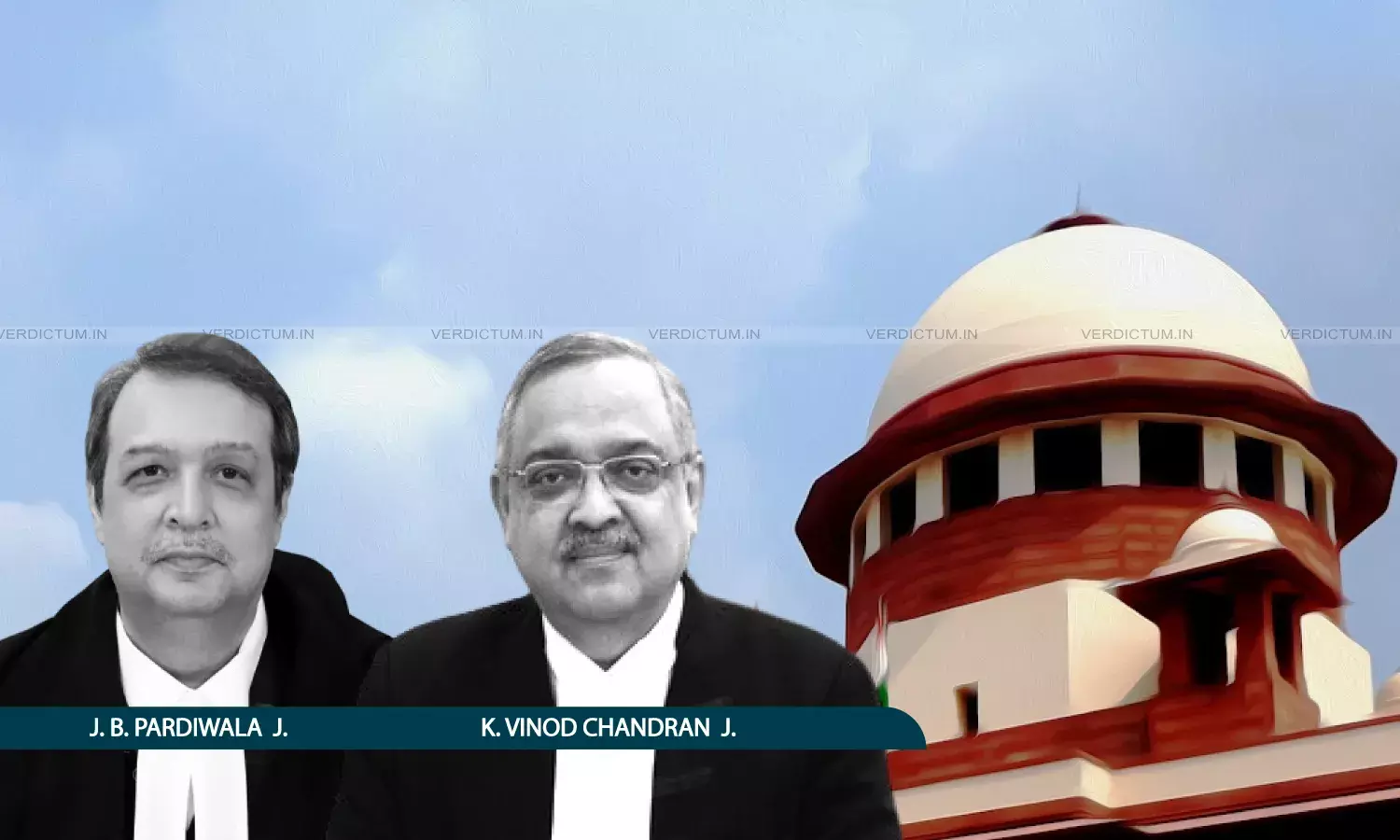
Justice J. B. Pardiwala, Justice K. Vinod Chandran, Supreme Court
While dealing with a matter pertaining to a money recovery suit, the Supreme Court has clarified that the proviso to Order VI Rule 17 of the Code of Civil Procedure (CPC) specifically speaks of amendment of the plaint after commencement of trial being permitted only if the party, despite having exercised due diligence, could not have raised the matter before the commencement of trial.
The appeal before the Apex Court was filed by the defendant in a suit for recovery of money challenging the impugned order, which permitted amendment of the plaint at the appellate stage, when the suit was dismissed on that principal aspect. The same was sought to be brought in by way of amendment. The District Court, in which the appeal was pending, had rejected the application.
The Division Bench of Justice J. B. Pardiwala and Justice K. Vinod Chandran held, “As noticed above the proviso to Order VI Rule 17 specifically speaks of amendment after commencement of trial to be permitted only if the party, despite having exercised due diligence, could not have raised the matter before the commencement of trial. In the present case, it is sheer carelessness, which the plaintiff has to necessarily suffer. Even if an application was filed after commencement of trial, the Court could not have concluded as per the proviso. In that circumstance, there is no question of amendment after the suit itself stood dismissed. True, the appeal is a continuation of the original proceeding but insofar as amendment, Order VI Rule 17 regulates the matter and puts the claim of the plaintiff/appellant in peril.”
AOR Chitrangda Rastravara represented the Appellant while AOR T. Harish Kumar represented the Respondent.
Factual Background
The appellant, a partnership firm, through its Manager, filed a plaint for recovery of money asserting that the first defendant had purchased a motor vehicle under a higher purchase agreement from the plaintiff and had committed default of the amounts due. The suit was dismissed on the ground that, the registration number in the agreement was different from the registration number in the suit.
An appeal was filed much later, in the year 2016. The subject application was filed seeking amendment of the plaint.
Reasoning
The Bench was of the view that the Principal District Judge rightly dismissed the application, finding that Order VI Rule 17 did not apply, specifically referring to the decision in Rajkumar Gurawara (dead ) Thr. Lrs. v. S.K. Sarwagi & Co. Pvt. Ltd. and Anr (2008).
The Bench noted that the District Judge, Salem, in rejecting the application, observed that the notice issued by the appellant also indicated the registration number as TN-31-K-9533. The reply notice issued by the respondent specifically pointed out that there was no purchase of such a vehicle and they had purchased only TN-31-F-9533, despite which the plaint was filed with a different number. The loan transaction was also denied. “Definitely before commencement of trial, the mistake could have been corrected, as a matter of right”, it held.
The Bench further explained, “This Court on an interpretation found Order VI Rule 17 permits pre-trial amendments liberally than those which are sought after commencement of the trial. While the first part of the rule makes it abundantly clear that at any stage of proceedings, parties are free to alter and amend their pleadings so as to bring forth the real questions in controversy; it is subject to the proviso, which restricts amendment after the trial has commenced to be allowed only if the Court comes to the conclusion that, in spite of due diligence, the party could not have raised the matter before the commencement of trial.”
Thus, finding no reason to sustain the impugned order and setting aside the same, the Bench allowed the appeal and further stated, “The First Appeal is said to be pending before the Principal District Judge, Salem which shall be considered on its merits.”
Cause Title: Chitra & Anr. v. C. Natarajan (Neutral Citation: 2026 INSC 781)
Appearance
Appellant: AOR Chitrangda Rastravara, Advocates Anirudh Singh, Abhijeet Singh, Aishwary Mishra,Dhananjai Shekhwat, Yuvraj Singh, Pearl Pundir, Anushikha Rathore, Dashrath Singh
Respondent: AOR T. Harish Kumar