

Income Tax Reopening Notice Valid When Based On Tangible Material With Live Link; Change Of Opinion Requires Conscious Application Of Mind: Supreme Court
The Bench noted that post-assessment investigation reports constitute fresh material; Section 143(1) intimations do not constitute assessments precluding a change of opinion; and a preliminary need for investigation differs from post-investigation reasons for notice.

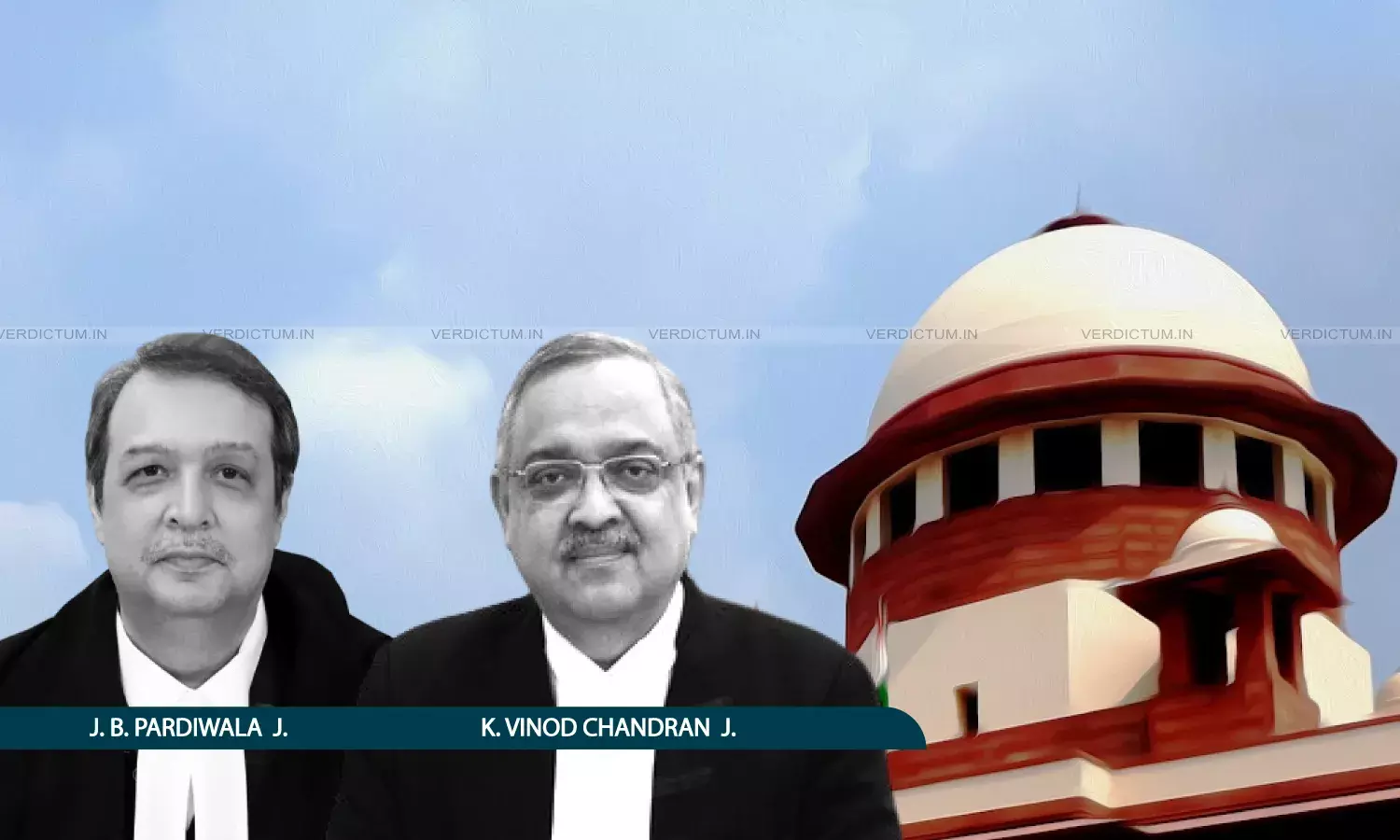
Justice J. B. Pardiwala, Justice K. Vinod Chandran, Supreme Court
The Supreme Court has held that a reassessment notice under Section 148 of the Income Tax Act, 1961 is valid where the recorded reasons rest on tangible material that has a rational connection or live link with the belief that income has escaped assessment. It held that a change of opinion presupposes a conscious application of mind and the formation of an opinion in the original assessment, and that the sufficiency of the reasons is not justiciable at the notice stage.
The Court held that an investigation report prepared after the assessment is fresh material on which the Assessing Officer can act. It held that an intimation under Section 143(1) is not an assessment, so no question of change of opinion arises. It also held that a conclusion that a transaction needs investigation differs from having reasons, post investigation, to issue a notice.
A Bench of Justice J.B. Pardiwala and Justice K. Vinod Chandran observed, “The expression “reason to believe” in Section 147 of the Act means cause or justification. The AO must have tangible material having a rational connection or a live link with the formation of the belief that income has escaped assessment, and need not have finally ascertained the fact by legal evidence or conclusion. At the stage of the notice, the only question is whether there was relevant material on which a reasonable person could have formed the requisite belief, and the sufficiency of the reasons is not a justiciable issue…”.
“…Further, a mere ‘change of opinion’ cannot be a reason to reopen, as the AO has the power to reassess and not the power to review. A change of opinion presupposes a conscious application of mind and the formation of an opinion in the original assessment, which the court must verify, either expressly or by necessary implication, before interfering with the reopening. The nonexhaustive principles governing ‘reason to believe’ and ‘change of opinion’ are at paragraph nos. 41 and 46 of this judgment, respectively”, the Bench further said.
Senior Advocate Mukul Rohatgi appeared for the appellants and Senior Advocate Nisha Bagchi, K.M. Nataraj, Additional Solicitor General appeared for the respondent.
The appellant and his brother, with two other shareholders, agreed on October 19, 2007 to sell shares of two companies to GYS Real Estate Pvt. Ltd. for Rs 195 crore and Rs 60 crore. The appellant filed his return for AY 2008-09 on September 25, 2008, declaring a loss of Rs 90.37 lakh, and claimed Section 54F relief after buying a half share in a Delhi property in April 2010. Assessment under Section 143(3) was completed in December 2010. An Investigation Unit report later concluded the shares were overvalued against the cost of land and building.
The Assessing Officer issued the notice on March 31, 2015 and rejected objections on September 24, 2015. The Delhi High Court dismissed the writ petition, on August 6, 2019. The assessees argued that overvaluation cannot cause escapement in the seller’s hands, that the transaction was scrutinised earlier, and that there was no failure to disclose.
The Court reviewed Calcutta Discount, Lakhmani Mewal Das, Kelvinator, Techspan India and Sanand Properties. It found the report, received after the assessment, was fresh material. The reasons also recorded the adjustment of gains to future years and the Section 54F claim, and the Court observed that escapement could be a diversion of income. For Nitin Sabharwal, only a Section 143(1) intimation had issued, following Rajesh Jhaveri. For Chetan Sabharwal, the assessment orders reflected no opinion on the matters in the notice.
Cause Title: Chetan Sabharwal v. Assistant Commissioner of Income Tax, (Neutral Citation: 2026 INSC 1163)
Appearances:
Appellants: Mukul Rohatgi, Senior Advocate.
Respondent: Nisha Bagchi, Senior Advocate, with K.M. Nataraj, Additional Solicitor General.