

Supreme Court Seeks Centre's Response On Anomalies In Pecuniary Jurisdiction Of Consumer Commissions Under 2019 Act
The primary question was whether the jurisdiction of the consumer fora would depend on the value of the goods or services paid as consideration or on the amount of compensation claimed.

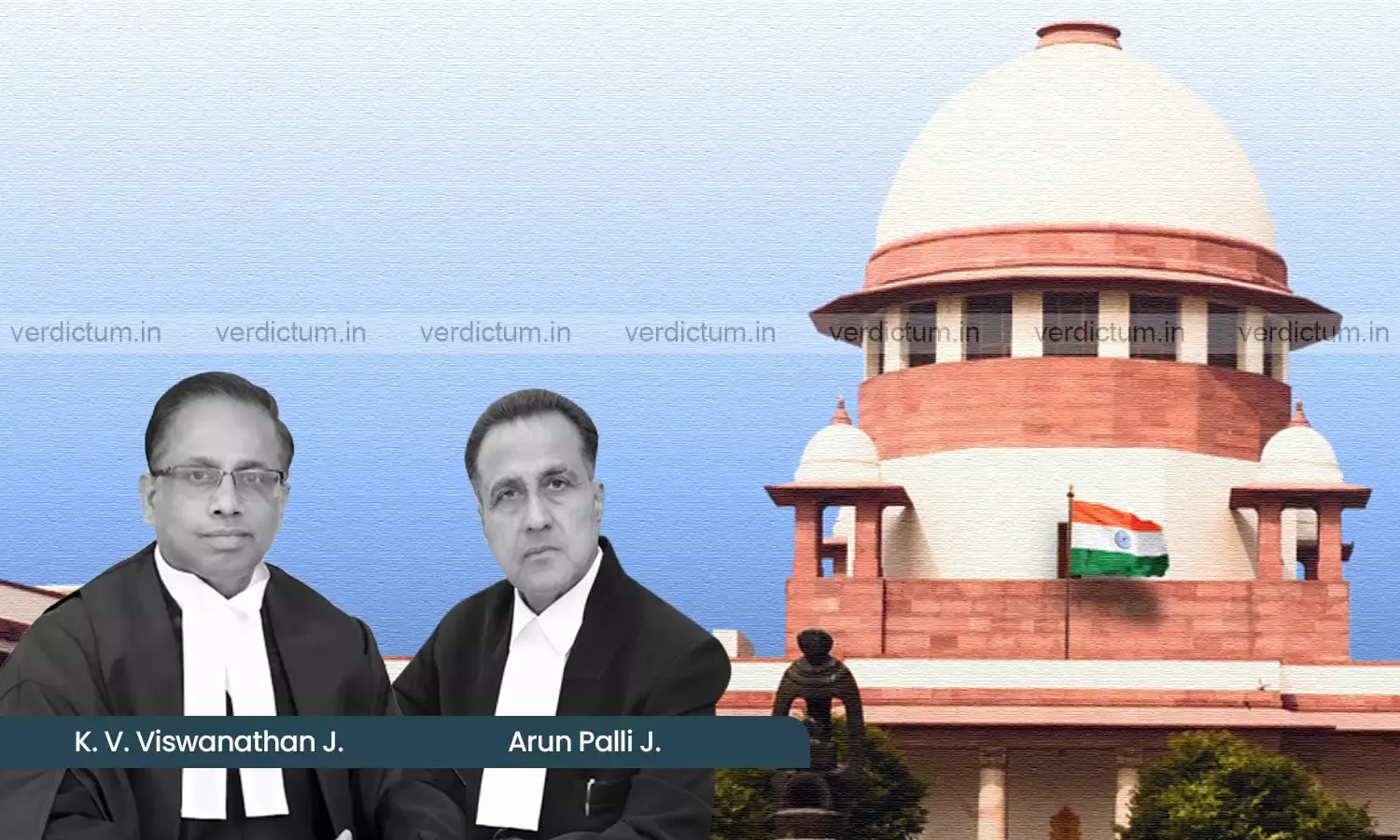
The Supreme Court has directed the Union of India to file an affidavit explaining potential operational anomalies in determining consumer forum jurisdictions based on consideration paid rather than compensation claimed.
The Court dealt with the question of whether the jurisdiction of the consumer fora, namely District Consumer Disputes Redressal Commissions, State Consumer Disputes Redressal Commissions and National Consumer Disputes Redressal Commission, will depend on the value of the goods or services paid as consideration or will depend on the amount of compensation claimed.
The Bench of Justice K. V. Viswanathan and Justice Arun Palli observed, "We are of the opinion that before we interpret the provisions, some time to be given to Union of India to reflect over these alleged anomalies and come back to us with an appropriate affidavit...The Union of India, within six weeks from today, shall file an appropriate affidavit to respond to these alleged anomalies...The affidavit should also address the reasoning behind the reduction of the pecuniary jurisdiction of National Commission from ten crores as was fixed in the year 2019 Act to Two crores, by notification dated 30.12.2021."
Senior Advocate Gagan Gupta appeared for the Petitioner, while ASG Vikramjit Banerjee appeared for the Union of India.
It was submitted by the Petitioner that, firstly, if the pecuniary jurisdiction is to be decided based on the value of the goods or services paid as consideration, then a whole host of anomalies arise and secondly, several deficiencies in service will be outside the purview of the consumer commissions.
It was pointed out that fixed deposit holders in banks are consumers, and if there were any deficiencies on the part of the bank in handling the fixed deposits, technically there is no consideration paid for the services, since all that has happened is the opening of a fixed deposit.
It was also illustrated by the Petitioner that the medical services in hospitals where there is subsidy in the sense that where some patients pay, and some patients do not pay any charges, those patients who do not pay are also covered under the head ‘consumer’. According to the Petitioner, difficulties may arise if charges paid are to be reckoned as the basis for determining pecuniary jurisdiction.
On this aspect, the Union submitted that as far as medical services are concerned, there are judgments in its favour answering the issue.
It was also argued by the Petitioner that if consideration paid is taken as the basis, in a given case, where in a proceeding against the builder, the deficiencies alleged is only against certain fixtures and fittings in the house/flat and since there is no breakup of consideration available, the value of the entire house/flat may have to be taken for lodging a claim before the appropriate fora.
Another aspect pointed out was that a consumer who bought a car worth Rs.2.50 crores, but only has a grievance against a defective windshield, even to replace that windshield, the consumer will have to move to the National Commission whereas in the case of a consumer who has paid an advance of Rs.40 lakhs for the car, where delivery of the car is delayed, the said consumer will have to approach the District Commission.
The Counsel for Respondent No.1 highlighted that proceedings before the District Commission, State Commission and National Commission are not only initiated by consumers. By drawing attention to Section 2(5) of the Consumer Protection Act, 2019 (for short, CP Act), it was submitted that voluntary consumer associations registered under any law, the Central Government or any State Government and the Central Authority(ies), can also file complaints.
Further, while referring to Section 18 of the CP Act, it was submitted by Respondent No. 1 that when a Central Authority initiates proceedings, it is to protect, promote, and to enforce the rights of the consumer, prevent unfair trade practices and to ensure that no false or misleading advertisement is made and so on.
The Union of India also submitted that it is the right of the law-making body to fix the basis for pecuniary jurisdiction. There is no quarrel with that proposition.
To which the Court observed, "However, we are anxious to know how the pecuniary jurisdiction will operate in the light of the alleged anomalies highlighted above...We make it clear that these anomalies are only illustrative, as highlighted above."
It also added, "However, we are of the opinion that what arises in this case is the interpretation of the provisions providing for the pecuniary jurisdiction and to in order to enable us to comprehensively address the matter, we are of the opinion that the Union of India, through the concerned Ministry of the Government of India, should place an affidavit addressing the aspects highlighted in the aforestated portion of the order."
Accordingly, the Court listed the matter for further hearing on October 8, 2026.
Cause Title: M/s Avon Elastomers v. M/s Bajaj Allianz General Insurance and Ors. [Special Leave to Appeal (C) No(s). 3806/2021]
Appearances:
Petitioner: Senior Advocate Gagan Gupta, Advocate on Record M/s Lawfic, Advocate Anuroop Chakravarti, Advocate M.S. Vishnu Sankaar, Advocate Aryan Shankar, Advocate Athira G. Nair, Advocate Saurabh Gupta, Advocate Jasbir Singh
Respondents: Additional Solicitor General Vikramjit Banerjee, Advocate on Record Vishal Meghwal, Advocate on Record Amit Kumar Singh, Advocate on Record Dr. Surender Singh Hooda, Advocate on Record Amrish Kumar, Advocate Jagdish Chandra, Advocate Jagdish Chandra Solanki, Advocate Sanskriti Sharma, Advocate K. Enatoli Sema, Advocate Chubalemla Chang, Advocate Prang Newmai, Advocate Vanshaja Shukla, Advocate Bhuvan Mishra, Advocate Padmesh Mishra, Advocate Gautam Bhardwaj, Advocate Gautam Bharadwaj, Advocate Prashant Rawat, Advocate Akansha, Advocate Aditya Kashyap, Advocate Sahil Bhalotia