

Steps To Be Taken By Domain Experts: Supreme Court Asks Centre To Consider Representation Against Deepfakes, Doxxing & Online Violence
The Bench disposed of the public interest litigation with directions to the concerned Ministries to consider the petitioner's representation for a judicially supervised framework.

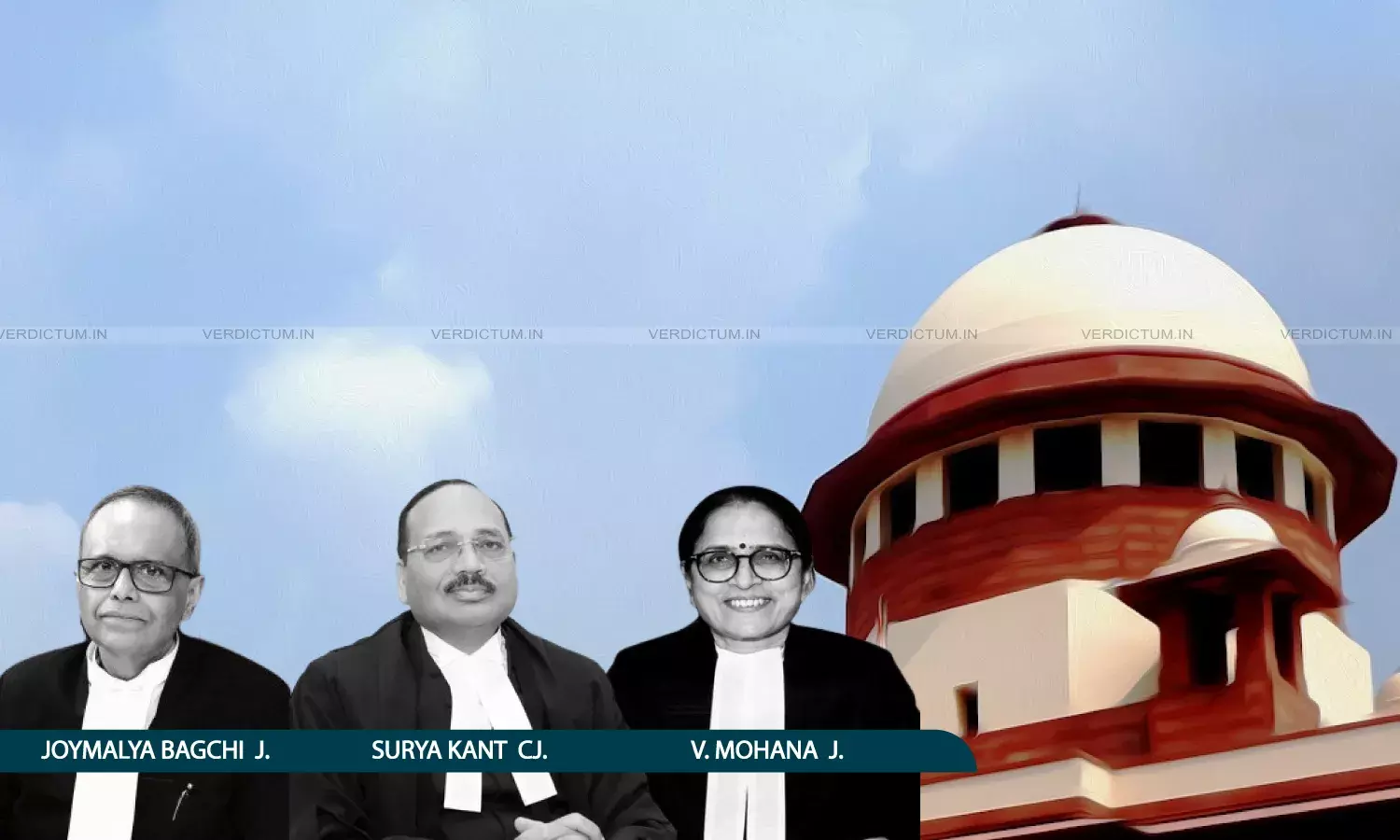
CJI Surya Kant, Justice Joymalya Bagchi, Justice V. Mohana, Supreme Court
The Supreme Court disposed of a Public Interest Litigation (PIL) seeking a narrow, time-bound, and judicially supervised emergency mechanism against grave digital harms, including threats of violence, doxxing, non-consensual deepfakes, and exposure of children's personal details.
Directing the Ministry of Electronics and Information Technology, the Ministry of Home Affairs, and the Ministry of Law and Justice—along with other stakeholders, to examine the petitioner's representation dated June 22, 2026, the Court said that domain experts and addressee authorities must first look into the issues raised and take appropriate remedial measures in accordance with law.
The Bench of Chief Justice Surya Kant, Justice Joymalya Bagchi and Justice V Mohana ordered, "We find that the petitioner has raised these issues comprehensively through a representation dated 22nd June 2026, addressed to the concerned Ministries of the Union of India. Since remedial actions are required to be taken by the addressee authorities, we dispose of this petition at this stage, with a direction to Respondent Nos. 1, 2, 3, and all other stakeholders to look into the issues raised by the petitioner in his representation and take such remedial measures as may be required in accordance with law."
The petition was filed by Advocate Narender Kumar Goswami, who appeared in person, seeking a constitutionally compliant, time-bound, URL-specific, judicially supervised emergency mechanism against grave, unlawful digital harms, namely:
a. specific threats of physical violence, sexual violence or death;
b. doxxing and unauthorised disclosure of private residential/contact/location details causing reasonable apprehension of harm;
c. unauthorised disclosure of private details, photographs, school details or identity markers of minor children;
d. non-consensual intimate, morphed, synthetic or AI-generated intimate content;
e. non-consensual deepfake/digitally manipulated impersonation causing immediate grave harm to safety, dignity, livelihood or reputation.
The Petitioner submitted, "this petition seeks a narrow, time-bound, URL-specific, and judicially or legally supervised emergency mechanism against some of the gravest forms of online harms—specifically, threats of rape, murder, or physical violence, dangerous doxxing, disclosure of children's school locations or other private particulars, non-consensual intimate or AI-generated material."
Chief Justice Kant said, "Will it be all right at this stage if we direct—because that is one of your prayers, your representation—because you have highlighted, the various modes of cybercrime, different kinds of cybercrime, different facets of cybercrime. How to detect them, what preventive measures—these are to be taken by domain experts. You have already raised this issue through a representation, and therefore, we direct the authorities first of all to examine that."
The Plea said that the existing remedies are insufficiently swift and procedurally certain to deal with grave digital harms which spread virally within minutes and cause irreversible injury to dignity, privacy, safety, reputation and free participation in public discourse.
It was stated in the plea, "That the existing Rules recognise that certain kinds of digital harms require urgent attention. However, grave digital harms such as specific threats, doxxing, exposure of children’s details and non-consensual non-intimate deepfake impersonation do not have a uniform, judicially supervised, time- bound emergency route...That the Bharatiya Nyaya Sanhita, 2023 contains penal provisions concerning criminal intimidation, stalking, defamation, personation and other offences. However, criminal prosecution punishes the offender; it does not by itself guarantee immediate, URL-specific disabling of harmful content or preservation of digital evidence before viral dissemination."
The Petitioner had submitted a representation to the concerned authoritites but no effective decision or remedial framework was communicated.
The Plea said, "That the constitutional problem is the “speed gap” between digital harm and legal remedy...A specific threat of rape or murder may silence a woman from public discourse before the police or courts act. A disclosed residential address may expose a judge, lawyer, journalist, witness, public servant, woman, student or activist to immediate physical danger. A child’s photograph, school detail or location information placed in a hostile digital environment can expose the child to harassment, stalking, grooming or exploitation. A non-consensual deepfake may falsely depict an identifiable person as saying or doing something never said or done, thereby destroying identity, livelihood, family life, reputation and mental well-being before forensic truth can catch up...Therefore, delay in remedy may itself become denial of remedy."
The Plea further sought directions for interim orders, which are disabling access, shall be:
i. URL-specific;
ii. reasoned;
iii. confined to the content complained of;
iv. limited to disabling access within India unless exceptional reasons
v. are separately recorded by a competent court;
subject to preservation of evidence;
vi. subject to notice to the uploader where identifiable;
vii. subject to post-order hearing within a reasonable short period.
"Direct Respondent Nos. 1 to 3 to consider constituting an expert consultative committee comprising representatives from MeitY, MHA, Ministry of Law and Justice, NCW, NCPCR, CERT-In, cyber law experts, free speech experts, privacy experts, child rights experts, women’s safety experts, intermediary representatives and civil society organisations", it prayed.
Accordingly, the Petition was diposed off.
Cause Title: Narender Kumar Goswami v. Union of India and Ors. [W.P.(C) No. 823/2026]