

Landlord Has Right To Enjoy His Own Property: Supreme Court Explains Contours Of "Bona Fide" Requirement
The Supreme Court was considering an appeal against the order of the Punjab & Haryana High Court.

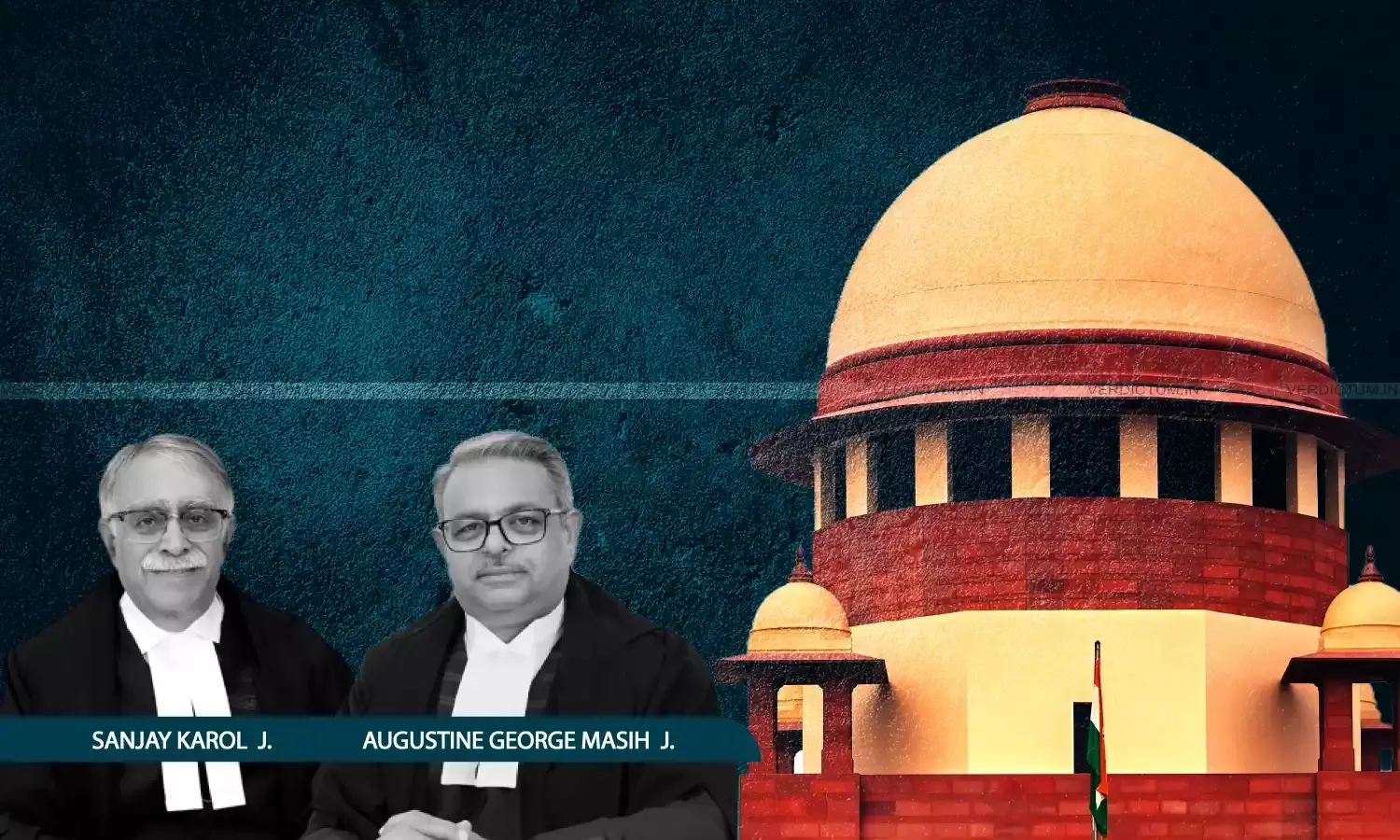
While dealing with a property dispute matter, the Supreme Court has dealt with the concept of 'bona fide requirement.
The Apex Court was considering an appeal against the order of the Punjab & Haryana High Court.
The Division Bench of Justice Sanjay Karol and Justice Augustine George Masih held, "First and foremost, the existence of the landlord-tenant relationship is essential. While it is true that a landlord has the right to enjoy his own property, the law does not grant its refuge to any arbitrary action, and so a landlord simply by virtue of that status, cannot show someone the door without the due process of law. It is here that bona fide requirement comes in. Bona fide translates to ‘in good faith’ which then predicates the requirement that may be faced by a landlord."
"Whether or not, in a particular set of circumstances a landlord’s decision to ask his tenant to vacate, falls within ‘bona fide requirement’ is not something that can be determined by a mathematical formula", it added.
AOR Anurag represented the Appellant while Amicus Curiae represented the Respondent.
Factual Background
One Kamla Devi had filed a suit for eviction against the respondent – tenant, on the grounds of non-payment of rent and bona fide requirement for herself and her son Madan Mohan. Both died, and the appeal was being prosecuted by their legal representatives. The Rent Controller, Nabha and the Appellate Authority, Patiala both found the case of the landlord to be proved and thus decreed the eviction. However, the High Court of Punjab and Haryana in the impugned judgment reversed these findings. Taking note of Section 13 of the Act, and the pleadings of the parties, it was observed that despite the fact having been pointed out, Kamla Devi denied that one of her shops was lying vacant. Allowing the Revision, the High Court held that she had concealed the existence of the third shop and only in the evidence she stated that Adarsh Mohan was using the third shop.
Reasoning
Dealing with the aspect of ‘bona fide requirement’, the Bench stated that bona fide translates to ‘in good faith’, which then predicates the requirement that may be faced by a landlord.
The Bench took note of the fact that right from the beginning the ‘bona fide requirement’ was pleaded by both Kamla Devi and Madan Mohan and it was concurrently held as such by the RA and the AA. “The primary reason why the High Court overturned the decision of the Courts below was that the landlady (Kamla Devi) had not come to the Court with clean hands and had concealed the availability of the third shop. It was observed that the said shop was used to store garbage. If the shop that is alleged to be an alternate accommodation was being used for storing waste material as has been held by both the RA and the AA, then that being the finding of fact, what occasioned the High Court to take a different view in civil revisional jurisdiction? The old saying is, ‘one man’s trash is another man’s treasure’. So, even if the statement is accepted as it is, we fail to see what is wrong with it. Let it be used as such. After all, right from beginning the ‘bona fide requirement’ was pleaded for by both Kamla Devi and Madan Mohan. It was concurrently held as such by the RA and the AA. The one that had hitherto been rented, will now be used as a shop to run a boutique", it held.
Reiterating that the scope of Section 115 Code of Civil Procedure is limited, the Bench set aside the judgment passed by the High Court.
“The concurrent findings and orders of the Rent Controller, Nabha dated 27th May 2010 and the Appellate Authority, Patiala are hereby affirmed”, the Bench held while allowing the appeal and directing the respondent to deliver vacant and peaceful possession of the demised shop to the appellants within two months.
Cause Title: Madan Mohan (Dead) Through Lrs. v. Thakar Dass (Dead) (Neutral Citation: 2026 INSC 730)