

Second Application Under Order VII Rule 11 CPC Barred By Res Judicata If Earlier Plea Decided & Attained Finality: Supreme Court
The Bench noted that interlocutory finality and commonality of legal title prevent successive pleas by co-defendants sharing identical interests.

The Supreme Court has ruled that a subsequent application under Order VII Rule 11 of the Code of Civil Procedure, 1908 seeking the threshold rejection of a plaint is barred by the doctrine of res judicata if an earlier plea raising substantially the same challenge has already been decided and allowed to attain finality. It observed that litigants cannot circumvent the finality of an adverse interlocutory order merely by shifting between different sub-clauses of the provision or by putting forward a different set of legal representatives to re-agitate the same summary dismissal.
The Bench clarified that the principle of interlocutory finality fully binds co-defendants who litigate under a common title and share an identical interest in protecting a disputed property transaction.
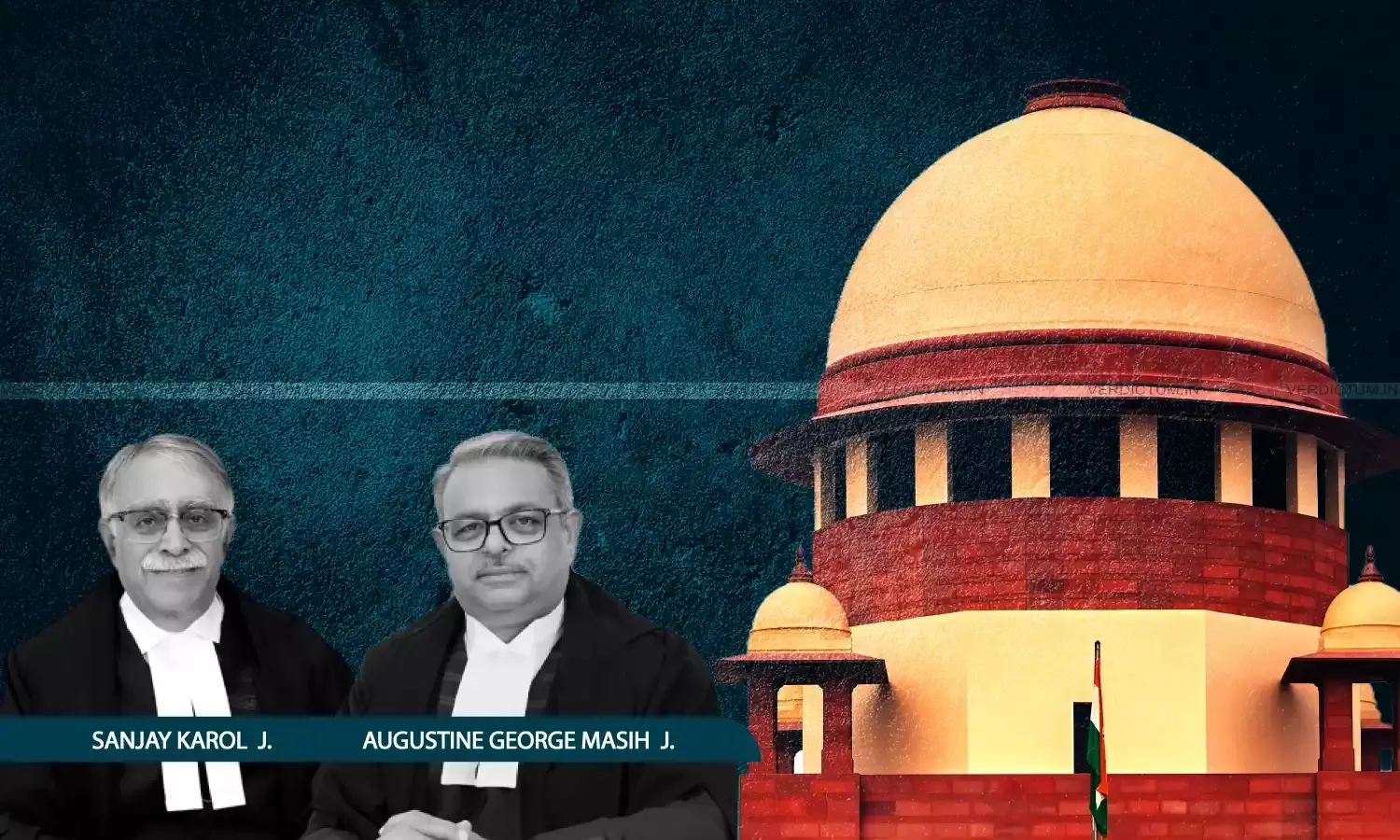
Justice Sanjay Karol and Justice Augustine George Masih observed, “…Explanation IV to Section 11 of the CPC provides that ‘any matter which might and ought to have been made ground of defence or attack in such former suit shall be deemed to have been a matter directly and substantially in issue in such suit’. The respondents’ submission that the two applications were filed under different subclauses of Order VII Rule 11, the first under clause (d) alone and the second under clauses (a), (b) and (d) is of no consequence. The ground that the plaint does not disclose a cause of action [clause (a)] or is defective [clause (b)] could have been, and indeed ought to have been, raised in the first application. The mere invocation of additional sub-clauses in the second application does not take the matter outside the scope of res judicata. The substance of the issue, whether the plaint should be rejected on the ground that the suit is barred by Section 6(5) of the H.S. Act, remains the same. A party cannot circumvent the finality of an adverse order by re-framing the same challenge under a different procedural provision”.
“…we are of the considered view that the High Court committed an error in allowing the second application under Order VII Rule 11, which was barred by res judicata, in holding that Section 6(5) of the Act creates a bar to the institution of the suit, and in rejecting the plaint at the threshold without permitting the trial to proceed on the contested questions of fact and law...”, it further noted.
Senior Advocate Kiran Suri appeared for the appellant and Senior Advocates Anand Sanjay M Nuli, Puneet Jain appeared for the respondents.
The Bench explained that a subsequent legal precedent does not override res judicata unless the core legal foundation of the initial determination has been completely undermined by the new ruling. Because the landmark judgment in Vineeta Sharma v. Rakesh Sharma and Others (2020) 9 SCC 1 dealt exclusively with retroactive coparcenary rights under Section 6, it left the independent statutory devolution rights of daughters under Section 8, which formed the undisturbed basis of the final 2013 maintainability order, completely untouched.
The brief facts of the case were that after the death of the propositus, B.M. Seenappa, who died intestate on March 06, 1985, a widow, four sons, and three daughters were left in the family. The defendants claimed that an oral partition occurred in September 1985, followed by a written family settlement (Palupatti) in 1988 where the daughters allegedly received monetary compensation and signed as consenting witnesses.
However, the daughters disputed the nature and validity of these transactions. Instead, the sons and mother secretly executed a registered Partition Deed on June 16, 2000, dividing the properties exclusively among themselves and completely excluding the three daughters from any allotment. 0n July 11, 2007, the daughters instituted a suit seeking a 1/8th partition share in the suit schedule properties as co-owners.
Thereafter, the mother and three sons initially preferred an application under Order VII Rule 11(d) in 2008, resulting in a Trial Court order rejecting the plaint on statutory grounds. The Karnataka High Court reversed this in January 2013, holding that because the father died intestate, the daughters held an independent maintainable right to claim a share in the father's estate as Class I heirs under Section 8 of the Act.
This maintainability order went unchallenged and attained finality, however, 8 years after issues were framed, the legal representatives of the deceased fourth son filed a second application under Order VII Rule 11(a), (b), and (d) citing a change in law via Vineeta Sharma. While the Trial Court dismissed the application on res judicata, the Karnataka High Court reversed it in revision, prompting this apex appeal.
The Bench framed three issues in the matter, and answered them accordingly.
(i) Whether the second application under Order VII Rule 11 (I.A. No. IV) is barred by the principle of res judicata.
“(i) The second application under Order VII Rule 11 of the CPC (I.A. No. IV, filed 16.12.2021 by the legal representatives of Defendant No. 4) is barred by the principle of res judicata, inasmuch as the identical issue was directly and substantially in issue in the first Order VII Rule 11 proceedings, was heard and decided by the High Court attained finality. The legal representatives of Defendant No. 4 litigate under the same title as Defendant Nos. 1 to 3 within the meaning of Explanation VI to Section 11 of the CPC, and the decision of this Court in Vineeta Sharma (supra) does not constitute a ‘change in law’ relevant to the basis of the 2013 order”, the Bench said.
(ii) Whether Section 6(5) of the H.S. Act operates as a bar to the institution of a suit, warranting rejection of the plaint under Order VII Rule 11(d).
“(ii) Section 6(5) of the H.S. Act is a saving clause of narrow and strict application. It does not create a jurisdictional bar to the institution of a suit for partition. Whether a valid partition within the meaning of Section 6(5) has been effected, and whether such partition is binding on persons who were not parties to it, are contested questions of fact and law that must be adjudicated at trial. The High Court erred in rejecting the plaint at the threshold on the basis of Section 6(5)”, the Bench answered.
(iii) Whether the appellants have a right under Section 8 of the H.S. Act that is independent of the 2005 Amendment and unaffected by Section 6(5).
“(iii) The appellants have an independent right under Section 8 of the H.S. Act, 1956 as Class I heirs of the propositus who died intestate on 06.03.1985. This right accrued in 1985 by operation of the proviso to the erstwhile Section 6 read with Section 8, is independent of the 2005 Amendment, and is unaffected by Section 6(5). The suit is maintainable, at minimum, to the extent of the appellants’ claim in the share of the propositus”, the Bench, thus, observed.
Accordingly, the Court allowed the appeal, set aside the High Court's revisionary order, and restored the plaint to the file of the Trial Court for an expedited trial on merits, ordering the parties to maintain the status quo regarding the subject properties in the interim.
Cause Title: B.S. Lalitha & Ors. v. Bhuvanesh & Ors. (Neutral Citation: 2026 INSC 499)
Appearances:
Appellant: Kiran Suri, Sr. Adv., S.j. Amith, Aishwarya Kumar, Dr. Vipin Gupta, AOR, Krishna Kumar, Nandani Gupta, Advocates.
Respondents: Shankar Divate, AOR, Anand Sanjay M Nuli, Sr. Adv., Dharam Singh, Suraj Kaushik, Nanda Kumar K B, Akhila Wali, Shiva Swaroop, Abhishek Kanyalur, Divya Sinha, Ashritsai Torgal, Tanya Chillar, M/S. Nuli & Nuli, AOR, Christi Jain, AOR, Puneet Jain, Sr. Adv., Om Sudhir Vidyarthi, Akriti Sharma, Aditya Jain, Siddharth Jain, Harsh Jain, Yogit Kamat, Sudhanshu Prakash, AOR, Anisha Agarwal, Arpit Yadav, Ishrafil Ansari, Advocates.
Click here to read/download the Judgment