RBI Bank Merger Scheme Cannot Override Section 14(1)(b) DRC Act: Supreme Court Restores Eviction Decree Against PNB
The Court held that an amalgamation scheme framed by the RBI under Section 45 of the Banking Regulation Act is administrative in nature and cannot be treated as a statutory enactment so as to override the operation of Section 14(1)(b) of the DRC Act.
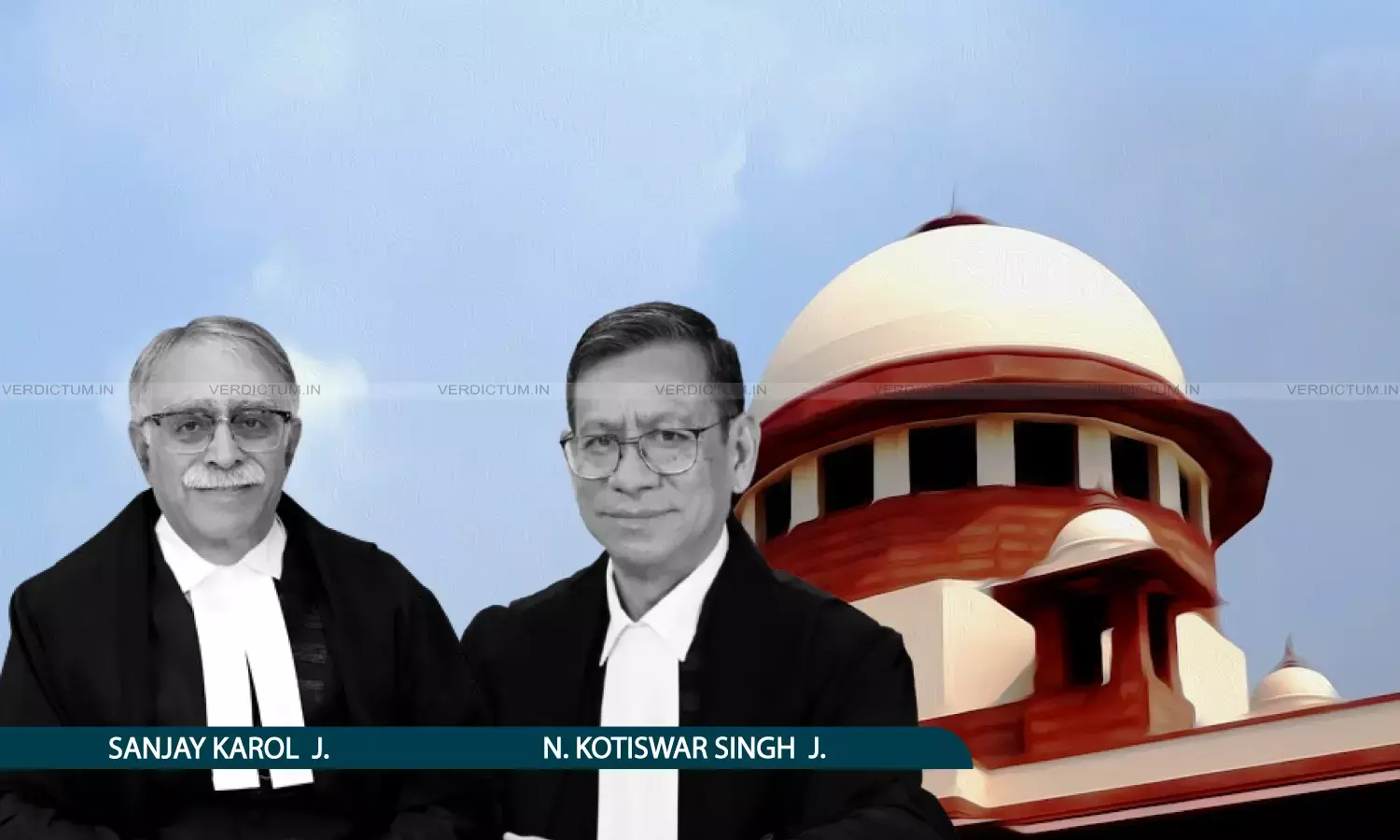
Justice Sanjay Karol, Justice N. Kotiswar Singh, Supreme Court
The Supreme Court has held that an RBI bank merger scheme framed under Section 45(4) of the Banking Regulation Act, 1949, cannot be treated as a statutory enactment capable of overriding Section 14(1)(b) of the Delhi Rent Control Act, 1958, while restoring an eviction decree against Punjab National Bank.
The Court was hearing an appeal filed by the British Motor Car Company challenging the judgment of the Delhi High Court, which had set aside the eviction decree passed by the Additional Rent Control Tribunal in proceedings arising out of an eviction petition under Section 14(1)(b) read with Section 14(1)(j) of the DRC Act.
A Bench of Justice Sanjay Karol and Justice Nongmeikapam Kotiswar Singh observed: “ … the amalgamation scheme framed by the Reserve Bank of India, in exercise of power under Section 45(4) of the BR Act, cannot be accorded the status of a statutory enactment so as to override the operation of Section 14(1)(b) of the DRC Act.”
Senior Advocate Shyam Divan appeared for the appellant, while Advocate Rajesh Kumar Gautam appeared for the respondents.
Background
The landlord had let out the tenanted premises to Hindustan Commercial Bank for non-residential purposes. Subsequently, HCB was amalgamated with PNB under a scheme framed by the RBI under Section 45 of the Banking Regulation Act. Upon the scheme taking effect, all rights and liabilities of HCB stood vested in PNB, which came into possession of the tenanted premises.
The landlord filed an eviction petition contending that HCB had sublet, assigned or otherwise parted with possession of the premises in favour of PNB without written consent, thereby attracting Section 14(1)(b) of the DRC Act. The Additional Rent Controller dismissed the petition, holding that the amalgamation scheme was statutory and binding, but the Additional Rent Control Tribunal reversed the decision and passed an eviction decree, holding that the written consent of the landlord was mandatory before any assignment or parting with possession.
The High Court set aside the eviction decree, holding that the merger was an involuntary statutory act and that the ground of subletting was not available to the landlord. Before the Supreme Court, the landlord contended that Section 14(1)(b) does not distinguish between voluntary and involuntary transfer of possession, while the respondents argued that vesting of tenancy rights in PNB occurred through a statutory scheme and could not amount to assignment or parting with possession.
Court’s Observations
The Supreme Court identified the short question as whether the amalgamation of HCB with PNB, effected pursuant to the scheme framed under the Banking Regulation Act, attracted Section 14(1)(b) of the DRC Act.
The Court examined Section 14(1)(b), which permits eviction where the tenant has sublet, assigned or otherwise parted with possession of the whole or any part of the premises without obtaining the landlord’s written consent. It noted that two ingredients must be satisfied before eviction can be ordered under the provision: the tenant must have sublet, assigned or parted with possession, and such act must have been done without the written consent of the landlord.
Referring to Jagan Nath v. Chander Bhan (1998), the Court reiterated the meaning of parting with possession in the context of rent control law. The Court noted that mere use by another person is not enough if the tenant retains legal possession, but where the tenant divests himself of physical possession as well as the right to possession, Section 14(1)(b) is attracted.
The Court referred to the following exposition in Jagan Nath: “It is well settled that parting with possession meant giving possession to persons other than those to whom possession had been given by the lease and the parting with possession must have been by the tenant; user by other person is not parting with possession so long as the tenant retains the legal possession himself, or in other words there must be vesting of possession by the tenant in another person by divesting himself not only of physical possession but also of the right to possession. So long as the tenant retains the right to possession there is no parting with possession in terms of clause (b) of Section 14(1) of the Act.”
The Court then considered the legal effect of amalgamation and noted that when two companies amalgamate and merge into one, the transferor company ceases to exist as a separate entity. In the present case, the amalgamation of HCB with PNB resulted in all assets, rights, liabilities and obligations of HCB vesting in PNB, while HCB itself ceased to exist.
The Court referred to Parasram Harnand Rao v. Shanti Parsad Narinder Kumar Jain (1980) and Singer India Ltd. v. Chander Mohan Chadha (2004), and held that Section 14(1)(b) is wide enough to cover not merely subletting, but also assignment and every other mode by which possession of tenanted premises is parted. It observed that the applicability of the provision depends on the occurrence of a factual situation, namely subletting, assignment or parting with possession, and not upon whether such transfer is voluntary or involuntary.
The Bench observed: “The exposition of law emerging from the aforesaid decisions is clear. Section 14(1)(b) of the DRC Act is wide enough to encompass every mode by which possession or tenancy rights of the demised premises are transferred from the original tenant to another entity. Once the possession of the tenanted premises, together with the accompanying rights, passes to an entity other than the original tenant without the written consent of the landlord, and the tenant losing its identity and control of possession of the tenanted premises, Section 14(1)(b) of the DRC Act stands automatically attracted. Therefore, what is material is that – (a) there is a transfer of tenancy rights and possession of the tenanted premises; and (b) such transfer is done without the written consent of the landlord.”
Applying the law to the facts, the Court held that once HCB ceased to exist and its rights, liabilities, assets and interests, including tenancy rights, stood vested in PNB, HCB had parted with possession and PNB came to occupy the premises. Since the transfer took place without the landlord’s written consent, both ingredients of Section 14(1)(b) stood fully satisfied.
Rejecting the respondents’ attempt to distinguish earlier precedents on the ground that those cases involved voluntary amalgamation under the Companies Act, the Court held that Section 14(1)(b) does not carve out any exception for transfers effected through a scheme of amalgamation.
The Bench observed: “The respondent(s), per contra, have sought to distinguish the aforesaid line of judicial precedents merely because they arose in the context of amalgamations effected under Sections 391 r/w Section 394 of the Companies Act 1956, where the process was initiated by the companies themselves and was thus voluntary in nature.According to the respondent(s), since the amalgamation in the present case was effected pursuant to a Gazette Notification and a scheme prepared by RBI under Section 45 of the BR Act, the transfer of tenancy rights and possession must be regarded as involuntary and falling outside the ambit of Section 14(1)(b). However, we are unable to agree with this contention and find it to be unsustainable in law.
The Bench added: “The ratio of Parasram Harnand Rao (supra) and Singer India Ltd. (supra) makes it abundantly clear that the applicability of Section 14(1)(b) upon occurrence of a factual situation, namely, sub-letting or assignment or otherwise parting with possession of the whole or any part of the premises by the tenant. The said provision does not distinguish between voluntary and involuntary transfers, nor does it carve out any exception in favour of transfers effected pursuant to a scheme of amalgamation or to secure compliance with law. Therefore, where, upon amalgamation effected under Section 45 of the BR Act, the tenancy rights vest in another entity and possession qua tenanted premises passes to it without the written consent of the landlord, the ingredients of Section 14(1)(b) shall stand fully satisfied. The reasons necessitating such transfer or whether it was voluntary or involuntary, are wholly immaterial for the purposes of attracting the said provision.”
The Court further held that the respondents’ contention that the RBI scheme under Section 45 of the Banking Regulation Act was legislative in nature was misconceived. Referring to K.I. Shephard v. Union of India, the Court held that the scheme-making process under Section 45 of the Banking Regulation Act is administrative and not legislative.
The Bench noted that merely because a scheme framed under Section 45 is sanctioned by the Central Government and placed before Parliament, it does not acquire the character of a legislative enactment. Therefore, such a scheme could not override the operation of Section 14(1)(b) of the DRC Act.
The Supreme Court distinguished G. Sridharamurti v. Hindustan Petroleum Corpn. Ltd. (1995) and Hindustan Petroleum Corpn. Ltd. v. Shyam Coop. Housing Society (1988), which had been relied upon by the respondents. It noted that those decisions were rendered in the context of the Esso (Acquisition of Undertakings in India) Act, 1974, which expressly provided for the vesting of tenancy rights in the Central Government by operation of statute.
The Bench observed: “The decisions relied upon by the respondent(s), viz., G. Sridharamurti (supra) and Shyam Coop. Housing Society (supra) are clearly distinguishable and have no application to the facts of the present case. These decisions were rendered in the context of the Esso (Acquisition of Undertakings in India) Act, 1974, a legislative enactment which expressly provided for the vesting of tenancy rights in the Central Government by operation of Sections 5 and 7 thereof. By virtue of these statutory provisions, the Central Government was held to have become a statutory tenant. The present case, however, stands on a completely different footing. Here, we are dealing with a scheme of amalgamation effected under Section 45 of the BR Act which, as held in K.I. Shephard (supra), is not a legislative enactment. The aforesaid decisions, therefore, lend no support to the case of the respondent(s).”
The Supreme Court further held that the High Court had misplaced reliance on Mrs Asha Rohatgi v. Erstwhile New Bank of India through General Manager PNB. The Court noted that the said decision arose in the context of an amalgamation under Section 9 of the Banking Companies (Acquisition and Transfer of Undertakings) Act, 1980, whereas the present case involved a scheme under Section 45 of the Banking Regulation Act.
Referring to New Bank of India Employees' Union v. Union of India, the Court held that schemes under Section 9 of the Acquisition Act and schemes under Section 45 of the Banking Regulation Act are not pari materia. It noted that while a scheme under the Acquisition Act was held to be legislative in nature, a scheme under the Banking Regulation Act was merely required to be placed before Parliament and was administrative in nature.
Conclusion
The Supreme Court held that the amalgamation of HCB with PNB rendered PNB liable to be evicted from the tenanted premises under Section 14(1)(b) of the DRC Act.
The appeal was accordingly allowed. The judgment of the High Court was set aside, and the eviction decree passed by the Additional Rent Control Tribunal was restored.
Since the respondents had remained in possession for a long time, the Court granted time till January 31, 2027, to deliver peaceful and vacant possession of the tenanted premises to the appellant. The respondents were directed to furnish an undertaking before the Court within four weeks and continue paying rent on contractual terms or as fixed by the Courts below. In case of default, the appellant was granted liberty to proceed for taking possession in accordance with the law.
Pending applications, if any, were directed to be disposed of.
Cause Title: British Motor Car Company (1939) Ltd. v. M/s Hindustan Commercial Bank Ltd. Since Has Been Merged Into Punjab National Bank & Anr. (Neutral Citation: 2026 INSC 671)
Appearances
Appellant: Senior Advocates Shyam Divan and Shyam Mehta.
Respondents: Advocate Rajesh Kumar Gautam.