

Eligibility Is Mere Qualifying Condition Which Can’t Create Right Where No Post Exists: Supreme Court
The appellant lecturer approached the Supreme Court challenging the final judgment passed by the Division Bench of the Jharkhand High Court.

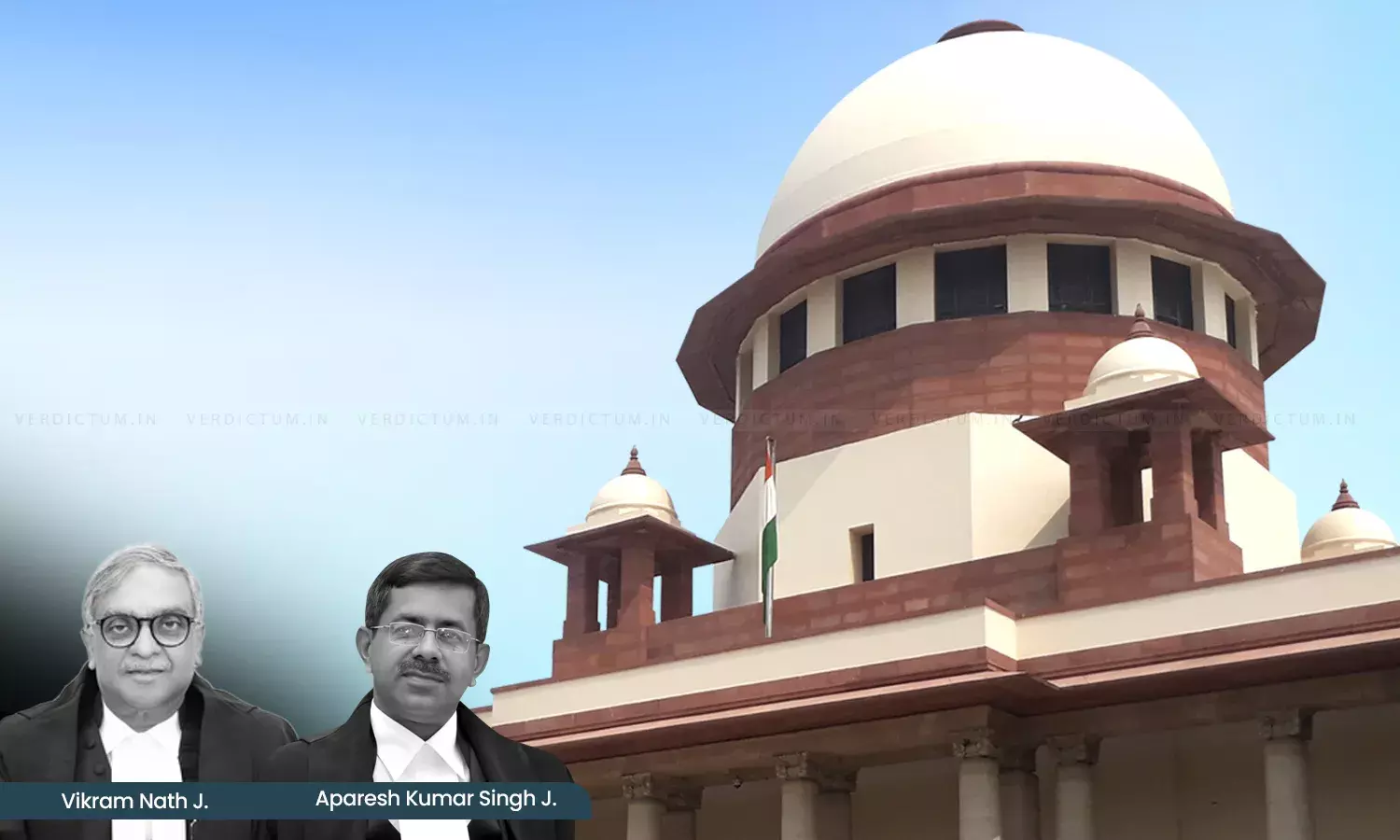
While dismissing an appeal, the Supreme Court has observed that eligibility is merely a qualifying condition and it cannot create a right where no post exists.
The appellant approached the Apex Court challenging the final judgment passed by the Division Bench of the Jharkhand High Court (Appellate Court) in Letters Patent Appeal (impugned judgment), setting aside the order whereby the respondent-University was directed to consider the case of the appellant and pass an appropriate order regarding fixation of the date of absorption in the S.J.S.N. College, Garhwa from the date of acquiring eligibility.
The Bench comprising Justice Vikram Nath and Justice Aparesh Kumar Singh held, “Annexure IV-A of the Justice Agrawal Commission Report does not, by itself, entitle the appellant to absorption from 05.12.1987. Its heading itself reads “Teaching staff who are eligible to be considered for absorption”, and the names of the teachers are arranged with reference to their respective dates of eligibility. Eligibility is merely a qualifying condition and cannot create a right where no post exists. Annexure IV-A merely records the academic eligibility of the teachers for the purpose of consideration of absorption and does not determine the category of the post against which each teacher was appointed. The column for ‘Nature of appointment’ is left blank in the said Annexure.”
AOR Neeraj Shekhar represented the Appellant while Advocate Tarkeshwar Nath represented the Respondent.
Factual Background
The appellant was appointed as a Lecturer in the said college on February 22, 1986 on the fifth post in the Department of Hindi. On that date, the appellant did not have the basic minimum qualifications to be appointed as a University teacher, which he subsequently acquired on December 5, 1987. Meanwhile, the college was converted into a constituent college of Ranchi University in pursuance of the Government of Bihar’s letter, with March 31, 1987 as its cut-off date. By the said cut-off date, only three posts of Lecturer in Hindi had been sanctioned in the said college. The fourth post was sanctioned on November 13, 1987. These four posts were held by Ram Naresh Pathak, Subarn Mahto, Ghanshyam Pandey and Baij Nath Rai, all of whom were working in the college before the appellant was appointed. All these four persons were later absorbed on the said four posts of Hindi lecturers in terms of the recommendation of the One-Man Commission headed by Justice S.C. Agrawal (Retd.) (Justice Agrawal Commission).
The appellant was identified by the Justice Agrawal Commission to be eligible for absorption on December 5, 1987, i.e. the date on which the appellant obtained M.A. degree with the required qualifying marks. His name was included in the Report at Sr. No.4 in the Hindi Department, which, as per the appellant, showed that he was appointed against the sanctioned post and became eligible for absorption from the said date. Another commission, the Justice Sinha Commission, upheld the absorption of the appellant with effect from June 1, 2003, when one post had become vacant following the retirement of Ram Naresh Pathak on May 31, 2003, one of the four lecturers absorbed in the said college and working against a sanctioned post.
The appellant filed a writ petition, and the Writ Court held that the Report of the Justice Sinha Commission was not binding and the University had acted contrary to the Justice Agrawal Commission’s Report. The respondent University, being aggrieved, preferred a Letters Patent Appeal. The Appellate Court set aside the judgment of the Writ Court. The appellant thus preferred the Special Leave Petition before the Apex Court.
Reasoning
On a perusal of the facts of the case, the Bench held that the remark ‘R-1’ against the appellant’s name in Annexure III-A couldnot create a recommendation which the Justice Agrawal Commission itself found did not exist. “Thus, the placement of the appellant herein at Sr. No.4 in Annexure IV-A, above Sh. Ghanshyam Pandey, reflects only his earlier date of eligibility. It therefore cannot be the basis for absorption from 05.12.1987”, it added.
The Bench was of the view that the claim of the appellant based on his eligibility of having acquired the minimum qualifying marks of 65% in M.A. Degree on December 5, 1987 before Ghanshyam Pandey, based upon Annexure IV-A of Justice Agrawal Commission Report alone could not form the basis for his absorption, since the four sanctioned posts were held by teachers appointed before him.
“The opinion of the Writ Court based upon Annexure IV-A of Justice Agrawal Commission’s Report hence does not stand the test of judicial scrutiny. The Appellate Court has correctly observed that appellant herein could not claim to be absorbed on the fifth post on the basis of eligibility alone as only four posts were sanctioned as on 05.12.1987 when the appellant herein attained the minimum qualifying marks for eligibility”, it held.
Thus, holding that the findings of the Writ Court on the question of absorption of the appellant could not be upheld, the Bench dismissed the appeal and clarified that the impugned judgment rendered by the Appellate Court, having taken the correct view of the matter, needed no interference.
Cause Title: Brij Kumar Mishra v. Nilamber Pitambar University & Ors. (Neutral Citation: 2026 INSC 1271)
Appearance
Appellant: AOR Neeraj Shekhar, Advocates Rajesh Kumar Maurya, Kshama Sharma, Ujjwal Ashutosh, Ritwik Prasad, Minakshi Singh
Respondent: Advocates Tarkeshwar Nath, A.K.Singh,Harshit Singh, Satyam Roy, Anant Dev, AOR Rameshwar Prasad Goyal, AOR Gopal Prasad