Police Opinion In Final Report Not Binding On Cognizance; Court Alone Decides Whether Trial Should Be Joint Or Separate: Supreme Court
The Supreme Court held that a Magistrate is not bound by the police opinion in a final report while deciding cognizance, and that committal orders do not determine whether trials must be single, separate or joint.
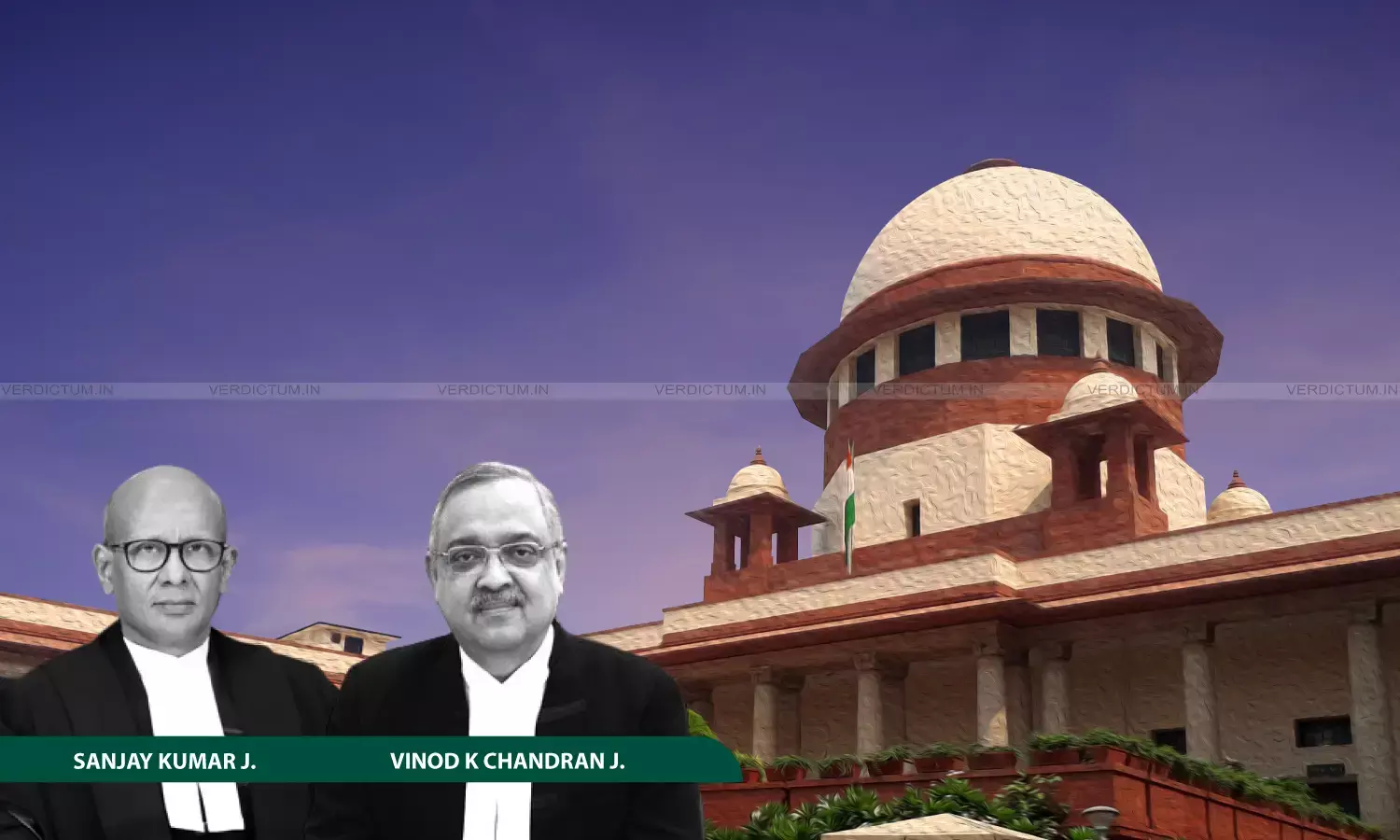
The Supreme Court has held that the opinion of the investigating officer in a final report is not decisive of cognizance, since the Magistrate may accept the report, take cognizance on the material disclosed, or direct further investigation.
The Court further held that committal orders do not determine whether the trial should be single, separate or joint, which remains within the Court’s discretion under the CrPC, provided no prejudice is caused to the accused.
The Court was hearing an appeal filed by a man convicted of dowry death and cruelty after two sessions of trials arising from two final reports filed on the same FIR. The High Court had remanded the matter to the trial court on the premise that the convicted accused was not present when some witnesses were examined in a connected case before the proceedings were clubbed.
A Bench of Justice Sanjay Kumar and Justice K. Vinod Chandran observed: “…the formation of opinion as to whether or not there is a case to place the accused on trial is exclusively with the officer in charge of the investigation. If a closure report is filed; finding no case made out, it is not open to the Magistrate to direct the police to file a charge sheet. It was also clarified that this is not to say that the Magistrate is absolutely powerless since the Magistrate is competent to proceed to take cognizance of the offence, on the materials revealed in the investigation, under Section 190 which imports a judicial discretion on the Magistrate to receive such report under Section 173. The Magistrate, hence, is not bound to accept the opinion of the police that there is no case to place the accused on trial as it is always open to take a contrary view on the facts disclosed in the report.”
Further, while explaining that “a committal order just gives the Sessions Court cognizance over the trial of the persons committed and is not the basis of the cognizance taken for trial” and that “if there is no prejudice to the accused, multiple committal orders can be consolidated to try the accused at one trial, provided it is justified under Sections 233 to 239 of the CrPC”, the Bench held that “the above discussion makes it crystal clear that the opinion in the final report filed is not decisive of the cognizance and the committal order/s is/are not determinative of whether the trial is single/separate/joint; which is at the exclusive discretion of the Court.”
Background
The case arose from the death of a woman who suffered burn injuries in her matrimonial home and later died in hospital. An FIR was registered on the basis of a complaint filed by her father, naming the husband and several members of the matrimonial family.
The first final report stated that offences under Sections 498A and 304B read with Section 34 IPC and Sections 3/4 of the Dowry Prohibition Act appeared to be made out, but a charge-sheet was filed only against the father-in-law and mother-in-law, with further investigation continued against the remaining accused. That trial ended in acquittal.
A later final report filed after further investigation stated that no further evidence had been found against the remaining accused. In the second trial, several accused were acquitted and the husband alone was convicted.
The Supreme Court noted at the outset that the case alleged “a serious procedural deviation” involving two trials from two final reports on the same FIR, leading to the conviction of only one accused despite the further investigation having unearthed no evidence against the remaining accused.
Court’s Observation
The Court first examined whether cognizance could be faulted because the later report did not find fresh material against the remaining accused. Referring to H.N. Rishbud v. State of Delhi (1954), Abhinandan Jha v. Dinesh Mishra (1967), Ram Naresh Prasad v. State of Jharkhand (2009), H.S. Bains v. State (U.T. of Chandigarh) (1980), and Ramswaroop Soni v. State of M.P. (2020), the Court reiterated that the police may form an opinion during investigation, but the Magistrate retains judicial discretion while deciding cognizance.
The Court stated: “In the instant case the first charge sheet was filed only against the two accused and investigation was continued against the other 15 accused arrayed in the FIR, on instructions of the S.P, which should have been left to the Court taking cognizance, especially when the charge sheet found a trial enabled against all the accused. On submission of the first charge sheet and if there is felt a need for further investigation, ideally it should have been done with the orders of the Court and the commencement of trial ought to have awaited the completion of such investigation. But the cognizance taken by the Court against the fifteen accused, on the basis of the subsequent final report cannot be faulted since though the report on further investigation found no fresh material, the first report found the offence made out against all the accused, which was also before Court when the closure report was considered.”
The Court held that the course adopted could at best be described as an irregularity, but not an illegality or miscarriage of justice.
The Court then addressed the argument arising from the two trials and the later clubbing and de-tagging of the proceedings. Relying on Banwari v. State of U.P. (1962), the Court explained that separate committal orders do not necessarily require separate trials if the Code permits joint trial and no prejudice is caused.
The Court elaborated: “When separate commitments are made of distinct offences not coming within the exception to Section 233, they cannot be tried at one trial. But, if there are separate commitment orders; (i) of persons who could be tried together or (ii) of the same person for offences which could be tried together, the accused could still be tried at one trial. Persons accused of committing a particular offence or offences jointly or in the course of the same transaction are not put up for trial at the same time, oftener than ever for reason of some being not available. When they are later made available and subsequently committed, the Sessions Judge is not bound to have two separate trials, one with respect to each commitment, if the trial in the first instance has not commenced.”
The Court found that although the accused persons could have been tried together, the first trial had already commenced before the further investigation report was filed. The temporary joint trial and later separation of cases did not prejudice the appellant because the trial court considered only evidence recorded in his presence.
The Bench observed: “Herein, though triable together, before the report of further investigation was filed, the first trial commenced. Despite the futile exercise of a joint trial in between, the cases were separated before final adjudication. The relevant witnesses led on behalf of the prosecution and the defence were identical and no prejudice is caused to the accused, which persuades us to consider the matter on its merits.”
This finding was central to the Supreme Court’s decision not to endorse the High Court’s remand order and instead decide the matter on merits.
After resolving the procedural issue, the Court examined the prosecution case and found serious evidentiary gaps. It noted that no postmortem was conducted, no wound certificate was produced, and the prosecution did not properly establish what happened after the burn injuries were sustained, although the victim was first taken to a district hospital and later shifted to another hospital where she died.
The Court remarked: “It is distressing that no postmortem was conducted of the deceased who died in the hospital at Allahabad nor is any wound certificate produced. A person who sustained serious burn injuries having been admitted to the hospital, intimation would have gone to the jurisdictional police station; both at Mirzapur and Allahabad but not produced or even enquired into.”
The Court also found that the evidence of dowry demand was a bland repetition of a Rs.50,000 demand, while the defence produced material showing investments in the joint names of the husband and wife and treatment-related documents.
The Court criticised the trial court for ignoring defence evidence despite substantive testimonies and documents remaining uncontroverted. It reiterated that the accused is not required to prove innocence, and that a reasonable hypothesis of innocence must benefit the accused.
The Bench underscored: “The defence evidence was given a complete go by without any valid reasons, despite the substantive testimonies and credible documents produced, remaining uncontroverted. The prosecution has failed to establish the charges beyond reasonable doubt and the attendant circumstances coupled with the defence evidence brings forth a probable hypothesis of innocence. The trial courts would do well to bestow equal attention to the defence evidence as that bestowed on the prosecution evidence. There is no cause to approach the defence evidence with distrust, suspicion or even scepticism. The accused is not obliged to prove his/her innocence and if a reasonable doubt is raised either from the unsatisfactory evidence led by the prosecution or from the evidence led by the defence its benefit should inure to the accused”.
Conclusion
The Supreme Court allowed the appeal, acquitted the appellant, reversed the Sessions Court’s conviction and set aside the High Court’s remand order. It directed that if the appellant had already been released on bail, his bail bonds would stand cancelled, and if he was still in custody, he should be released forthwith unless wanted in any other case.
Cause Title: Brajesh Kumar @ Birjesh Kumar Singh v. The State of Bihar (Neutral Citation: 2026 INSC 695)