

Complainant Under MRTU & PULP Act Has To Prove Employer-Employee Relationship If Management Denies Same: Supreme Court
The Supreme Court was considering an appeal filed at the instance of the employer, against the common judgment of the Bombay High Court.

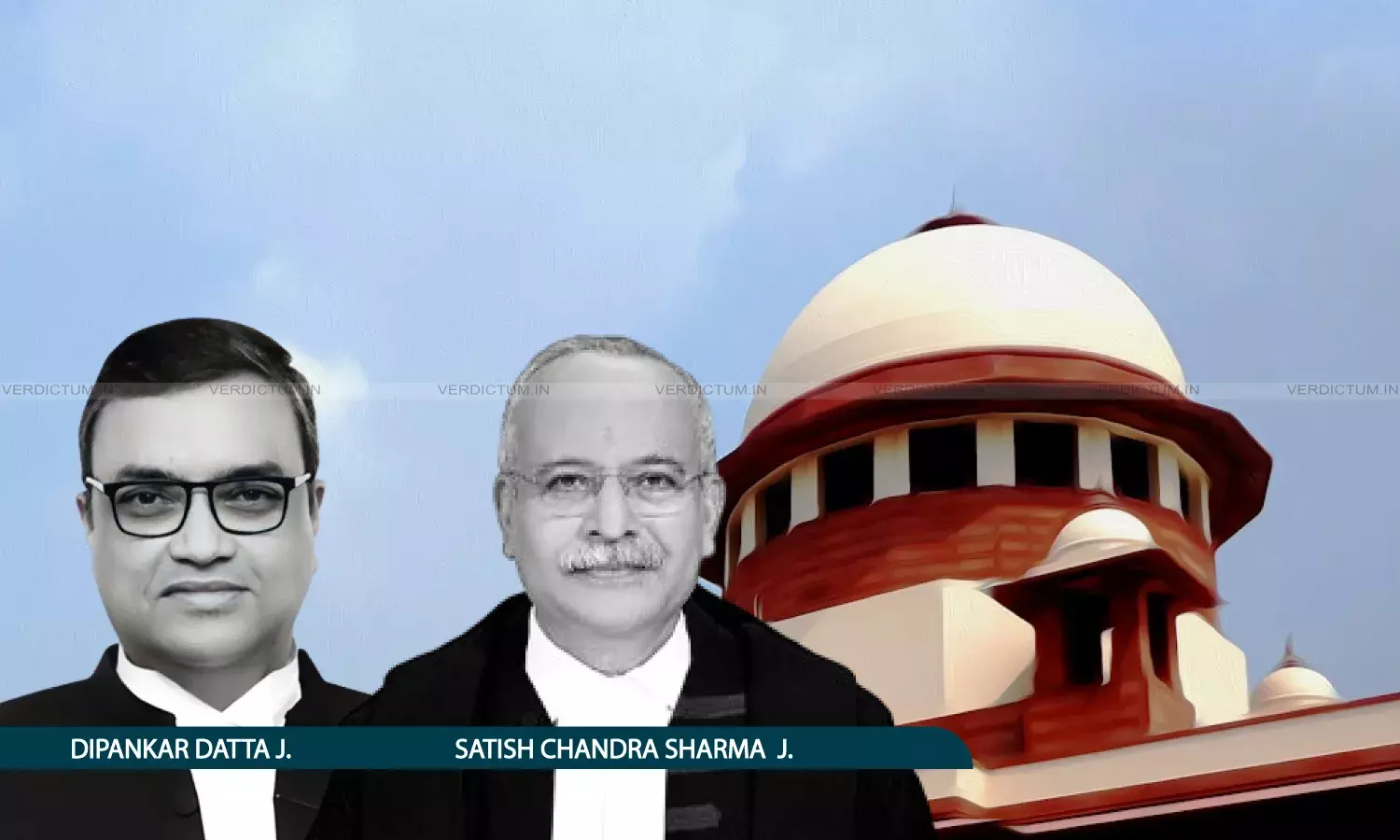
Justice Dipankar Datta, Justice Satish Chandra Sharma, Supreme Court
The Supreme Court has held that if in the course of adjudication of a complaint under the Maharashtra Recognition of Trade Unions and Prevention of Unfair Labour Practices Act, 1971 (MRTU & PULP Act), the management as a point of demurrer either denies the employer-employee relationship or disputes the status of an employee contending that he is not a workman, the burden would be on the complainant to prove the relationship or the status and persuade the Industrial Court to proceed ahead for consideration of grant of relief.
The Apex Court was considering an appeal filed at the instance of the employer, Bonatrans India Pvt. Ltd., which was aggrieved by the common judgment of the Bombay High Court.
The Division Bench of Justice Dipankar Datta and Justice Satish Chandra Sharma held, “It is, thus, obvious that if in course of adjudication of a complaint under the MRTU & PULP Act the management as a point of demurrer either denies the employer-employee relationship or disputes the status of an employee contending that he is not a workman, the burden would be on the complainant to prove the relationship or the status, as the case may be, then to persuade the Industrial Court to overrule the objection and proceed ahead for consideration of grant of relief, as prayed. This would imply, as in the present case, that the Union (which has been espousing the cause of the employees) has to prove that they are workmen within the meaning of ‘workman’ as defined in Section 2(s) of the ID Act and, therefore, the complaint is maintainable.”
Senior Advocate Sudhir K. Talsania represented the Appellant, while Advocate T. K. Prabhakaran represented the Respondent.
Factual Background
Proceedings before the Industrial Court, Aurangabad, under the Maharashtra Recognition of Trade Unions and Prevention of Unfair Labor Practices Act, 1971, were initiated by the Union by lodging a complaint claiming diverse relief. Prayers included declarations that the employer had engaged in unfair labor practices, disciplinary proceedings initiated against certain employees by the employer were ultra vires the terms and conditions of employment, etc. The employer had filed an objection questioning the status of the employees on whose behalf the complaint had been lodged by the Union. According to the employer, the employees were not workmen within the meaning of ‘workman’ defined by Section 2(s) of the Industrial Disputes Act, 1947 and hence, the complaint was not maintainable. The Industrial Court, however, in the face of opposition raised by the Union, did not frame any preliminary issue.
The Industrial Court declined to protect the employees from facing the enquiry which had been initiated by the employer. This order formed the subject matter of challenge before the High Court in the Union’s writ petition. The High Court also asked the Industrial Court to frame the issue whether the respondent/employer could prove that the employees, for whom the complainant Union was espousing the cause, were covered by the definition of workman under Section 2(s) of the Industrial Disputes Act, 1947. Aggrieved thereby, the employer petitioned the Apex Court under Article 136 of the Constitution.
Reasoning
The Bench explained that the principle Ei incumbit probation qui dicit, non qui negat translates to ‘the burden of proof lies on the one who asserts, not on the one who denies’. The Bench further stated that Section 104 of the Bharatiya Sakshya Adhiniyam, 2023 (former Section 101 of the Indian Evidence Act, 1872) embodies this principle by ordaining on whom the burden of proof lies. “Although the BSA, or for that matter the Evidence Act, does not strictly apply to adjudication under the MRTU & PULP Act, he who asserts must prove is the cardinal rule of evidence which admits of no exception and extends to all forms of adjudication”, it added.
As per the Bench, the Union (which has been espousing the cause of the employees) has to prove that they are workmen within the meaning of ‘workman’ as defined in Section 2(s) of the ID Act and, therefore, the complaint was maintainable. The Bench further stated, “Should the Union, in discharge of the burden of proof, fail to prove that the employees are indeed workmen, no further inquiry is required and the complaint would be closed. The position is so well settled in law that we need not refer to any precedent on the point.”
The Bench noted that the issue of whether the employees were workmen within the meaning of ‘workman’ as defined in Section 2(s) of the ID Act was considered by the Judge to be at the heart and soul of the litigation as well as the conflict between the employees and the employer. The Bench thus ordered, “In our considered opinion, the appeals can be disposed of by a modification of the issue framed by the learned Judge by replacing the expression ‘respondent/employer’ in the first line by ‘complainant-union’ and in the manner following: “Whether, the complainant-union, proves that the employees, for whom the complainant-union is espousing the cause are covered by the definition of workman under Section 2(s) of the ID Act?”
The Bench ordered that the recording of oral and documentary evidence before the Industrial Court be completed within a month. The Bench further clarified that if the issue regarding the applicability of definition of workman is decided in favour of the employer and against the Union, the employer would be free to pass the final order and take the disciplinary proceedings to its logical conclusion. “However, if the issue is decided in favour of the Union, the employer would be required to apply for and obtain permission from the Industrial Court to pass the final order, it ordered.
The Bench thus allowed the appeals in part with the aforementioned modifications.
Cause Title: Bonatrans India (Pvt.) Ltd. v. Bonatrans Employees Union (Neutral Citation: 2026 INSC 445)
Appearance
Appellant: Senior Advocate Sudhir K. Talsania, Advocates Sachin Dankh, Shivaji M. Jadhav, Aditya S. Jadhav, Brij Kishor Sah, Apurva, Vignesh Singh, AOR Shivaji M. Jadhav
Respondent: Advocate T. K. Prabhakaran, AOR Sandeep Sudhakar Deshmukh, Advocates Nishant Sharma, Ankur Savadikar, Kartik Sharma