

Prior Gram Sabha Consent Requirement For Land Acquisition Under RFCTLARR Act In Scheduled Areas Is Mandatory: Supreme Court
Setting aside land acquisition for a cement company’s mining project in Odisha, the Court held that the Section 41(3) requirement is “mandatory in nature” and that prior consent must be taken before the proposal is examined.

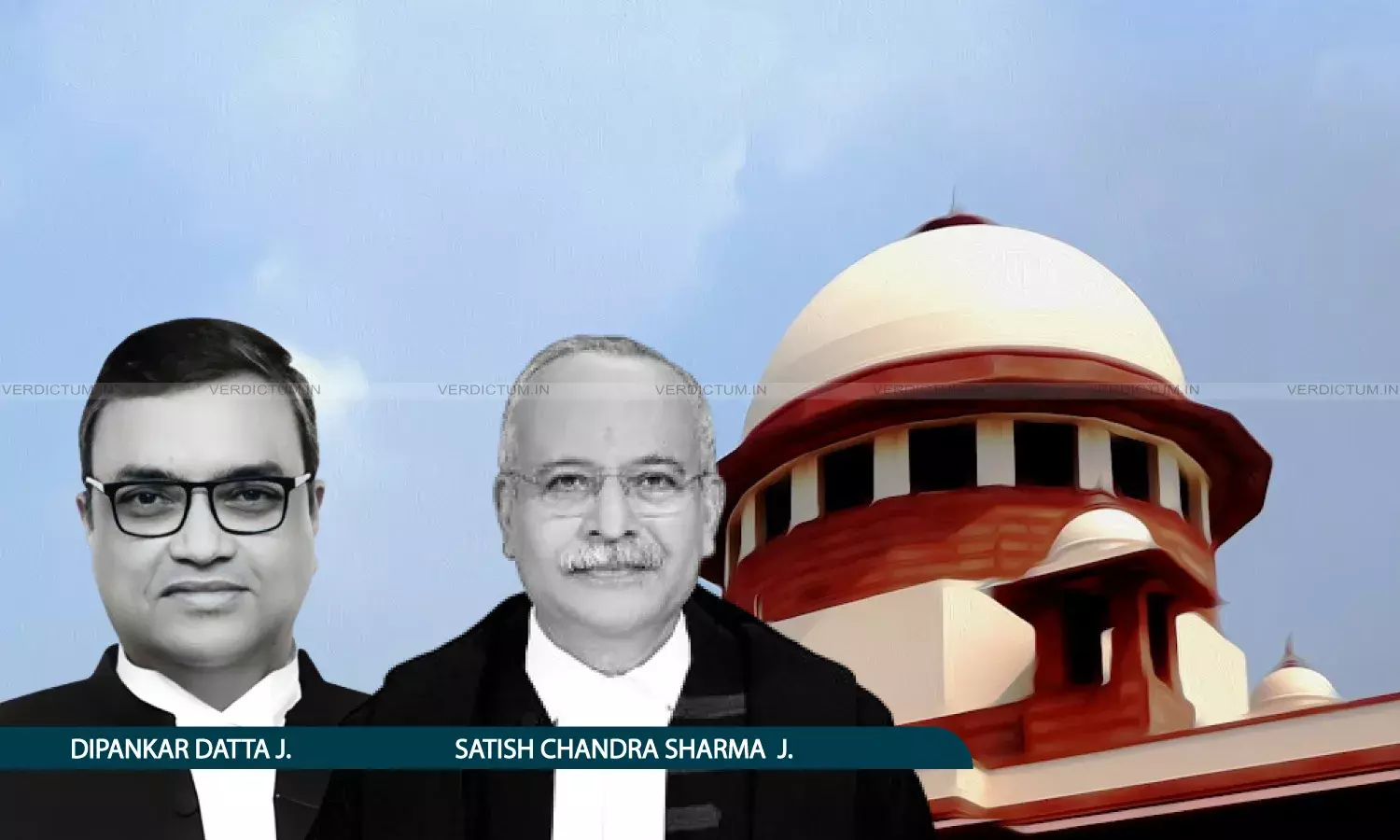
Justice Dipankar Datta, Justice Satish Chandra Sharma, Supreme Court
The Supreme Court has held that the requirement of prior consent of the Gram Sabha under Section 41(3) of the Right to Fair Compensation and Transparency in Land Acquisition, Rehabilitation and Resettlement Act, 2013 (LARR Act) is mandatory for land acquisition in Scheduled Areas, and cannot be treated as directory or advisory.
Setting aside the acquisition of land in three villages of Sundergarh, Odisha, for a cement company’s mining project, the Court also held that prior consent of affected families must be obtained before the Government examines the acquisition proposal, and that the independence of the Expert Group under Section 7 had been compromised.
A Bench of Justice Dipankar Datta and Justice Satish Chandra Sharma observed, “…At this juncture, the mandatory requirement of sub-section (3) cannot be negated by referring to the directory nature of the words used in sub-sections (1) and (2). To do so would not only be against the principle of simple and textual interpretation of the statute, but would also amount to a gross violation of the language and scheme of the statute. Therefore, we hold that the requirement of Section 41(3) of the Act is mandatory in nature, and there is nothing to suggest it to be directory or advisory”.
Senior Advocate Sanjay Parikh appeared for the appellant and Tushar Mehta, Solicitor General, K. M. Nataraj, A.S.G., Senior Advocate Rakesh Dwivedi appeared for the respondents.
“The observations are quite interesting, as they reflect the consciousness and concern of the legislature regarding the growing instances of compromising with the requirement of taking Gram Sabha’s prior consent and reducing it into a paper formality. The Committee not only restates that the requirement of such consent is mandatory in Scheduled Areas, but also recommends that such consent must be made mandatory to other areas as well. Unfortunately, the impugned judgment has the effect of reducing a mandatory statutory requirement into a paper formality. What is more concerning is that the present case is on an even worse footing. Far from a meaningful consent, there is not even paper consent of Gram Sabha in this case. This consent was required to be taken on Form M as per Rule 41 of Odisha Rules, and there is no such material on record. Contrarily, it is the admitted position that both the Gram Sabha(s) had expressly rejected the proposal at the threshold through the resolutions passed on 26.01.2020. Nevertheless, the respondents proceeded unhindered on the path of illegality”, the Bench had categorically said.
The appellants, residents of Kukuda, Bihabandha and Lanjiberna villages, challenged acquisition initiated by the State of Odisha at the instance of Dalmia Cements Bharat Limited, which held a mining lease extended till 2040 but needed surface rights over the land. The Gram Panchayats had unanimously rejected the proposal on January 26, 2020. Notifications under Sections 11 and 19 of the Act were nevertheless issued in 2021.
The Orissa High Court dismissed their writ petition on September 6, 2024. It held that prior consent was not required as the acquisition was by the State, that consent was a “continuing process”, and that Section 41 was directory in view of the words “as far as possible” and “demonstrable last resort”.
Reversing this, the Supreme Court held that an acquisition made for the exclusive purpose of mining by a private company falls under Section 2(2)(b), requiring prior consent of at least 80% of affected families in the prescribed manner. It called the “continuous process” view “erroneous”, and said subsequent consent would amount to rewriting the statute.
On Section 41, it held that sub-sections (1) and (2) are of “guiding value” while sub-section (3) operates in a different sphere. Absence of an express consequence did not make a provision directory, it added, and no Gram Sabha consent was on record.
The Court held that inclusion in the Expert Group of a member who was the company’s Advisor for Land Acquisition violated Section 7. It also found no material that a public hearing on the Social Impact Assessment took place, and held that the Mines and Minerals (Development and Regulation) Act, 1957 and the 2013 Act operate in distinct spheres.
The acquisition, notifications and the High Court judgment were set aside, with liberty to the State to begin fresh acquisition in accordance with law.
Cause Title: Bibol Toppo & Ors. v. State of Odisha & Ors. (Neutral Citation: 2026 INSC 1244)
Appearances:
Appellants: Sanjay Parikh, Sr. Adv., Abhimanue Shrestha, AOR, Sridevi Panikkar, Ashok Kumar Minj, Satwik Parikh, Kritika, Pritesh Patni, Antaryami Upadhyay, Dipankar Das, Sahil, Advocates.
Respondents: Tushar Mehta, Solicitor General, K. M. Nataraj, A.S.G., Pitambar Acharya, Advocate General, Divya Roy- 1820, AOR, Deveshi Mishra, Vinayak Sharma, Satyam Pahal, Ruturaj Satpathy, Yogya Rajpurohit, Rakesh Dwivedi, Sr. Adv., Mahesh Agarwal, M.S. Ananth, Kamakshi Sehgal, Paranjai Singh, E. C. Agrawala, AOR.