

Mere Receipt Of Money By Third Person Cannot Automatically Result In Criminal Liability Being Imputed To Public Servant: Supreme Court
The Court acquitted former RPF Divisional Security Commissioner in two corruption cases, holding chain of demand, acceptance and recovery through intermediaries was never completed.

The Supreme Court has held that criminal liability under the Prevention of Corruption Act, 1988 cannot be fastened on a public servant merely because money changed hands with a third party who is said to have acted on the public servant's behalf, unless the prosecution independently establishes that the intermediary was acting under the accused's authority and that the demand itself was attributable to the accused.
Acquitting the appellant in both appeals before it, the Court found that in each of the transactions relied upon by the prosecution, the evidentiary chain linking the intermediaries' receipt of money to actual acceptance or obtainment by the accused himself remained incomplete, resting at critical junctures on the uncorroborated testimony of pardoned approvers.
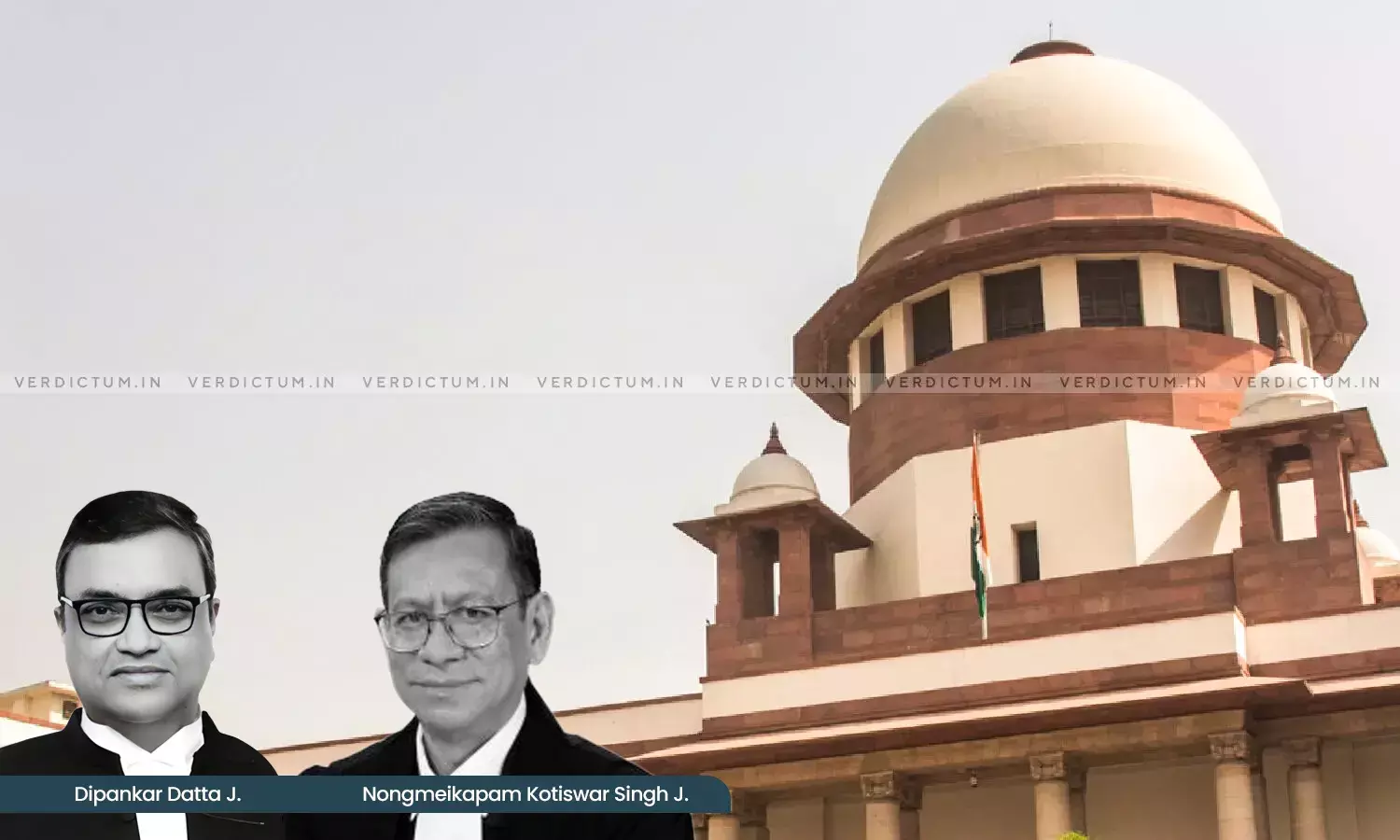
A Bench comprising Justice Dipankar Datta and Justice Nongmeikapam Kotiswar Singh observed, “…before criminal liability can be fastened upon the public servant, the prosecution must establish by reliable evidence that the intermediary was acting under the authority, direction or for the benefit of the accused and that the demand itself was attributable to the accused. Mere receipt of money by a third person cannot automatically result in criminal liability being imputed to a public servant”.
“Lastly, it follows that although the foundational facts of demand and of payment to an intermediary are considered proved, and although circumstantial evidence is, in principle, available to this Court to establish acceptance, no inference beyond the merely speculative can be drawn here that the appellant himself accepted, obtained, or would have obtained the gratification. The presumption under Section 20 of the Act does not arise in the first place, since it presupposes proof of acceptance or obtainment by the accused, which, for the reasons above, remains unproved. The prosecution has, at its best, established that money changed hands between a complainant and an intermediary who invoked the appellant’s name. But that itself can be said to be a proof of appellant’s acceptance of bribe”, the Bench said.
Senior Advocate Mukta Gupta appeared for the appellant and Rajkumar Bhaskar Thakare, A.S.G. appeared for the respondent.
The appeals arose out of a CBI investigation into allegations that the appellant, while serving as Divisional Security Commissioner, Railway Protection Force, Palakkad, had demanded and collected illegal gratification from RPF personnel seeking transfers and postings, using subordinate officials as intermediaries.
The Special Judge, CBI, Ernakulam, convicted the appellant in two separate cases, one concerning a trap laid on a complaint by P.P. Nandakumar, and another involving three alleged transactions, of which only the one concerning N.P. Gopi Kumar survived in appeal. The Kerala High Court affirmed both convictions.
Examining the trap transaction, the Court noted material inconsistencies between the complainant's and the approver-intermediary's accounts of how the money was to be delivered, and found it inexplicable that the appellant, having allegedly demanded the bribe directly, declined to accept it when offered to him personally and instead redirected it through the intermediary.
The Court also faulted the CBI for terminating the trap at the point of recovery from the intermediary rather than allowing the money to reach the appellant, which would have furnished direct proof. As for the remaining transaction, the Court held that the appellant's own contemporaneous diary placed him away from Palakkad on the only date attributable to the alleged meeting, and that the testimony of the approver and the bribe-giver, both interested participants in the same transaction, did not constitute the independent corroboration required by the rule of prudence governing accomplice evidence.
“The present case raises an additional dimension inasmuch as the prosecution relies substantially upon the testimony of persons who were originally arraigned as accused and were subsequently tendered pardon. The law relating to accomplice evidence is equally well settled. Section 133 of the Evidence Act declares that an accomplice is a competent witness and that a conviction is not illegal merely because it proceeds upon uncorroborated accomplice testimony. At the same time, Illustration (b) to Section 114 embodies a rule of prudence that an accomplice is ordinarily unworthy of credit unless corroborated in material particulars”, the Bench observed.
Allowing both appeals, the Court acquitted the appellant of all charges, discharged his bail bonds, and directed refund of any fine deposited by him.
Cause Title: Bharat Raj Meena v. Central Bureau of Investigation (Neutral Citation: 2026 INSC 999)
Appearances:
Appellant: Mukta Gupta, Senior. Advocate, Vaibhav Srivastava, Sugandha Anand, AOR, Nitya Gupta, Bhargava Ravikumar, Advocates.
Respondent: Rajkumar Bhaskar Thakare, A.S.G., Mukesh Kumar Maroria, AOR, Jagdish Chandra Solanki, Alankar Gupta, Astha Singh, Advocates.