

RPF Rules| Candidate Liable To Be Discharged From Service On Deliberate Suppression Of Information Regarding Subsistence Of Criminal Case Against Him: Supreme Court
The civil appeals before the Supreme Court were filed by the aggrieved candidates against the common judgment of the Division Bench of Allahabad High Court.

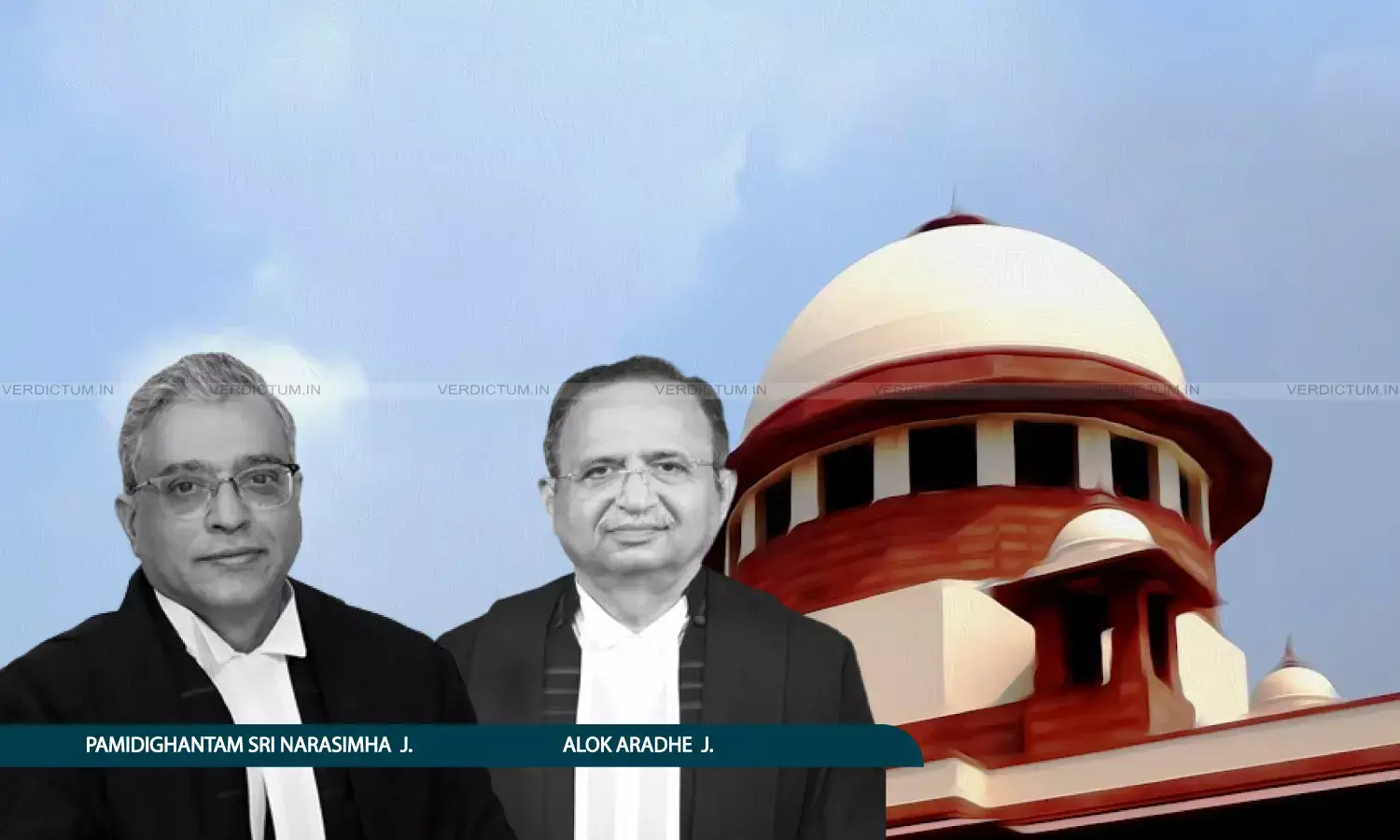
Justice Pamidighantam Sri Narasimha and Justice Alok Aradhe, Supreme Court
While upholding the discharge of candidates undergoing training for the post of constables in Railway Protection Force (RPF) and Railway Protection Special Force (RPSF), the Supreme Court has held that as per the RPF rules a candidate who intends to participate in the selection process must provide complete information, which includes subsistence of any criminal case against him/her and if such disclosure is not made, the candidate is liable to be discharged from service.
The civil appeals before the Apex Court were filed against the common judgment of the Division Bench of Allahabad High Court upholding certain decisions of the Single Judge, dismissing the writ petitions filed by the appellants against the order of discharge from service for non-disclosure of criminal antecedents at the recruitment process to the post of constables in RPF and RPSF.
The Division Bench of Justice Pamidighantam Sri Narasimha and Justice Alok Aradhe held, “The mandate of law is that a candidate who intends to participate in the selection process must provide complete information, which includes subsistence of any criminal case against him/her. The rules that govern the field make it clear that if the disclosure is not made, the candidate is liable to be discharged from service at any point of time.”
Senior Advocate Sanjay M. Nuli represented the Appellant while Additional Solicitor General Vikramjit Banerjee represented the Respondent.
Factual Background
The Chief Security Commissioner, RPF issued an Employment Notice in 2011 for filling up vacancies in the post of constables in RPF and RPSF. The appellants appeared and qualified in the written examination and also cleared the physical and efficiency test, resulting in their names being published in the select list. The respondent-authorities proceeded to issue allotment letters, and the appellants were sent for training. At the time the appellants were undergoing training, the respondent-authorities came to know of the subsisting criminal cases against them and also realised that such facts were suppressed and deliberately not mentioned during the verification process.
The Authorities then proceeded to issue orders of discharge from service to each of the appellants between June to October 2015. This action was based on the mandate of Rules 52 and 67 of the RPF Rules, 1987, Clause 9(f) of the Employment Notice, as also paragraph 3 of the Attestation Form. Aggrieved by the orders of discharge, the appellants approached the Allahabad High Court by filing writ petitions under Article 226 of the Constitution. These writ petitions were initially heard and decided by Single Judge Benches, which quashed the orders of discharge and directed the authorities to reconsider the appellants’ cases as per the principle laid down by this Court in Avtar Singh v. Union of India & Ors. Thereafter, the Division Bench proceeded to dismiss the writ appeals of the appellants, which led to them approaching the Apex Court.
Reasoning
Referring to the provisions, the Bench explained that the same lay down that when recruitment commences and before a candidate is selected to any post under RPF Rules and is given an order of employment, there is a requirement of self-verification, and there is also a consequence of suppression.
On a perusal of the Verification required under Rule 52, coupled with the Disciplinary Control that would be exercised under Rule 67, followed by the Declaration in clause 9(f) of the Employment Notice and the Attestation Form, the Bench stated that the candidate would be discharged for non-disclosure of information about the pending criminal cases.
The Bench was of the view that the case fell under the instance referred to in para 38.7 of the judgment in Avtar Singh (supra), as the appellants had chosen not to indicate pendency of the criminal cases in the verification form. It has been held in Avtar Singh (supra) that in a case of deliberate suppression of fact with respect to multiple pending cases, such false information by itself will assume significance and an employer may pass an appropriate order cancelling candidature or terminating services, as appointment of a person against whom multiple criminal cases were pending may not be proper.
Considering the findings of the Single Judge as well as the Division Bench that there was no averment in the pleadings about the ignorance of the appellants qua such pendency, the Bench held that the Single Judge as well as the Division Bench had not committed any error in dismissing the Writ Petitions.
One of the arguments raised by the appellants was that the respondent-authorities had reinstated candidates who were similarly placed as that of the appellants. The Additional Solicitor General had informed that 19 candidates were in fact reinstated and out of those, 12 candidates were reinstated as they were acquitted of the criminal cases even before filling the Attestation Form. “We are of the opinion 19 that these 12 candidates stand on a different footing, and the appellants cannot claim parity with them”, it added.
Thus, finding no error with the impugned judgments, the Bench dismissed the Civil Appeal.
Cause Title: Bappa Barai v. Union of India & Ors. (Neutral Citation: 2026 INSC 882)
Appearance
Appellant: Senior Advocates Sanjay M. Nuli, Gopal Sankaranarayanan, AOR Anand Mishra, Advocate Amrendra Kumar Singh, Karmendra Pratap Singh, Rahul Kumar Singh, Siddharth Saket, Pradyut Kashyap
Respondent: Additional Solicitor General Vikramjit Banerjee, Advocates Ketan Paul, Vimla Sinha, Abhishek Singh, Rukhamani Bobde, Vikash Shukle, AOR Amrish Kumar, AOR Sudarshan Lamba