

Conferment Of Bhumidhari Rights On Public Utility Lands Prohibited; Diversion Of Such Land Through Administrative Process Illegal: Supreme Court
The Supreme Court held that the diversion of public utility land through administrative processes cannot be countenanced by law.

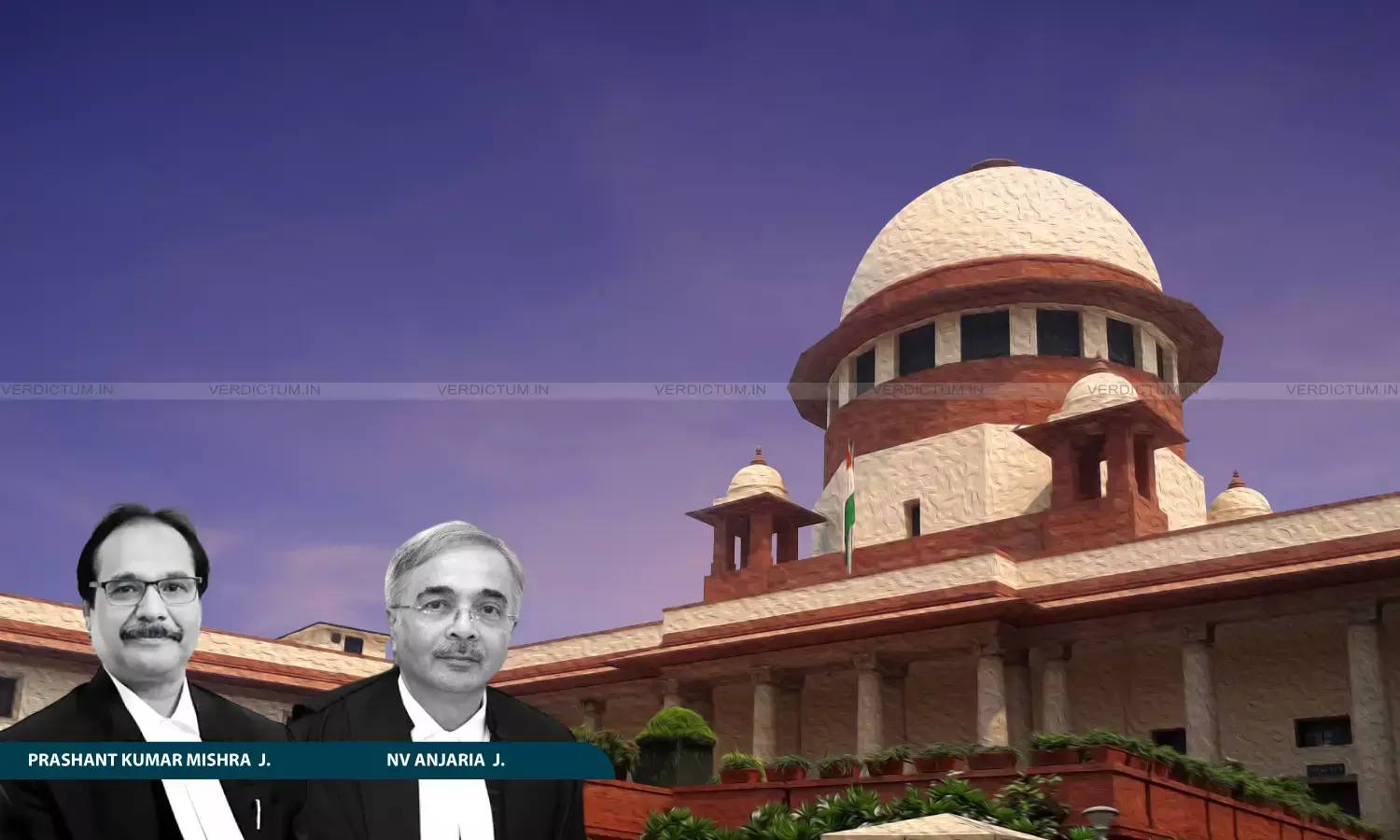
Supreme Court, Justice Prashant Kumar Mishra, Justice N.V. Anjaria
While dealing with a matter where an attempt was made to divert the khalihan and pasture land meant for public utility through an invalid re-categorisation, the Supreme Court has held that Section 132 of the Uttar Pradesh Zamindari Abolition and Land Reforms Act, 1950 (UPZALR Act) expressly prohibits the conferment of bhumidhari rights in respect of public utility lands, including pasture lands and khalihan.
The Apex Court further held that the diversion of public utility land through administrative processes cannot be countenanced by law.
The Apex Court was considering a matter concerning the validity of the change in categorization of certain land situated in District Hardoi, Uttar Pradesh and the subsequent grant of pattas in favour of the appellant.
The Division Bench of Justice Prashant Kumar Mishra and Justice N.V. Anjaria held, “Section 132 of the Abolition Act, expressly prohibits the conferment of bhumidhari rights in respect of public utility lands, including pasture lands and khalihan. If the submissions advanced on behalf of the appellant were to be accepted, it would permit subordinate officers to circumvent this express prohibition through the simple expedient of re-categorising land in revenue entries, thereby defeating the legislative intent entirely. Such an interpretation must be rejected as it would render the statutory prohibition nugatory and enable indirectly what the statute forbids directly.”
“The present case exemplifies precisely such an attempt wherein the subject land, despite its character as Khalihan and pasture land meant for public utility, was sought to be diverted through an invalid re-categorisation. Such diversion of public utility land through administrative processes cannot be countenanced by law”, it added.
Senior Advocate S.R. Singh represented the Appellant, while AOR Tanmaya Agarwal represented the Respondent.
Factual Background
Prior to October 31, 1992, the subject land in dispute was recorded in Category-6 in the khatauni in terms of paragraph A-124 of the U.P Land Records Manual, which classified the lands within a village. Category-6 denotes barren or uncultivated land, including the lands covered with water, sites, roads, buildings and other non-agricultural uses. The area in which the subject land was situated was governed by the provisions of the Uttar Pradesh Zamindari Abolition and Land Reforms Act, 1950. On April 5, 1992, the Lekhpal submitted a report stating that the Land Management Committee (Gaon Sabha) had resolved to change the category of the subject land from Category-6 to Category-5. Based on these reports, the Tehsildar recommended to the Sub-Divisional Officer that the land be reclassified as Category-5, and the Sub-Divisional Officer approved the said recommendation, effecting the change, leading to grant of pattas to the appellant and certain other individuals. Subsequently, the village in which the subject land was situated was brought under consolidation operations through a notification issued under Section 4 of the U.P. Consolidation of Holdings Act, 2004.
During the consolidation proceedings, the land settled in favour of the appellant by the lease was assigned a valuation, and the corresponding chaks were carved out under Section 20 of the U.P. Consolidation of Holdings Act. Subsequently, during consolidation proceedings, the Consolidator submitted a report to the Assistant Consolidation Officer, concluding that the appellant’s name had been erroneously recorded and ought to be expunged. The Consolidation Officer passed an order expunging the name of the appellant as Bhumidhar with non-transferable rights and ordered the land to be recorded in its original khata. The High Court dismissed the writ petition, holding the subject land as public utility land under Section 132 of the Abolition Act. It was further held that no bhumidhari rights or agricultural pattas could be granted in respect of such land. The pattas were held illegal, incapable of conferring rights, and the consolidation authorities were justified in correcting the revenue records. Taking exception to the judgment passed by the High Court, the appellant approached the Apex Court.
Reasoning
The Bench at the outset explained that Section 129 of the Abolition Act enumerates the classes of tenure holders recognised under the statute, namely bhumidhar with transferable rights; bhumidhar with non-transferable rights, asami and Government lessee. The Bench stated, “Once the land is referable to Section 132 of the Abolition Act, bhumidhari rights cannot accrue in respect thereof. At best, such land may be temporarily settled by way of an Asami patta. Arguendo, even if it were assumed that a patta had been granted in favour of the appellant in respect of the subject land, the same could only have been in the nature of an Asami patta. In terms of Rule 176-A of the Uttar Pradesh Zamindari Abolition and Land Reforms Rules, 1952, the term of an Asami patta is limited to a period of only five years. Consequently, even on that assumption, the patta in favour of the appellant would stand expired upon completion of the said period.”
The Bench also made it clear that the Abolition Act does not confer any authority upon the Sub-Divisional Officer to alter the category of land to bring it outside the prohibitory ambit of Section 132. The Bench explained that Section 117(6) empowers the State Government—and the State Government alone—to resume land from the Gaon Sabha and make a fresh declaration vesting such land in a local authority. “While this provision does not expressly authorize an alteration in the category of the land, such power can be inferred when read conjointly with Section 77(2) of the U.P. Land Revenue Code, 2006, which explicitly permits the State Government to change the class of public utility land in exceptional cases and only subject to stringent safeguards: recording reasons in writing, reserving equivalent land for the same purpose, and considering location and public utility value. This deliberate restriction to the State Government alone demonstrates the legislative recognition that no subordinate revenue authority possesses such power”, it added.
The Bench held that the Sub-Divisional Officer’s action of altering the category of the subject land was undertaken without jurisdiction. Holding that the grant of the patta in favour of the appellant was inextricably founded upon this invalid re-categorisation, the Bench held that the land continued to retain its original character as Category-6 land, falling in the class of lands referable to Section 132 of the Abolition Act. “Since it is established that no bhumidhari rights accrue in respect of such lands, the pattas granted in favour of the appellant cannot be sustained and are treated to be void ab initio”, it mentioned.
As per the Bench, it could not be said that the issue relating to the validity of the pattas granted in favour of the appellant was directly and substantially in issue and finally decided in the earlier proceedings, since the existence and legality of the pattas were never adjudicated on merits. The Bench thus held that the principle of res judicata would have no application to the facts of the case.
Thus, finding no illegality in the impugned order, the Bench dismissed the appeal.
Cause Title: Babu Singh v. Consolidation Officer And Others (Neutral Citation: 2026 INSC 395)
Appearance
Appellant: Senior Advocate S.R. Singh, Advocates Sushant Kumar Yadav, Prateek Yadav, Mangal Prasad, Prithvi Yadav, Gaurav Lomes, Radha Rajput, Anurag Singh, Anusha Yadav, AOR Ankur Yadav
Respondent: AOR Tanmaya Agarwal, Advocates Wrick Chatterjee, Aditi Agarwal, Udit Bhardwaj