

Substantive Proof Regarding Execution Of Document Overrides Expert Opinion Regarding Handwriting In Determining Document’s Genuineness: Supreme Court
The appellant, the beneficiary of a Will executed by her brother, had approached the Supreme Court challenging the order which refused to quash the criminal proceedings.

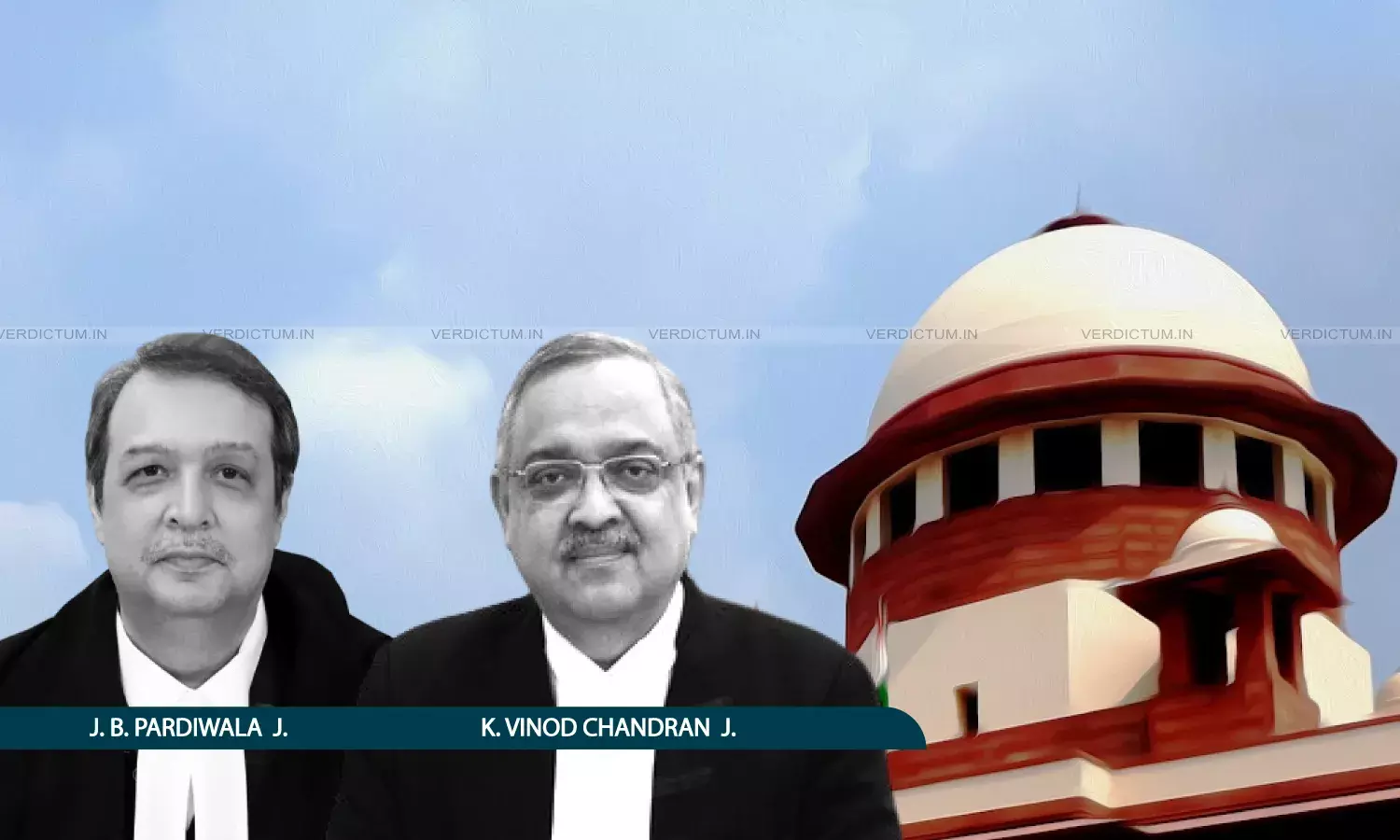
Justice J. B. Pardiwala, Justice K. Vinod Chandran, Supreme Court
While directing expeditious disposal of the probate proceedings, the Supreme Court has held that the substantive proof offered regarding the execution of a document, overrides the expert opinion regarding the handwriting, in determining the genuineness of the document and the signature affixed therein.
The appellant, the beneficiary of a Will executed by her brother, had approached the Apex Court challenging the impugned order which refused to quash the criminal proceedings initiated by the the son of the executant of the Will (second respondent).
The Bench comprising Justice J.B. Pardiwala and Justice K. Vinod Chandran held, “We cannot but notice that the decision in Syed Askari Hadi Ali Augustine Imam turns on the facts and circumstances of that case. Sukhdev Singh clearly lays down a rule of prudence that opinion evidence cannot take precedence over substantive evidence and there should be corroboration before acting on such evidence. Though, there is no hard and fast rule as to the weight that could be attached to the opinion of a handwriting expert; definitely it cannot be viewed with suspicion and would depend upon the facts of each case. The indubitable principle is that the substantive proof offered regarding the execution of a document, overrides the expert opinion regarding the handwriting, in determining the genuineness of the document and the signature affixed therein.”
AOR K. K. Mohan represented the Appellant while Additional Solicitor General Davinder Pal Singh represented the Respondent.
Factual Background
The Will was said to have been executed on April 29, 2011 and registered on May 4, 2011. The executant passed away in 2013, upon which the appellant, along with her mother who were the joint beneficiaries of the Will filed a petition for probate. The respondent, along with his mother, appeared in the testamentary case and filed their reply. In the testamentary case, the respondents sought to send the Will for examination by a handwriting expert, since there was an allegation of forgery. The handwriting expert expressed a suspicion with respect to the execution by the deceased. It was opined that the disputed signature of the executant, for the reasons stated in the report, was not written by the executant.
An application under Section 156(3) of the Criminal Procedure Code, 1973, was moved by the second respondent, which resulted in a direction to register an FIR. The impugned order refused to quash the proceedings in a petition filed under Section 482. The mother of the executant and his wife are no more, leaving the aunt and nephew to fight it out.
Reasoning
On a perusal of the facts of the case, the Bench noted that the mother and the sister of the testator were the beneficiaries, who filed a testamentary case as early as 2014. The persons excluded from the Will, being the wife and son of the testator, were the respondents, who filed a reply. The Bench also noticed that the husband was estranged from his wife and son and was living with his mother and sister.
The Bench took note of the fact that the Will was registered and the Registrar had recorded that the same was presented by the executant and his left-hand thumb impression was affixed in his presence. It was further noticed that there were two attesting witnesses who had signed the Will and also affixed their thumb impression at the time of registration. The status report filed by the Investigating Officer indicated that during the course of investigation, one of the attesting witnesses summoned to the police station and interrogated had given a statement that the executant had signed all the pages of the Will in front of him.
“It is also to be reiterated that the mother of the testator is no more and there is no possible means by which it can be ascertained whether the discrepancy in signature, if at all found and established as a forgery, could be attributed to the mother or the sister. There is also the overwhelming substantive evidence of a registration made at the time of execution itself in the presence of two attesting witnesses which prima facie offers proof of the document and its due execution, which however has to be proved in the probate proceedings”, it added.
Thus, allowing the appeal, the Bench held, “We only found the criminal proceedings to be not sustainable, which even if the probate proceedings end in a rejection, would not entail revival of such prosecution on the facts hereinabove noticed, especially the death of one of the beneficiaries.”
Cause Title: Babita Chopra v. State (GNCT of Delhi) & Anr. (Neutral Citation: 2026 INSC 1258)
Appearance
Appellant: AOR K. K. Mohan
Respondent: Additional Solicitor General Davinder Pal Singh, AOR Shreekant Neelappa Terdal, Advocates Sanjay Kumar Tyagi, Vidushi Pandey, Purnendu Bajpai, Garvil Singh, Shreya Dutt, Sanjay Tyagi