

DRT Can Execute Recovery Certificate Against Property Outside Its Local Limits, Transmission U/S 19(23) RDB Act Is A Judicial Discretion: Supreme Court
Resolving a divergence among High Courts, the Court held that "may" in Section 19(23) of the RDB Act cannot be read as "shall". It laid down a structured test and safeguards for deciding whether a Tribunal should retain execution or transmit the certificate.

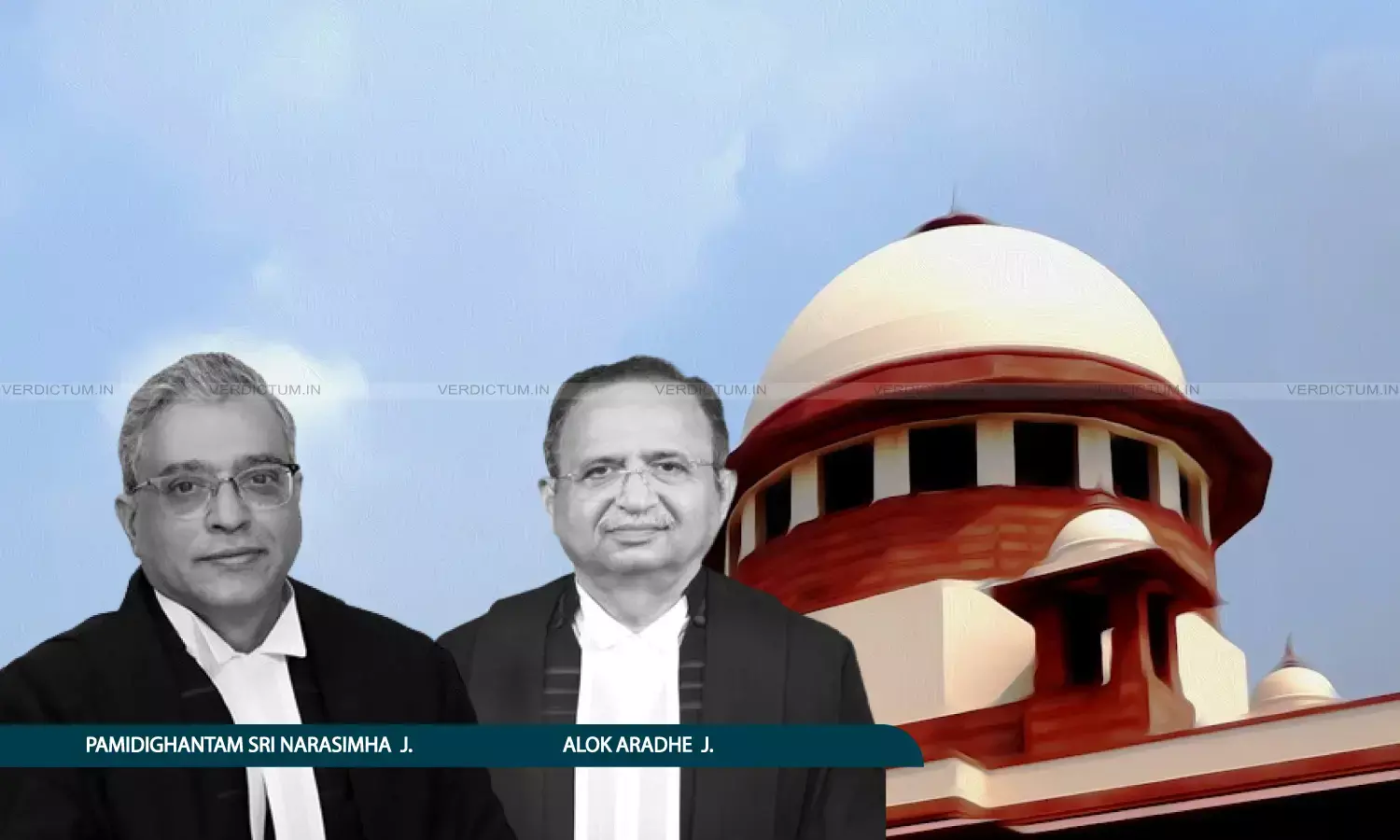
Justice Pamidighantam Sri Narasimha and Justice Alok Aradhe, Supreme Court
The Supreme Court has held that a Debts Recovery Tribunal which has issued a recovery certificate may execute it, through its Recovery Officer, against property situated outside its local limits. It held that the word "may" in Section 19(23) of the Recovery of Debts and Bankruptcy Act, 1993 (RDB Act) confers a "judicial discretion" on the Tribunal "to retain the execution or to transmit the certificate" to another Tribunal.
The Court approved the view of the Gujarat and Bombay High Courts and disapproved the contrary view of the Delhi, Punjab and Haryana, and Calcutta High Courts. It held that the discretion vests in the Tribunal and not in the Recovery Officer or the certificate holder, and must be exercised by a reasoned order on the five-point test and safeguards.
A Bench of Justice Pamidighantam Sri Narasimha and Justice Alok Aradhe allowing the State Bank of India's appeal, observed, “…Section 19(23) of the 1993 Act permits the Tribunal to execute a recovery certificate issued by it in relation to a property situate outside its local limits, and that the word 'may' in Section 19(23) confers a judicial discretion on the Tribunal to retain the execution or to transmit the certificate, which is to be exercised on the parameters set out hereinafter. In the light of the construction which we have placed on Section 19(23) of the 1993 Act, we approve the view taken by the Gujarat and Bombay High Courts, subject to the parameters which we lay down hereinafter, and do not agree with the view expressed by the High Courts of Delhi, Punjab & Haryana and Calcutta”.
N. Venkataraman, Additional Solicitor General appeared for the Bank, while respondent no. 1 appeared in-person, and Advocate Devanshi Singh appeared as amicus curiae.
Between 2004 and 2006, a partnership firm availed of credit facilities from the Bank's Commercial Branch at Tiruchirappalli. The Borrower and his late wife were partners and guarantors, and had created an equitable mortgage over two properties at K. Sathanur Village, Tiruchirappalli, which fall within the jurisdiction of DRT, Madurai. After the account became non-performing, the Bank filed an application on August 13, 2010 before DRT, Madurai for recovery of Rs. 1,50,77,944 with interest.
On the Borrower's allegations of bias, the proceedings were transferred to DRT-III, Chennai. By a common order dated September 16, 2020, it allowed the Bank's claim, though at a reduced rate of interest, and issued Recovery Certificate No. 14 of 2022 on January 7, 2022. The Recovery Officer attached both properties and took possession of one on January 6, 2023.
The Borrower challenged the attachment before the Madras High Court (Madurai Bench), which held on August 22, 2025 that DRT, Madurai alone could execute the certificate. The Supreme Court stayed that judgment on January 6, 2026.
The Bank argued that "may" in Section 19(23) is directory, that the Act aims at speedy recovery, and that the Borrower had filed about 49 applications and appeals and stalled recovery for sixteen years, with the amount due about Rs. 9.39 crore as on February 28, 2026. The Borrower, appearing in person, contended that transmission was obligatory. The Amicus Curiae submitted that nothing in the Act bars the issuing Tribunal from executing, though it may transmit in cases of practical difficulty.
The Court held that the provisions of the CPC which are inconsistent with the Act cannot be imported to curtail the Tribunal's powers. It also drew a distinction between adjudication under Section 19(1), where the situs of the property is not a criterion, and the territorial reach of execution.
It also rejected the Amicus's unqualified view, observing that otherwise "the choice would, in practice, rest with the certificate holder". It held that neither the geographical location of the property in isolation nor the convenience of a party can be the sole basis for the decision.
“We are, therefore, of the considered view that the discretion under Section 19(23) of the 1993 Act must be exercised upon an objective assessment of the relevant circumstances, supported by reasons. Neither the geographical location of the property, viewed in isolation, nor the convenience of one of the parties can constitute the sole basis for determining the appropriate course of execution. The paramount consideration must be whether the proposed course would facilitate lawful, effective and expeditious enforcement of the recovery certificate, 43 with due regard to the rights of the certificate debtor and of third parties. The ultimate object of the provision is to ensure that territorial considerations do not frustrate or unduly impede the recovery mechanism, while simultaneously ensuring that execution is undertaken by an authority competent in law to do so, and in a manner which is fair to the certificate debtor”, the Bench said.
The Structured Test
(i) The Tribunal should determine the exact location, the nature of ownership of the property and the question of territorial jurisdiction.
(ii) The Tribunal must identify the nature of the execution, namely, it should ascertain whether the same requires attachment, possession, appointment of a receiver, valuation or sale, and whether the property is occupied, tenanted, the residential house of the certificate debtor, or the subject of claims by third parties or of attachment by another Tribunal.
(iii) The Tribunal should examine whether its existing Recovery Officer can effectively execute the certificate with appropriate local assistance.
(iv) The Tribunal must consider the balance of convenience, expedition, cost, avoidance of multiplicity, the stage of the execution, the conduct of the parties and protection against prejudice to any of the parties or to third parties.
(v) The Tribunal must pass a reasoned order while deciding the issue whether the execution should be retained or transmitted.
In addition to it, the Court also laid down the Debts Recovery Tribunals shall observe the following safeguards:
(i) The decision under Section 19(23) shall be taken by the Tribunal ordinarily at the time of issuing the recovery certificate or at the earliest thereafter, and in any event before any coercive step is taken against a property situated outside the limits of the Tribunal.
(ii) The decision shall be taken after notice to the certificate holder and the certificate debtors. Either party may apply for such a decision, and the Tribunal may also act on its own motion. Such an application shall be decided expeditiously.
(iii) The Recovery Officer attached to the Tribunal which has issued the recovery certificate shall scrupulously comply with Chapter V of the 1993 Act and the Second Schedule to the Income-tax Act, 1961.
The Court noted that both properties lie in one district of the same State, are not occupied by third parties or under prior attachment, and that the proceedings had been transferred to Chennai at the Borrower's own instance. It quashed the High Court judgment and restored the recovery proceedings. It directed the Recovery Officer at DRT-III, Chennai to proceed in accordance with the test and safeguards, preferably within six months. It did not decide the Borrower's remaining pleas of nullity, abatement and fraud.
Cause Title: Asst. General Manager, State Bank of India v. S. Loganathan & Ors. (Neutral Citation: 2026 INSC 1287)