

Rules Of Game Couldn’t Be Changed Mid-Way: Supreme Court Asks Authorities To Reconsider UP ITI Instructor Recruitment
The matter before the Supreme Court revolved around the recruitment of Instructors in the Industrial Training Institutes by the State of Uttar Pradesh.

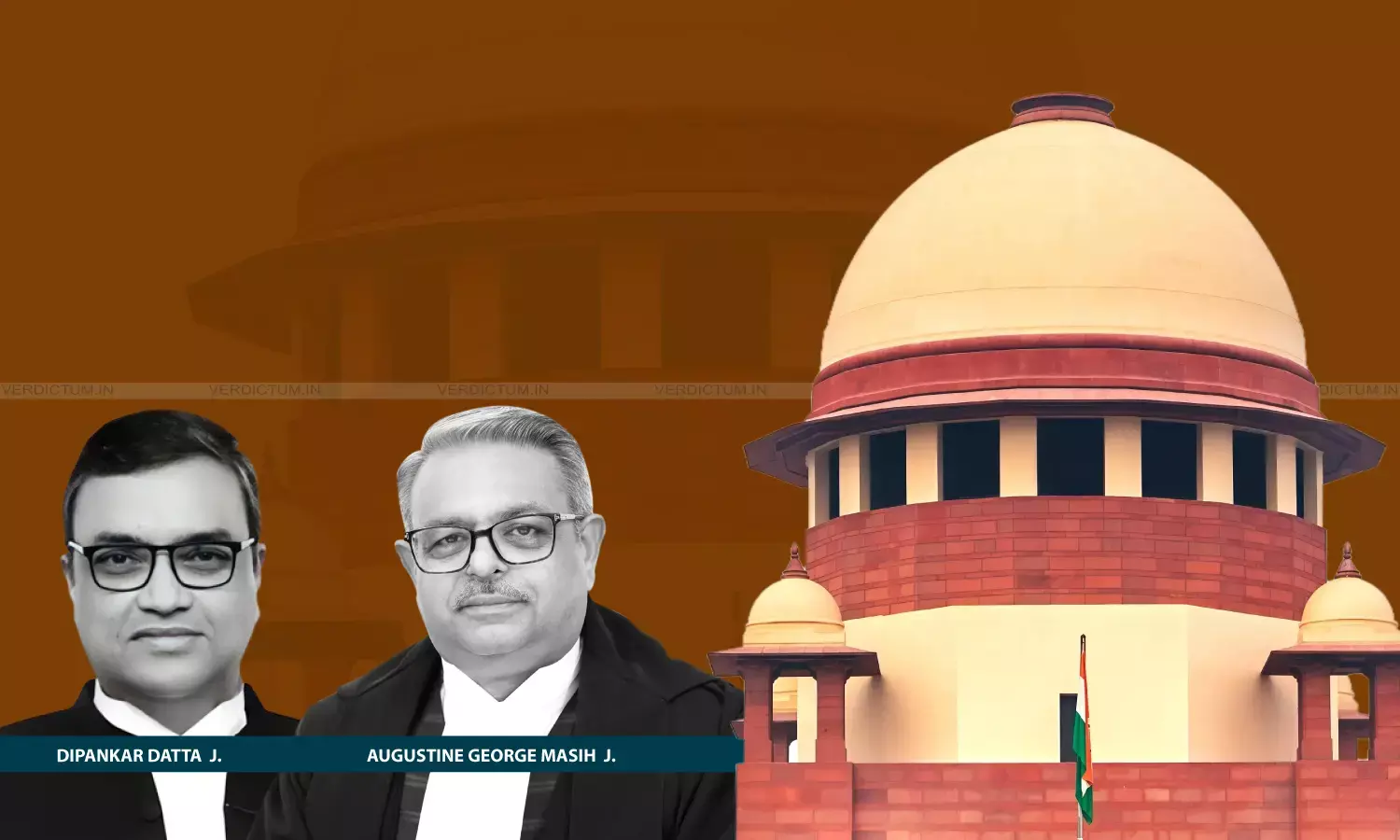
Justice Dipankar Datta, Justice Augustine George Masih, Supreme Court
While observing that the rules of the game, midway, could not have been changed by the Selection Committee/SoUP to the detriment of several candidates, the Supreme Court has asked the aggrieved candidates to approach the Appointing Authority for recruitment against the vacant posts for Instructors in the Uttar Pradesh Industrial Training Institutes.
The matter before the Apex Court revolved around the recruitment of Instructors in the prestigious Industrial Training Institutes by the State of Uttar Pradesh.
The Division Bench of Justice Dipankar Datta and Justice Augustine George Masih held, “The rules of the game, mid-way, could not have been changed by the Selection Committee/SoUP to the detriment of a number of candidates. Since there has been arbitrariness in State action, which has vitiated the process of selection including nonselection of the appellants, this is sufficient for us to consider the question of grant relief to the appellants, without going into the validity of the 2014 Rules.”
“We grant liberty to the members of the Regd. Society, the other appellants and the impleaded candidates to approach the appointing authority with a copy of this judgment within two weeks”, it ordered.
Factual Background
To enhance the skills of the available workforce in the country, the Industrial Training Institutes (ITIs) were established in the 1950s to ensure quality vocational education and training. One of the essential qualifications for a candidate seeking appointment as an Instructor in the ITIs was a ‘certificate under regular Craft Instructor Training Scheme of one year duration.’ The Appellants (128 appellants in the main appeals, sole appellant in the first, third and fourth connected appeals and 134 candidates/members of a Regd. Society which is representing them) claimed to be the holders of certificates issued under CITS. Their grievance was that in supersession of all existing rules and orders on the subject, the SoUP diluted the requirement of CITS certificate by making it a “preferential qualification” instead of “essential qualification” by framing the Uttar Pradesh Industrial Training Institutes (Instructors) Service Rules 2014.
Notwithstanding awareness in respect of the changes made but desirous of appointment on the posts of INSTRUCTORS, the appellants had applied pursuant to two advertisements issued in the year 2014 and 2015 but did not qualify. They felt prejudiced due to the dilution of the CITS certificate requirement, as non-CITS candidates were appointed. This is when this litigation commenced. Rules 9(B)12, 16(3)(a)(iii), 13 and 17(3)14 of the 2014 Rules came to be challenged, as also the advertisements, at the instance of the appellants before the Allahabad High Court. The High Court heard a total of 43 petitions together, which were dismissed. The appellants thus approached the Apex Court challenging the impugned judgment.
Reasoning
The Bench, at the outset, clarified, “...though a candidate for a post cannot ordinarily challenge the process of selection where he has participated without objection, law is well-settled that he can do so in a situation where arbitrariness/illegality in the selection process is writ large. After all, the candidate while agreeing to participate in the selection process can neither expect an illegality in the process to be pressed into service to rule out his candidature nor can he be said to have accepted the illegality in it. If indeed illegality in the process is demonstrated to have vitiated the process, notwithstanding his participation, the candidate could be granted relief as the situation would warrant and permit.”
The Bench was of the view that the failure of the Selection Committee/SoUP to follow the 2014 Rules to the tee, more particularly excluding the appellants by fixing an arbitrary qualifying or cut-off marks in the guise of screening eligible candidates though the vacancies advertised out-numbered candidates prima facie found eligible, could not be validated merely on the ground that the appellants participated in the selection process.
The Bench also held that the fixation of qualifying or cut-off marks resulted in ouster of a substantial number of candidates including the appellants and, thereby, vacancies remained unfilled despite the availability of candidates otherwise eligible under the Rules. “Such fixation has to be characterised as arbitrary and contrary to the 11 recruitment procedure prescribed by the 2014 Rules as well as the overall object behind them”, it added.
The Bench noted that as per the written arguments lastly filed by the SoUP, presently 5,507 INSTRUCTORS were in position out of 7,768 sanctioned posts. Granting liberty to the members of the Regd. Society, the other appellants and the impleaded candidates to approach the appointing authority, the Bench ordered, “Appellants (including the members of the Regd. Society) and the impleaded candidates shall be considered for recruitment against the posts which are now vacant in the relevant discipline/trade. If, per chance, the number of eligible appellants exceed the number of available vacancies, supernumerary posts be created for them in the relevant discipline/trade.”
Cause Title: Arvind Kumar & Ors. v. State of U.P. (Neutral Citation: 2026 INSC 741)