

Will Not Be Treated As Precedent: Supreme Court Sets Aside POCSO Conviction After Victim Marries Accused Upon Attaining Majority
The Court observed that forcing the appellant to serve the remainder of his ten-year prison sentence would disrupt the settled domestic life of the couple, especially after the appellant paid ten lakh rupees as financial security to the victim.

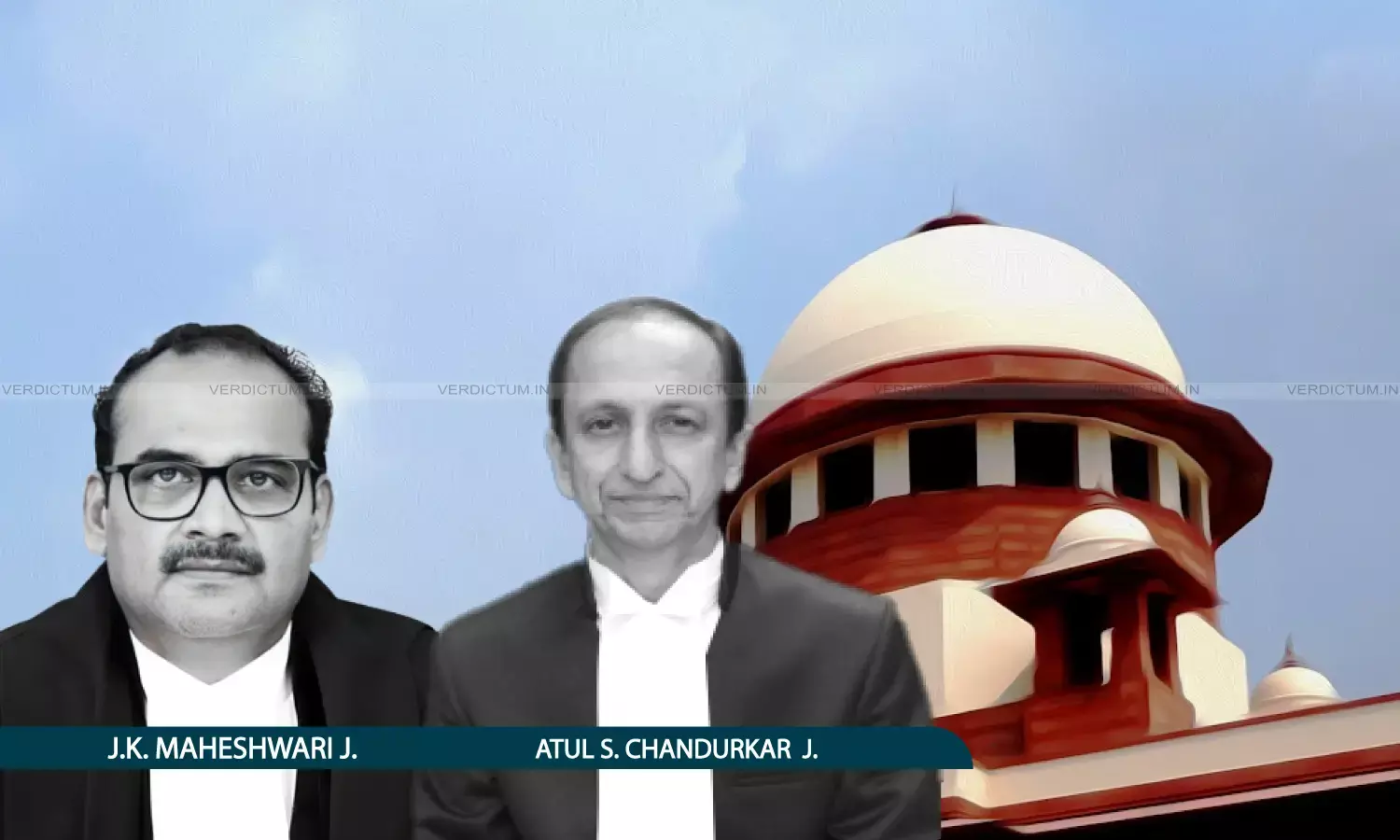
The Supreme Court invoked its plenary powers under Article 142 of the Constitution to set aside the conviction and ten-year sentence of a person charged under Section 5(1) read with Section 6 of the POCSO Act, while clarifying that the decision will not be treated as a precedent.
Noting the highly peculiar factual matrix of the case—where the victim voluntarily married the appellant after reaching the age of majority and fully realized a compensation amount of Rs. 10,00,000/- for her life security—the court observed that quashing the conviction was necessary to ensure the couple could live peacefully in society as spouses.
The Court explicitly clarified that the indulgence was granted purely in light of these unique subsequent events and would not be treated as a legal precedent for any other matter.
The Bench of Justice JK Maheshwari and Justice Atul S Chandurkar observed, "Even as per the orders of this Court with intent to have security of the family life of the appellant Rs. 10,00,000/- has been paid to the victim which she has realised. Now as per subsequent statement, appellant and the victim have solemnised the marriage on attaining the age of majority and also received the amount of compensation for his guilt with minor victim. Therefore, at this stage, without entering into the merits of the case, in the peculiar facts, as narrated above, we deem it appropriate to exercise our plenary power under Article 142 of the Constitution of India for setting aside the judgment of conviction and sentence of the appellant for the charge under Section 5(1) of POCSO Act and in terms of the statements as recorded and the appellant is acquitted from the charge."
Advocate on Record Rahul Shyam Bhandari appeared for the Petitioner, while Advocate on Record Sabarish Subramanian appeared for the Respondents.
Brief Facts of the Case
The appellant was convicted by the Fast Track Mahila Court for committing an offence under Section 5(1) read with Section 6 of the Protection of Children from Sexual Offences Act, 2012 (POCSO Act) and was sentenced to undergo ten years of rigorous imprisonment along with a fine. Aggrieved by the order, the appellant preferred a Criminal Appeal before the High Court, which subsequently suspended his jail sentence.
During the pendency of the appeal, the victim moved an application under Section 482 read with Section 391 of the Code of Criminal Procedure, seeking further examination to bring out the "untold truth." She filed an affidavit stating that she had been living with the appellant and wished to depose in his favour so they could live peacefully. The High Court rejected her plea to adduce additional evidence. The appellant then approached the Supreme Court against this rejection.
The Supreme Court directed the recording of the victim's statements before a Judicial Magistrate. It was revealed that the parties initially had a relationship while the victim was a minor, which soured when the appellant refused marriage, leading to the criminal complaint. The victim subsequently married another man, but that marriage collapsed once her past history became known. Eventually, after attaining majority, the victim and the appellant solemnized their marriage, and the appellant agreed to pay a lump sum compensation of Rs. 10,00,000/- for her life security, which was fully realized by the victim.
Contention of the Parties
Observations of the Court
The Court observed that the matter presented a peculiar factual backdrop where the victim, despite the initial trauma and a broken intermediate marriage, had voluntarily solemnized her marriage with the appellant after attaining majority. The Court noted that the appellant had successfully deposited the full compensation amount to ensure the victim's financial and social security.
The Court observed that forcing the appellant to undergo the remaining sentence would disrupt the settled domestic life of the couple.
It said, "The appellant and the victim are left free to live their life peacefully in society as spouse. We make it clear that the present order has been passed in the peculiar facts of the case, therefore, it will not be treated as a precedent for any other purpose."
Consequently, without delving into the factual merits of the initial conviction, the Court deemed it fit to invoke its plenary powers under Article 142 of the Constitution of India. It observed that ends of justice would be met by setting aside the conviction to allow the couple to live peacefully as husband and wife, explicitly clarifying that this indulgence was based purely on the unique facts of the case and would not serve as a precedent.
Cause Title: Maruthupandi v. State represented by Inspector of Police & Anr. [Special Leave to Appeal (Crl.) No(s). 2782/2021]
Appearances:
Petitioner:Advocate on Record Rahul Shyam Bhandari, Advocate G Priyadharshni, Advocate Satyam Pathak.
Respondents:Advocate on Record Sabarish Subramanian, Advocate on Record Konark Tyagi, Advocate Arpitha Anna Mathen.