

Continued Survival Of Reference Depends Upon Continued Existence Of Doubt Which Occasioned It: Supreme Court While Closing 7-Judge Bench Reference As Infructuous
The CJI Surya Kant led Bench said that the nine-judge Bench judgment in MADA overruled the premise of India Cement; transition to GST also leaves question of no prospective significance.

The Supreme Court has held that a reference to a larger Bench survives only as long as the doubt which occasioned it continues to exist. Where that doubt has been authoritatively dispelled by a Bench of greater strength, the Court said, the referred Bench would be called upon only to restate what is already binding. Accordingly, a Seven-Judge Bench closed the reference on the validity of surcharges computed on sales tax payable, which had remained pending since 1998.
The Court noted that the Nine-Judge Bench in Mineral Area Development Authority & Anr. v. Steel Authority of India & Anr (2024) 10 SCC 1 had held royalty is not a tax and overruled India Cement Ltd. & Ors. v. State of Tamil Nadu & Ors. (1990) 1 SCC 12 to that extent. The Bench said this removed the very premise on which India Cement was seen as holding a levy on another levy to be a “tax on tax”. It also observed that Entry 54 of List II, in the form under which the surcharges were enacted, has been substituted by the Constitution (One Hundred and First) Amendment Act, 2016, and that the State sales tax laws were replaced first by VAT and then by GST. The question was therefore of no prospective significance for the States concerned, and S. Kodar v. State of Kerala (1974) 4 SCC 422 continues to hold the field.
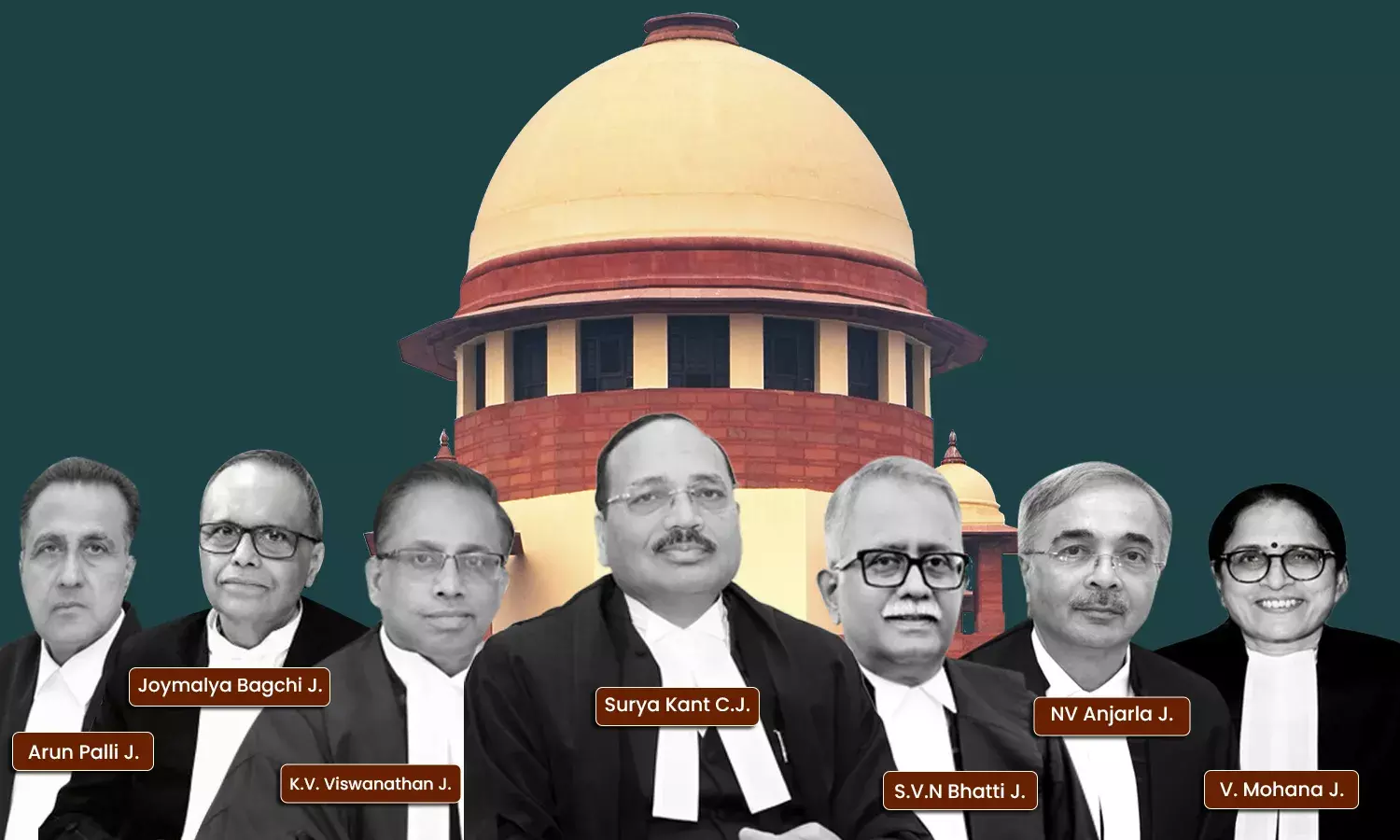
The Bench comprised Chief Justice of India Surya Kant and Justice S.V.N. Bhatti, Justice Joymalya Bagchi, Justice N.V. Anjaria, Justice Arun Palli, Justice V. Mohana and Justice K.V. Viswanathan. The CJI authored the lead judgment, while Justice Viswanathan wrote a separate opinion.
The Bench observed, “…where the doubt which occasioned a reference is resolved by a subsequent decision of a Bench of even larger strength, the law stands declared by that decision, and the Bench to which the reference was made would only be called upon to restate what is already binding…It must follow that the continued survival of a reference depends upon the continued existence of the doubt which occasioned it. Where the doubt has been authoritatively dispelled, in the interregnum, whether by a subsequent decision of a Bench of greater strength, by a legislative or constitutional amendment, or otherwise, the reference ceases to serve the purpose for which it was made. To answer it in such circumstances would be to render, in substance, an opinion on a question that no longer requires an answer, and to wastefully occupy a larger Bench’s time in restating the settled law”.
“We may hasten to add that we do not suggest that a reference must automatically be returned whenever there is some subsequent development in the law. There may well be cases where, notwithstanding subsequent developments, the question referred retains a live significance, either because it continues to govern a large number of pending disputes, or because the subsequent developments themselves give rise to fresh uncertainty. The inquiry in each case must be whether, having regard to the law as it stands on the date on which the reference comes up for hearing, there remains a genuine doubt which only a Bench of the strength to which the matter has been referred can resolve”, it noted further.
Advocate Shubhranshu Padhi appeared for the appellant and Tushar Mehta, Solicitor General, N. Venkataraman, ASG appeared for the respondent.
Pertinently, Justice K.V. Viswanathan, in a separate concurring opinion, agreed that the reference does not warrant a Seven-Judge Bench ruling, but reached that result by deciding the question rather than treating it as academic. It was held that S. Kodar is correctly decided, remains good law and needs no reconsideration.
Justice Viswanathan found Hoechst Pharmaceuticals Ltd. & Ors. v. State of Bihar & Ors. consistent with S. Kodar, noting that the concession recorded in Hoechst did not detract from its holding on legislative competence. It was further noteed that India Cement, which concerned a cess on royalty under Entries 23, 45, 49 and 50 of List II and Entry 54 of List I, was “qualitatively different” and could not be used to make inroads into S. Kodar. Further, it was added that MADA, which overruled India Cement on royalty, only reinforced this, and that neither the pending curative petition against MADA nor the new Section 9-D of the MMDR Act affects S. Kodar’s ratio. Accordingly, directed that the Orissa and Punjab Sales Tax appeals go to an appropriate Bench to be decided in line with S. Kodar, and that the Punjab Social Security Act appeals be segregated and placed before a Division Bench.
The batch concerned a ten per cent surcharge under Section 5-A of the Orissa Sales Tax Act, 1947, and under Section 5(1-C) of the Punjab General Sales Tax Act, 1948. Both applied to dealers above a turnover threshold and were computed on the tax payable, not on turnover. The Punjab Act’s Section 30-AA, and a cess under the Punjab Social Security Act, 2000, were also tagged.
On August 13, 1998, a Two-Judge Bench referred the Orissa appeals to a larger Bench, noticing an apparent divergence between Hoechst Pharmaceuticals and India Cement. On October 6, 1999, a Five-Judge Bench held that S. Kodar also required consideration and sought a Seven-Judge Bench. The matter was listed for hearing on August 12, 2026.
The CJI-led judgment found the perceived conflict “more apparent than real”. It held that India Cement turned on a cess on royalty in a field occupied by the MMDR Act, not on the mode of computation. Its premise that royalty is a tax was overruled in MADA. The Court said the “tax on tax” argument draws force from “a conflation between two distinct concepts, namely, the subject matter of a tax and the measure by which the tax is quantified.”
“The submission that a levy computed on the tax payable is a ‘tax on tax’, and therefore not a tax on the sale of goods, does not, in our view, bear close scrutiny. We say so for the following reasons. A sales tax is itself computed as a percentage of the taxable turnover. A surcharge computed as a percentage of that tax is, therefore, by simple arithmetic, a further percentage of the same taxable turnover. To illustrate, a surcharge of 10 per cent upon a sales tax levied at the rate of 10 per cent of the turnover is, in substance, nothing but an additional levy of 1 per cent upon the turnover. The subject of the surcharge remains the sale or purchase of goods; the only difference lies in the arithmetical route by which the quantum is reached. Accordingly, the measure of a tax, as we have noticed, does not determine its character”, it said.
It added that a ten per cent surcharge on a ten per cent sales tax is, by arithmetic, “nothing but an additional levy of 1 per cent upon the turnover”. Since the liability arises irrespective of profit, the Court held that the surcharge “cannot, by any stretch, be characterised as a tax on income”. It also noted that Entry 54 of List II, in its earlier form, no longer exists. Justice Viswanathan separately held that S. Kodar “has been correctly decided, continues to be a good law and needs no reconsideration.”
The reference was answered as infructuous, and legislative competence is to be governed by S. Kodar. The challenge to Section 30-AA and the Article 266 question on the Punjab cess were left open, as were all other contentions. The Registry was directed to list the matters before appropriate regular Benches.
Cause Title: Arjun Flour Mills v. State of Odisha Finance Department Secretary & Ors. (Neutral Citation: 2026 INSC 1192)
Appearances:
Appellant: Shubhranshu Padhi and Sandeep Sudhakar Deshmukh, Advocates.
Respondent: Tushar Mehta, Solicitor General, N. Venkataraman, ASG, Pitambar Acharya (Odisha), Advocate General and Vivek Jain, AAG (Punjab), Advocate Samapika Biswal as nodal counsel.