

Substantive Compliance Of Audi Alteram Partem Is Non-Negotiable : Supreme Court Sets Aside Removal Of Mathadhipati Of Tirupathi's Hathiramji Mutt
The Bench said that the structural bias in Dharmika Parishad rendered remand futile; appointed an independent enquiry committee under Article 142.

The Supreme Court has set aside the removal of Arjun Dass, the Mathadhipati of Sri Swamy Hathiramji Mutt, Tirupathi, holding that service of a charge memo by affixation on a residence already in the physical possession of the serving authority is a legal absurdity and no service in the eyes of law.
The Court further held that where a statutory enquiry body is composed entirely of State nominees and has by prior resolution pre-determined the course of action before any charge is framed, remand to a reconstituted version of that body would recreate the very conditions of structural taint. Invoking Article 142 of the Constitution of India, the Court appointed Retired District Judge Mr. Boddepalli Rama Rao as a one-man independent enquiry committee and a supervisory Administrative Committee, to conduct a de novo enquiry under Section 51(2) of the Andhra Pradesh Charitable and Hindu Religious Institutions and Endowments Act, 1987, with a one-year deadline.
The Court further observed that any arrangement permanently bifurcating the religious functions of a Mathadhipati from secular administration, or vesting the latter indefinitely in a Fit Person while the lawful Mathadhipati continues in office, "would amount to a denial of the very concept of Mahantship".
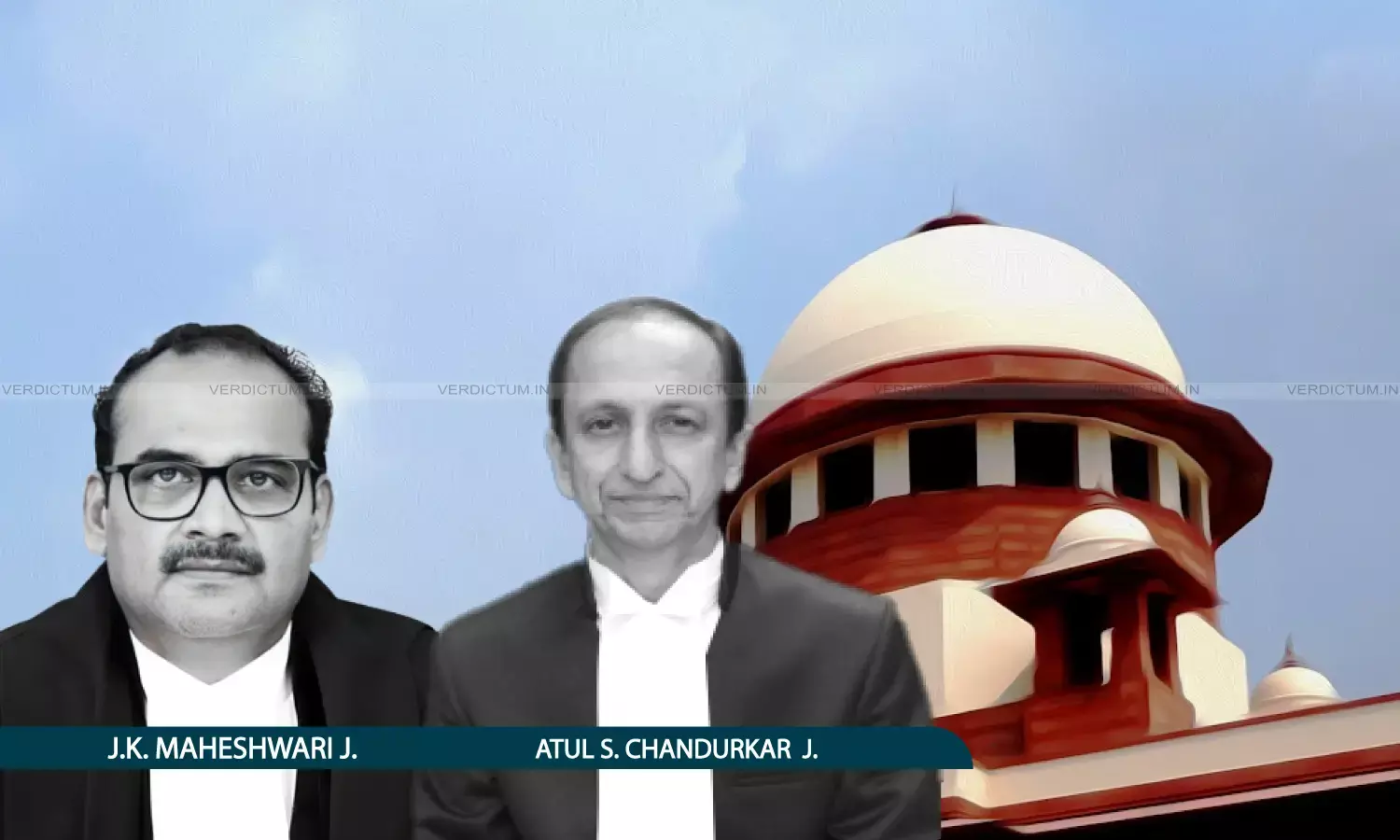
A Division Bench comprising Justice J.K. Maheshwari and Justice Atul S. Chandurkar observed, “…we find that the proceedings resulting in the removal of the Appellant as Mathadhipati of Mutt are vitiated by multiple violations of the principles of natural justice – First, the charge memo of 27 pages and the 29 relied-upon documents running to over 600 pages were never duly served upon the Appellant. Purported service by affixation on the door of premises in the physical possession of the Respondents themselves is not service in the eyes of law; Second, the Appellant's requests for supply of documents and grant of reasonable time were wholly ignored, and the enquiry was conducted ex-parte; and Third, the pre-decisional resolution of 09.05.2023, directing simultaneous preparation of charges and suspension order, reveals that the entire process was predetermined and not a genuine quasi-judicial exercise of statutory power”.
"Where a Mathadhipati is going to be removed, it is incumbent upon the Dharmika Parishad to follow the principles of natural justice since religious institutions connected to the Mutt which is under the control of Mathadhipati or Trustee and consequently, the public at large, may also be affected. Therefore, in such a situation, substantive compliance of audi alteram partem is non-negotiable.", the Court added.
Senior Advocate Puneet Jain appeared for the appellant and Senior Advocates Sidharth Luthra, D.N. Goburdhun appeared for the respondents.
The appellant, Arjun Dass, has been associated with Sri Swamy Hathiramji Mutt, Tirupathi since 1970, rising through the ranks from Pujari to Adhikari, and was confirmed as permanent Mahant, the 21st in succession, by the Akhil Bharatiya Sri Panch Digambar Ani Akhada, Nasik, in 1999, with a formal appointment order issued under Section 53(1) of the 1987 Act in July 2000.
His tenure was marked by persistent attempts by the State Endowments Department to control Mutt administration, including a suo motu cancellation of his appointment in 2003, which was set aside by the High Court in 2006.
On June 8, 2023, the Dharmika Parishad simultaneously framed sixteen charges, suspended the appellant, and appointed a Fit Person, physically seizing the Mutt premises and the appellant's residence on the same date.
An enquiry committee of three Dharmika Parishad members conducted proceedings on July 19, 2023, ex-parte, found all sixteen charges proved, and submitted its report on August 1, 2023. The Dharmika Parishad passed the removal order on November 24, 2023, confirmed by the State Government vide G.O.Ms. No. 581 dated December 8, 2023.
Therefore, the appellant challenged the removal order before the Andhra Pradesh High Court under Section 51(4) of the 1987 Act. The High Court granted interim protection in February 2024 but ultimately dismissed the appeal on May 9, 2025, affirming the removal while finding three of sixteen charges not proved.
The appellant preferred the present appeal before the Supreme Court, which stayed the removal order in December 2025 and dismissed the respondents' application to vacate the stay in February 2026.
Now, the Court, after examining the facts and surrounding circustances, held that Rule 26 of the 2009 Rules, permitting enquiry committees drawn from Parishad members, was intended for administrative committees only and could not constitute an adjudicatory body. A bare remand being futile given the structural taint, the Court invoked Article 142 to appoint an independent mechanism.
“…to contend that service of the charge memo was completed by affixation on the door of the residence that is not in the possession of the Appellant is a legal absurdity. To hold otherwise would be to hold that the Authorities may take over a person’s place of residence and then validly serve him with a legal notice by pasting it on the door of the residence it has taken over. Such a proposition would render the guarantee of fair opportunity meaningless”, it observed.
On the question of remand, the Court held that a bare remand to a reconstituted Dharmika Parishad, composed of the same class of State nominees and ex-officio functionaries, would recreate structural conditions of taint, and that the 1987 Act itself contained a procedural vacuum at the heart of removal proceedings, leaving no independent neutral mechanism for conducting an enquiry. Invoking Article 142, the Court constituted a one-man independent enquiry committee and a supervisory Administrative Committee.
“…it is sufficient to observe that, whatever is the constitutional validity of Section 152, the officials who by virtue of that provision would constitute several ex-officio positions in any freshly constituted Dharmika Parishad are the very officials whose prior conduct in this matter forms the subject matter of the infirmities found by us. To remand to that body, even reconstituted, would mean remanding the dispute to an institution whose structural composition re-creates the very conditions of taint”, it noted.
Accordingly, the High Court judgment, removal order, confirmatory Government Order, interim Mahant appointment, and enquiry report were all set aside.
A six-member Administrative Committee chaired by retired High Court Judge Justice Duppala Venkata Ramana was constituted to oversee Mutt administration without displacing the appellant's religious authority. The appellant was restored as Mathadhipati, subject to a prohibition on alienation of Mutt properties. These directions were expressly declared case-specific and non-precedential.
Cause Title: Arjun Dass v. The State Of Andhra Pradesh & Ors. (Neutral Citation: 2026 INSC 592)
Appearances:
Appellant: Christi Jain, AOR, Puneet Jain, Sr. Adv., Om Sudhir Vidyarthi, Aditya Jain, Siddharth Jain, Yogit Kamat, Advocates.
Respondents: Sidharth Luthra, Sr. Adv., Guntur Pramod Kumar, AOR, Prerna Singh, Mihir Joshi, Sohail Ahmed, Vanshika Singh, Rakshita Rana, Aakash Nandolia, AOR, G. Sateesh, Ch. Carveswar Leela, Akash Kakade, Somanatha Padhan, AOR, D.N. Goburdhun, Sr. Adv., Nidhi, AOR, Dr. Suvesh Kumar, Divyanshi, Vikas Kumar, Bhupendra Arya, Bhuvnesh, Praharsh Chaudhary, Rohan Garg, Praveen Swarup, AOR, Padmesh Mishra, EVS Venugopal, M. A. Chinnasamy, AOR, C Raghavendren, Rubavathi, Ch. Leela Sarveswar, Advocates.