

Robbery Or Attempted Robbery Essential Component Of Offence Under Section 394 Of IPC: Supreme Court
The Supreme Court was considering an appeal filed against the judgment affirming the accused’s conviction under Section 394 of the Indian Penal Code.

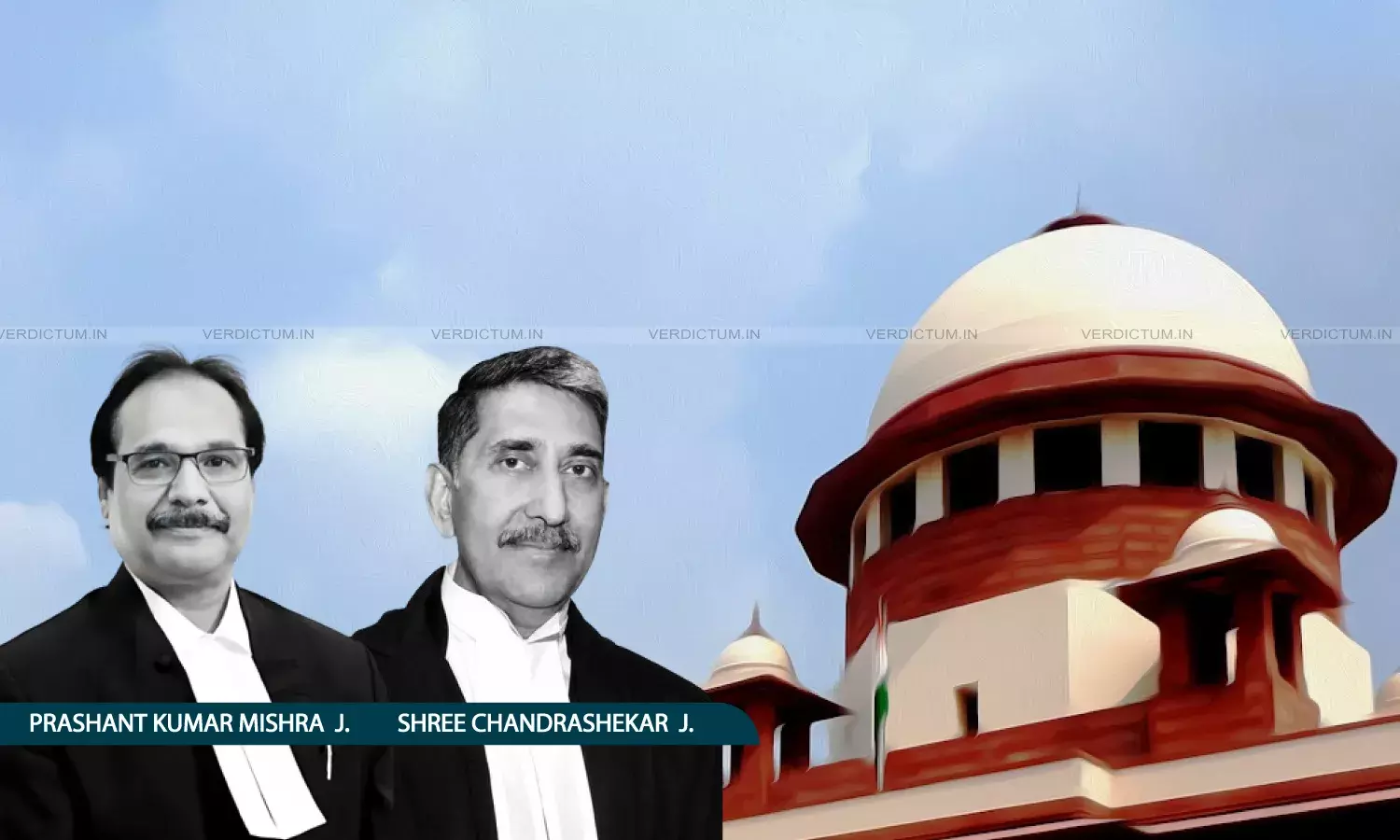
Justice Prashant Kumar Mishra, Justice Shree Chandrashekhar, Supreme Court
While acquitting an accused in a case registered under Section 394 of the Indian Penal Code, the Supreme Court has observed that robbery or attempted robbery is not a peripheral circumstance and is an essential component of the offence.
The Apex Court was considering an appeal filed against the judgment passed by the Bombay High Court affirming the appellant’s conviction under Section 394 of the Indian Penal Code, 1860 and the sentence of rigorous imprisonment for seven years with a fine of ₹1,000.
The Division Bench of Justice Prashant Kumar Mishra and Justice Shree Chandrashekhar held, “However, at this point, we must examine whether the appellant’s conviction under Section 394 of the IPC, specifically, is sustainable. Said provision applies where the offender, in committing or attempting to commit robbery, voluntarily causes hurt. The robbery or attempted robbery is not at all a peripheral circumstance and is rather an essential component of the offense.”
Senior Advocate Sudhanshu S. Choudhari represented the Appellant while Advocate Ira Mahajan represented the Respondent.
Factual Background
The family of the complainant consisted of her, her husband, and their minor daughter, who lived together in a three-roomed farmhouse situated in their agricultural fields. One night, the complainant was sleeping on a cot on the porch outside the house, her daughter was sleeping on the floor nearby, and her husband had gone to irrigate the onion crop near the well in the field, when four persons came to the farmhouse. The complainant arose from slumber and saw the appellant sitting near her on her cot. He threatened her by pointing a knife at her neck and told her to stop talking. When she attempted to resist and seize the knife, she sustained an injury to her hand. The appellant then punched her in the face, causing an upper tooth to fall out. He also removed her gold jewellery worth ₹4,000. Another assailant, the second accused, took the daughter inside the house, assaulted her, and demanded to know where money received from the onion crop was kept.
The remaining two assailants restrained the husband, tied his hands and took him into the room of the house. After some time, the complainant untied her husband’s hands. The family shouted, and villagers eventually approached. All four assailants fled toward the railway line. An FIR came to be registered under Sections 394 read with Section 34 of the IPC. In the course of investigation, only the appellant and the second accused were traced and arrested, and the other two assailants could not be found. The Trial Court convicted the appellant under Section 394 of the IPC, and the same was affirmed by the High Court on appeal. The second Accused was also convicted under Section 376 of the IPC. It was in such circumstances that the appeal came to be filed by the sole accused.
Reasoning
On a perusal of the facts of the case, the Bench noted that the FIR was lodged within four hours of the incident, though it occurred late at night. The complainant (PW1) identified the appellant, stated his name and place of residence, the nature and manner of their prior acquaintance. She also reiterated this in her examination-in-chief and cross-examination. The Bench found that the medical evidence also materially corroborated the prosecution’s case regarding the appellant.
Referring to Section 394 of the IPC, the Bench held that the conviction under this provision could not be sustained as there was no recovery of the alleged jewellery said to be snatched from the complainant and nothing incriminating was seized from the appellant’s possession either.
The Bench further explained that under Section 222 of the Code of Criminal Procedure, 1973 (corresponding to Section 245 of the Bharatiya Nagarik Suraksha Sanhita, 2023), a person charged with an offence consisting of several particulars may be convicted where the proved facts constitute a minor offence, notwithstanding that the minor offence was not separately charged.
Considering the assertion of the complainant that the appellant struck her in her mouth and caused her left upper incisor tooth to fall out which was sufficiently proved through witness testimony and medical evidence, the Bench held, “The same falls squarely within the definition of ‘grievous hurt’ given in Section 320 of the IPC viz. fracture or dislocation of a bone or tooth. We thus consider it appropriate to alter the conviction of the appellant to one under Section 325 of the IPC.”
Decision
Taking note of the fact that the appellant was stated to be around 63-64 years old and he had suffered incarceration for about 10 months, the Bench partly allowed the appeal, convicted him under Section 325 of the IPC and reduced his sentence to the period already undergone by him.
Cause Title: Appa v. The State of Maharashtra (Neutral Citation: 2026 INSC 1091)
Appearance
Appellant: Senior Advocate Sudhanshu S. Choudhari, Advocates Mahesh Prakash Shinde, Ratnesh Dube, Pranjal Chapalgaonkar, Ashok Kumar Gupta
Respondent: Advocates Ira Mahajan, Siddharth Dharmadhikari, AOR Aaditya Aniruddha Pande, Advocate Shrirang B. Varma